


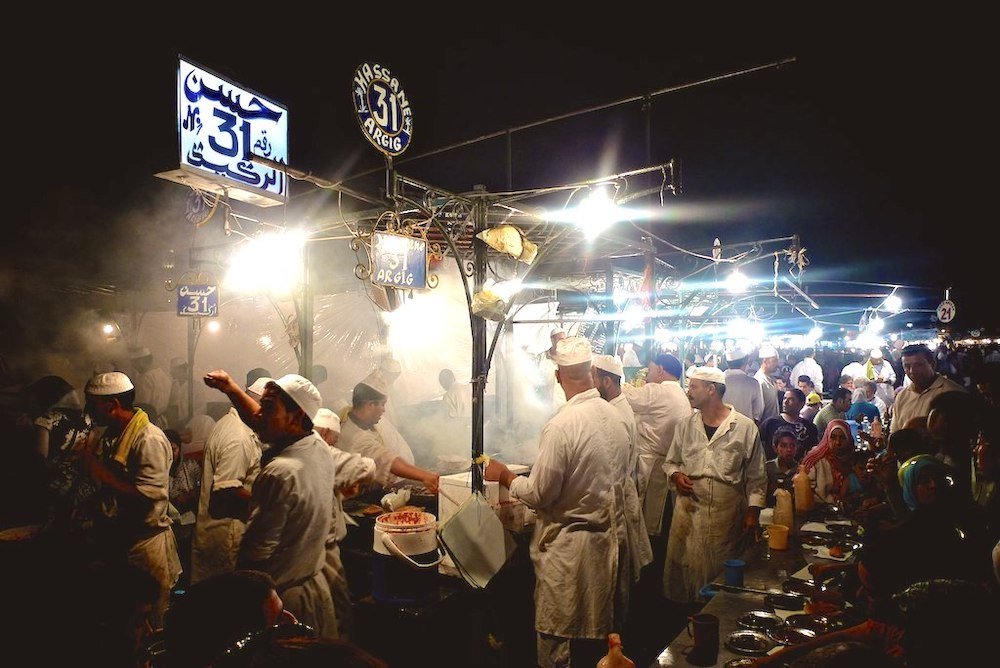
Jemaa el-Fnaa square in Marrakech (also Jemaa el-Fna, Djema el-Fna or Djemaa el-Fnaa) is a market place in Medina. It’s the best-known place in Marrakech; an exotic spot even for Moroccans. Most people say if you have not visited Jemaa el-Fnaa, you have not seen Marrakech.
Jemaa El-Fnaa Square is a legendary gathering place where Morocco’s diverse communities have converged for centuries. This iconic square brings together storytellers, musicians, trance dancers, snake charmers, monkey handlers, herbalists, preachers, fortune tellers, acrobats, and street performers. It’s a space where traditions are kept alive in real time. Recognising its unique role in preserving oral and performance traditions, UNESCO designated Jemaa El-Fnaa as a Masterpiece of the Oral and Intangible Heritage of Humanity in 2001.
The square’s historical records date back to 1573, when Spanish traveler Luis del Mármol Carvajal described it as a bustling hive of life. At its center once stood a raised platform used for public executions—a detail that may explain the literal translation of “Jemaa El-Fnaa” as “assembly of the dead.” Today, the square continues to evolve, serving as a living stage of Moroccan culture, especially after sunset when it transforms into a vibrant night market. Learn more about Marrakech past in my article A short history and structure of Marrakech.
In the daytime, Jemaa el-Fnaa square is usually quite empty. You can see many henna painters, although I do not recommend having henna drawings done at the square. The quality of henna paste is questionable, and ornaments are not the best (head to Henna Art Cafe for nice henna art paintings).

Your Morocco trip begins here
10 years in Morocco. Boutique planning for curious travellers
Be aware of taking pictures with animals
Honestly, in the square, I dislike the mistreatment of animals. Monkeys are kept in cages throughout the day, led around on chains for entertainment. Recently, I started to see even eagles attached to chains for pictures. The sounds of the snake charmers pungi flutes have become an integral part of the square’s atmosphere. However, most of the snakes are drugged and abused daily. Be attentive as the charmers like to put their snakes on the tourists’ shoulders without asking their permission. I am always encouraging travellers not to take a picture with these poor animals. Nothing is free! If you want to take photos of musicians, dancers, theatre artists, always have small coins. The artists are attentive and will notice you taking pictures or listening to a concert.
Interesting people you can see at the square
Mysterious Dentist
One of the most curious characters in Jemaa El-Fnaa is the street dentist, who proudly displays a collection of extracted teeth on his small table. To me, he remains a mysterious figure—I still can’t tell whether he’s selling teeth or charging visitors to photograph his setup.
Water boys
During the day, look out for the men, wearing bright red costumes with wide Berber hats, carrying furry goatskins and brass cups. They are called water boys, who used to carry cold water in the furry goat skins. Of course, water boys will charge you if you take a picture.
Night life at Jemaa El Fna square
In the evening, the Jemaa El Fna square bursts into life. There come plenty of different traditional gnowa musicians, dancers, story tellers, theatre artists, dressing men, entertainers, magicians, street restaurants, tea sellers, snail soup sellers… I enjoy watching a unique street game – bottle fishing. Plastic bottles of Coca Cola or any other soft drinks are placed on the ground into a circle, and the players are given fishing rods with the rings hung on them. The aim of the game is to throw the ring onto the bottle and fish them up. Crowds of locals are often gathered around the legendary story tellers (only in Arabic). It is also worth to spend your time watching theatre performances, where men usually perform dressed as women. Throughout the day and into the night, the square is alive with vendors selling paintings, spices, herbs, natural cosmetics, and more. African women offer to braid your hair right there on the spot, adding to the square’s vibrant, chaotic rhythm.
TIPS FOR VISITING JEMAA EL FNAA SQUARE
1. Be aware of pickpockets! Look after your wallets and cell phones.
2. Always leave at least a few dirhams for square’s musicians, dancers or performers if you watch or listen to them.
3. Always pay for taking photos of snakes, monkeys or water boys. Even if you take pictures from a distance, you will be spotted and asked for money.
4. You must try snail soup!
5. If you are a woman, in the square you will probably hear “compliments” like barbie, nice ass etc. It can be challenging to ignore them, but remember you can’t change their behaviour, but you can change your reaction to them. Don’t say anything back, be neutral.
Jemaa el-Fnaa food stalls

The largest Moroccan Street restaurant is located in Jemaa el-Fnaa Square. In the evening you can count over 50 food stalls, where you can try different dishes. I rarely eat at the square food stalls. First, because of pushy food stalls guys offering menus for everyone. They are so annoying! Second, They do not necessarily serve the best Moroccan street food. I advise you to choose a stall where you see local people eating. They know where is the best food. Even if it doesn’t look too attractive or delicious, avoid tourist crowded booths! At Jemaa el-Fnaa square I wouldn’t suggest eating tagines or couscous. Many food stalls server tagine in a simple plate. And although the stew on the plate is also tagine, it does not taste much like eating from a clay bowl.
My Recommended Food Stalls in Jemaa El-Fnaa Square
- Grilled meats – Stalls 93, 31, and Stall No. 1, run by Aisha. Aisha’s stall stands out for its warm atmosphere and is the only food stall in the square operated by a woman.
- Grilled seafood – Stall No. 14
- Harira soup – Stall No. 5
- Tangia (slow-cooked Marrakchi meat stew) – Stall No. 10
Spiced tea / Khoudenjal
In winter and autumn seasons, at the Jemaa el-Fnaa square try Moroccan spiced tea called Khoudenjal. This tea has a strong taste and includes many spices. With tea, try local sweet tasting similar to halva. A cup of spicy tea and halva sweet cost around 10 MAD. The tea stalls are mostly located aside the food stalls in the cold season. I always choose the tea stall No. 72. In the summer season, these stalls sell cold spicy lemonade.
