


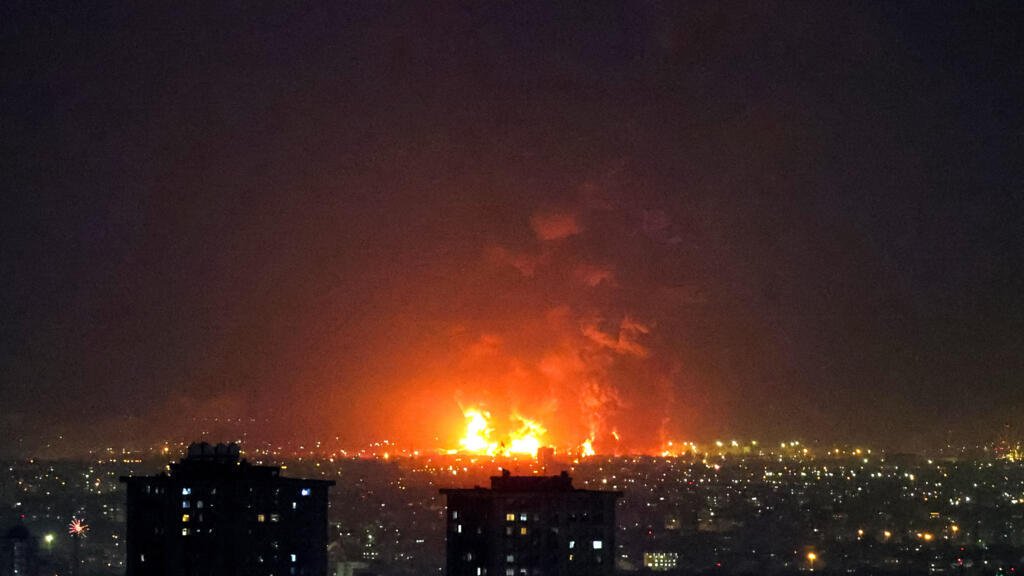
Rabat – Residents of Tehran woke on Sunday to an unsettling scene as thick black smoke from burning fuel depots covered the sky above the capital, hours after Israeli airstrikes hit oil storage sites.
Instead of daylight, many people found the city under a dark haze. The heavy smoke blocked much of the morning sun and forced residents to switch on lights inside their homes.
“I thought my alarm clock was broken,” a driver in his fifties told AFP, speaking on condition of anonymity.
Even later in the morning, vehicles still drove with headlights along Valiasr Street, one of the city’s main north-south arteries. Black smoke from the burning depots mixed with grey rain clouds, deepening the gloom across a metropolis that normally houses more than 10 million people.
The strikes mark the first time oil infrastructure in Iran has come under attack during the nine-day war that erupted after the US and Israel launched strikes on Iran last weekend.
Israel’s Occupation Forces (IOF) confirmed that it targeted “fuel storage facilities in Tehran,” which it said were used to support military infrastructure.
Local authorities said four oil depots and a petroleum logistics site in and around the capital were hit. At one location, six people died and around 20 others suffered injuries.
More than twelve hours after the strikes, flames still rose from one of the depots, where oil continued to burn. Explosions shattered windows in nearby buildings, according to AFP journalists at the scene.
Smoke spread far beyond the immediate area. Residents living dozens of kilometres away said rain mixed with fuel residue covered balconies and streets.
On the ground, security forces directed traffic while wearing protective coats and masks. Officials warned that the smoke contains toxic substances that could cause breathing problems and eye irritation. Authorities urged residents to remain indoors.
The Iranian Red Crescent Society said the blasts released “significant quantities of toxic hydrocarbons, sulfur and nitrogen oxides” into the air.
Fuel distribution in the capital also faced disruption.
For now, each vehicle in Tehran can receive no more than 20 litres of fuel. Long queues formed quickly at petrol stations.
Sunday marked the first working day after a week-long holiday declared following the death of Supreme Leader Ayatollah Ali Khamenei in US-Israeli strikes last weekend.