



Agadir – The second day of the International Argan Tree Fair in Agadir continued today with discussions focused on the realities of argan oil production, especially the role of women-led cooperatives, the challenges facing the sector, and the social importance of argan in rural Morocco.
Exhibitors explained the long, demanding process of making argan oil and the environmental and economic pressures that affect it.
Cooperatives are central to turning the argan tree into food, cosmetics, and artisanal products, while supporting local communities.
One of them, the women’s agricultural cooperative Taitmatine, took part in the fair with two of its leaders. The cooperative works in several areas tied to the argan ecosystem.
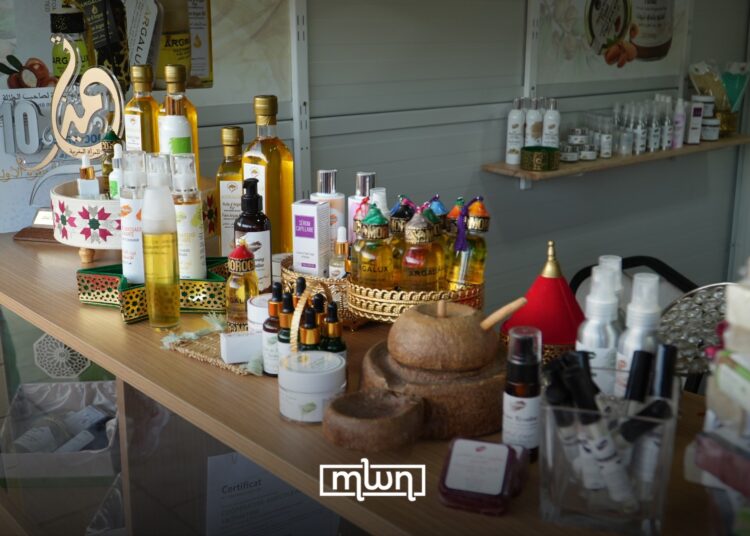
A branch in Tiout, Taroudant Province, faces long-standing structural and environmental challenges. Founded in March 2022, it operates in a region where women once had little access to the labor market.
Amina Aït Taleb, president of Taitmatine, said cooperatives helped change this. “At one point, there were only three or four cooperatives nationwide,” she explained. “It was very difficult for rural women to enter the labor market, but cooperatives broke that barrier and gave women the chance to work and contribute to local development.”
The cooperative produces argan oil for food and cosmetic use, as well as a wide range of argan-based products. “We produce natural argan oil for cooking and beauty, amlou made with argan and almonds, honey-based products, and other natural oils,” Aït Taleb said.
The cooperative also manufactures soaps, creams, shampoos, and cosmetic products, all processed locally. “Our goal is to add value to argan, not just sell raw oil,” she added.
Argan production challenges
Aït Taleb underlined the complex production process as a key reason behind argan oil’s high price. “Argan oil goes through many stages, from peeling and crushing to grinding and filtering,” she explained, noting that producing one liter requires a large quantity of raw material. As a result, prices range between 650 and 800 dirhams per liter.
Similar challenges were stressed by cooperatives from the Agadir region, including the Taitmatine cooperative branch based in Tighanimine village, Drarga commune, which focuses on certified argan production. Founded in 2006 with around 22 women, this cooperative has grown to include approximately 460 women and has obtained several quality certifications for its products.
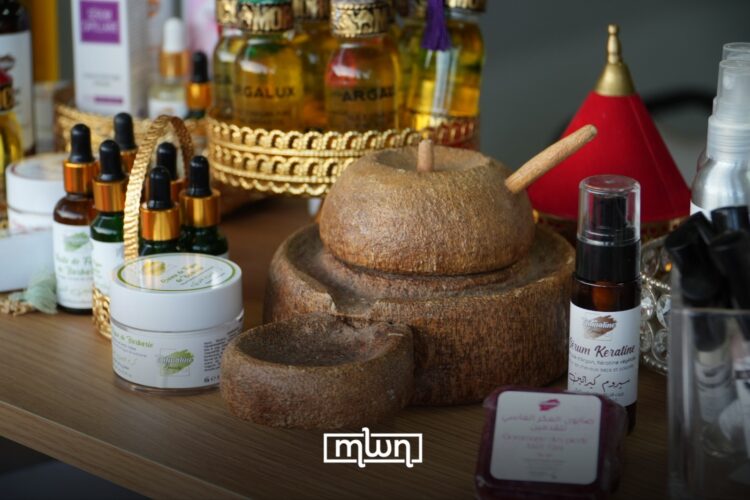
According to Zahra Bousaid, Quality Manager and President of the cooperative, argan oil’s value lies in the effort behind its production. “Producing one liter of argan oil requires about 32 kilograms of argan fruit,” she explained. “The oil passes through several precise stages, which explains why prices range between 700 and 750 dirhams per liter.”
Both Ait Taleb and Bousaid pointed to raw material scarcity, caused mainly by drought and climate conditions, as one of the sector’s biggest challenges.
Several years of low yields have affected argan production, limiting supply and making it harder for cooperatives to sustain their activities and market their products.
Beyond production, the cooperatives play a strong social role, particularly in rural areas. They provide professional training, literacy programs, health coverage, medical caravans, and school support, benefiting both members and non-members. “From the beginning, our project was not only economic,” Aït Taleb said. “It was designed to have a positive impact on women, families, and the entire community.”
These efforts have earned national recognition. The Taitmatine Cooperative recently won the National Award for Excellence for Moroccan Women, ranking first at the national level. “Winning this prize gave us motivation to continue,” Aït Taleb said. “Our work is economic, but it is also social, and it has a real impact on rural women.”
