


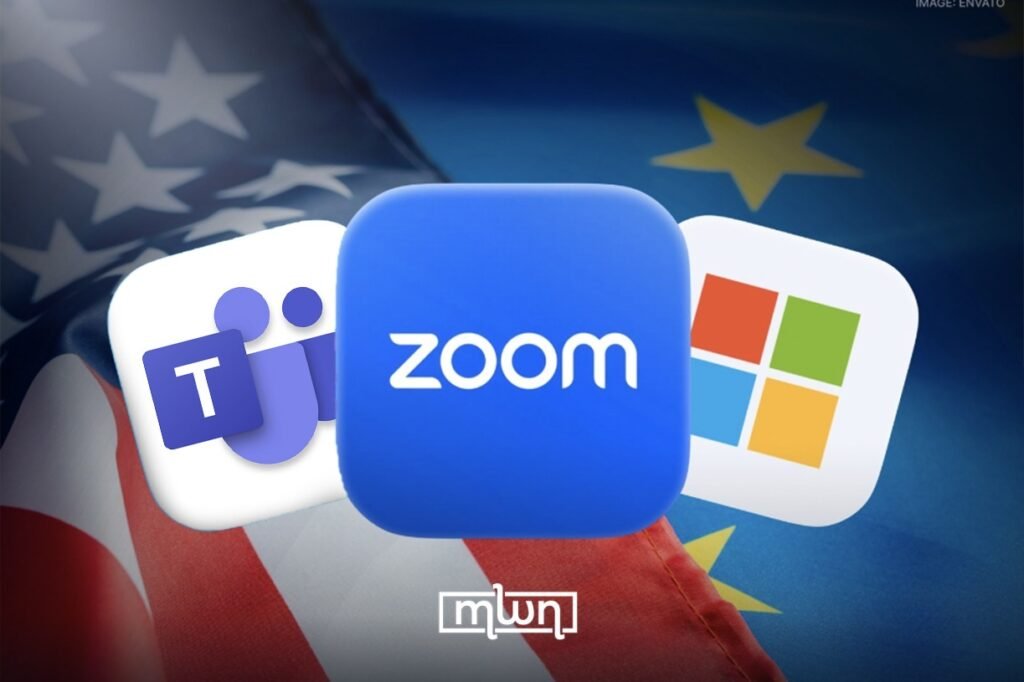
Casablanca – European governments are reassessing their reliance on American technology providers, with several countries moving toward domestic or open-source alternatives amid growing concerns over security, dependency and digital sovereignty.
France has taken the most sweeping step so far. The government announced that by 2027 its 2.5 million civil servants will stop using US-based video conferencing platforms, including Zoom, Microsoft Teams, Webex and GoTo Meeting, and will transition to a French-developed service known as Visio.
Civil Service Minister David Amiel said the move is intended to safeguard sensitive communications and ensure that scientific exchanges, strategic innovations and public data are not exposed to non-European actors.
The shift in France forms part of a broader pattern across the continent. In Germany, the northern state of Schleswig-Holstein has already migrated 44,000 employee email accounts from Microsoft to an open-source program and replaced SharePoint with Nextcloud for file sharing.
Officials are also considering moving from the Windows operating system to Linux and adopting open-source systems for telephony and video conferencing. The state’s digital minister has framed the transition as an effort to achieve greater digital independence.
Read also: WhatsApp Android Zero-Click Bug Allowed Images to Download Without User Interaction
Austria’s military has switched to LibreOffice, an open-source alternative to Microsoft’s office suite, citing a desire to avoid vendor lock-in and concerns over cloud-based storage.
The Document Foundation, the non-profit behind LibreOffice, said public sector demand for independence from single suppliers has increased in recent years.
Denmark’s government and the cities of Copenhagen and Aarhus are testing open-source software, while the French city of Lyon has already deployed free office programs to replace Microsoft products.
The Dutch government is examining autonomous communication tools, including Visio and a German alternative developed by Nextcloud.
The debate intensified after US sanctions against officials at the International Criminal Court led to the disconnection of a sanctioned prosecutor’s Microsoft email account.
The episode raised concerns among some European officials about potential service disruptions. Finland recently assessed the possible impact of a US technology shutdown scenario and concluded that any disruption would be wide-ranging.
Despite these efforts, several governments have cautioned that a full technological decoupling from the United States is not realistic in the near term.
US companies continue to dominate Europe’s cloud infrastructure, with Amazon, Microsoft and Google controlling more than two-thirds of the market. For many capitals, the transition toward greater digital sovereignty is expected to be gradual rather than immediate.