


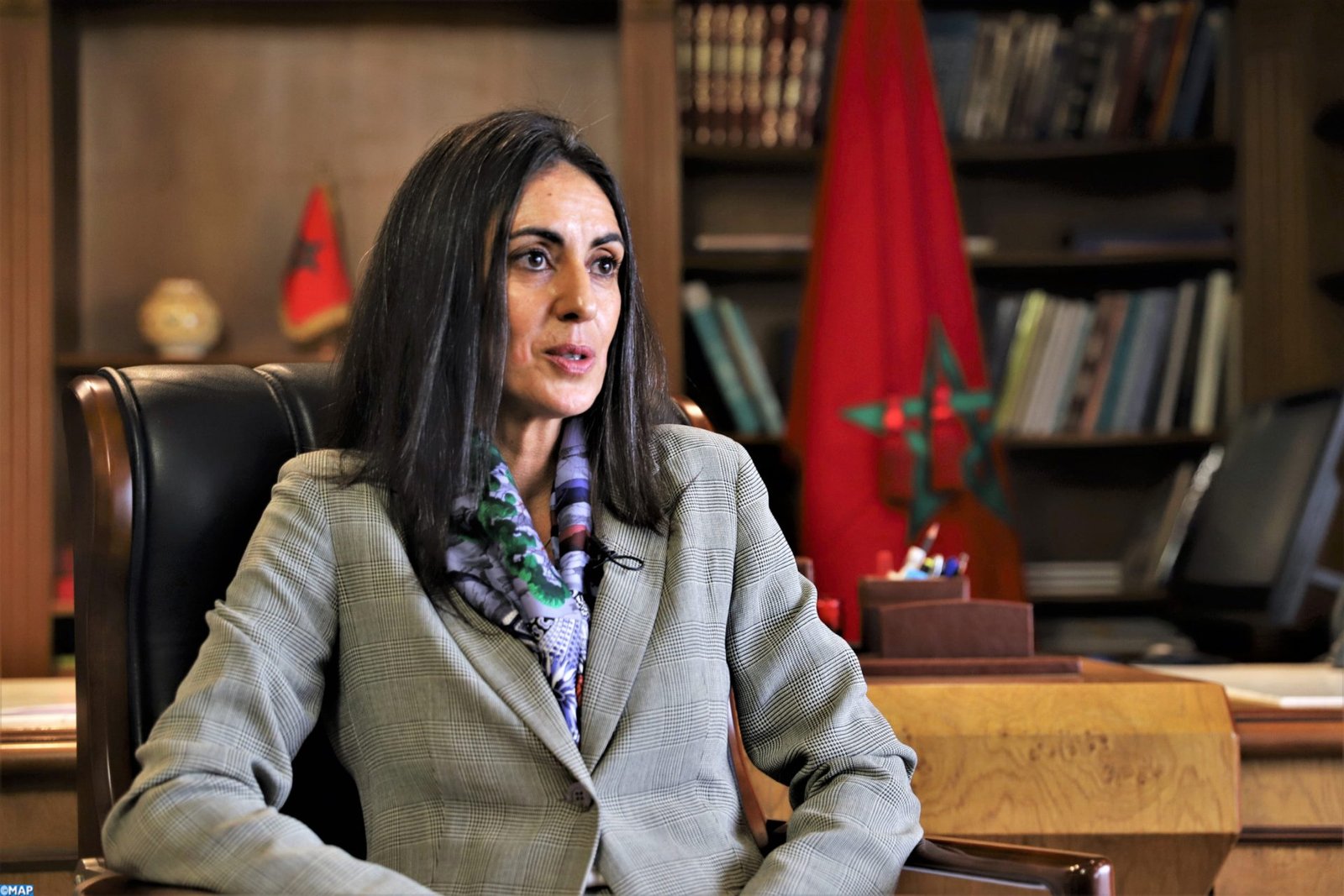
Marrakech – Morocco’s Minister of Economy and Finance Nadia Fettah Alaoui said the country is no longer simply attracting foreign investors – it is building long-term industrial partnerships that serve its economic sovereignty.
Her remarks came in an interview with the French publication L’Express, published Friday, days after French aerospace giant Safran announced a new landing gear manufacturing plant in Morocco. This follows an October announcement of a LEAP engine assembly line for Airbus A320 and A321 aircraft.
Fettah Alaoui, the first woman to hold her position and an HEC graduate, noted that the two announcements within six months reflect a deepening relationship. “We are no longer in a simple logic of industrial implantation, but in a relationship of trust and upgrading,” she stated. Safran has been present in Morocco for 25 years.
Beyond aerospace and automotive – where local integration exceeds 60% – the minister told L’Express that Morocco has identified 16 industrial sectors structured around 56 ecosystems.
Agri-food processing, pharmaceutical manufacturing, green hydrogen, and electric mobility are among the priority areas. “The agri-food transformation remains below our potential,” she stressed. “It is a priority axis of development.” On pharmaceuticals, she maintained that the COVID crisis accelerated Morocco’s positioning, particularly in vaccine production.
On the country’s competitive advantages, Fettah Alaoui pointed to stability as the primary factor. “In a turbulent world, Morocco is a country that inspires confidence. Being reliable, predictable, disciplined in the execution of public policies is a real economic asset.”
She also cited the country’s green energy transition – launched in 2010 – its pool of engineering talent, and its logistics infrastructure as key drivers of investment decisions.
Morocco trains approximately 24,000 engineers annually, she revealed, adding that engineers working domestically are integrated into global value chains, ensuring their international mobility. She called for deeper structured cooperation with French grandes écoles to expand this capacity further.
Moving past existing industrial strongholds, Fettah Alaoui pointed to the Oriental region in northeastern Morocco as a key development frontier. She referenced the Nador West Med port project as a direct continuation of the Tanger Med success model. “The objective is not only to create a new port but a real economic ecosystem around this infrastructure,” she stated.
International maritime operators are already establishing a presence in the area, she noted, while a 700-hectare industrial zone is currently under development.
The minister affirmed that the project’s value lies not in the infrastructure alone, but in its capacity to attract investors and generate a durable productive fabric. She added that regional actors must be closely involved, particularly in training and youth employment, “in order to create a strong local dynamic.”
On Africa, the minister described that Morocco approaches the continent as “a shared economic and human destiny,” not merely a market. Morocco is the second-largest African investor on the continent, she noted, with Moroccan banks holding market shares exceeding 30% in some West African countries.
“They have become indispensable actors in local economies,” she stated, adding that the next step involves developing access to more sophisticated financial instruments to meet the continent’s financing needs.
Regarding the global fragmentation between the United States, Europe, and China, Fettah Alaoui argued that Morocco’s long-standing policy of balance and openness is now a strategic asset. “Being a stable and predictable partner allows Morocco to capture investments and integrate serenely into new value chains.”
On fiscal discipline, she indicated that Morocco’s public deficit, which reached around 7% of GDP after COVID, is on track to reach 3.5% in 2025 and approximately 3% in 2026. Public debt is projected at 67.4% of GDP in 2025, ahead of targets. Inflation stands at 0.8%, and economic growth is close to 5% for 2025, with a similar projection for 2026.
Looking ahead to the 2030 FIFA World Cup, co-hosted with Spain and Portugal, Fettah Alaoui said the deadline does not change Morocco’s trajectory but imposes “greater coherence in the execution of economic policies.” The tourism sector is already recording historic activity levels, she added.
