


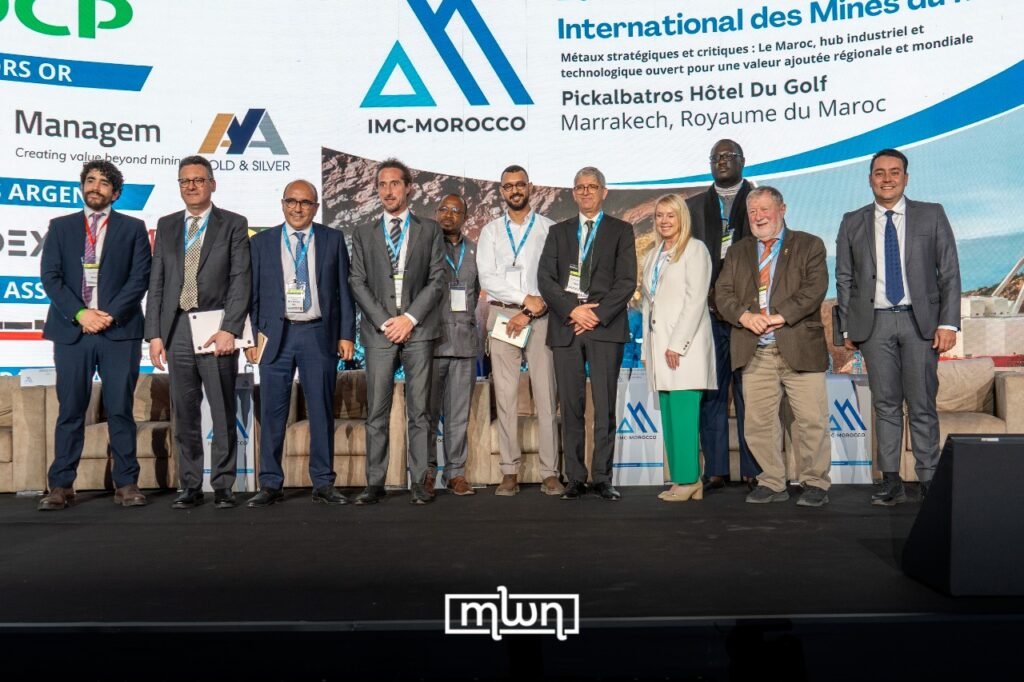
Marrakech – Day 2 of the Morocco International Mining Congress (IMC 2025) placed a spotlight on the country’s mining sector as a lever of national sovereignty, industrial integration, and technological advancement.
Senior government representatives, industry leaders, and research institutions converged to outline how Morocco is positioning itself as a competitive global player in strategic and critical minerals.
Throughout the day, speakers underscored how Morocco’s mineral wealth and evolving regulatory framework support national priorities in energy security, industrial transformation, and economic resilience.
Breakaway Sessions, including “Integrated Logistics and Industrial Corridors,” explored strategic pathways to reinforce energy and mining sovereignty while accelerating industrial integration.
Speaking on the sidelines of the congress, Abderrazzak Gmira, Vice President of the Federation of Mineral Industries (FDIM), described Morocco as “known for being the paradise of the geologist,” citing its long history of mining and remarkable geological diversity.
“The rich geology of the country makes it a country that is prized by many stakeholders in the mining sector,” he emphasized, pointing to Morocco’s cobalt, copper, silver, and other key metals that continue to anchor the nation’s mining identity.
FDIM’s interventions focused on strengthening the country’s attractiveness for investment, supporting industrial value chains, and advancing responsible, high-impact mining.
On the exhibition floor, Afrilab showcased its expanding capabilities in supporting Morocco’s mining ecosystem.
The company’s booth saw strong engagement from operators seeking advanced laboratory services and new-generation analytical technologies.
Read also: Morocco Leads Africa in Adopting Landmark ESG Framework at IMC 2025
“Our participation in IMC Morocco 2025 comes from the fact that Afrilab, given its position supporting and assisting mining partners in Morocco, the producers and mining operators, already has an important presence to discuss innovations,” said Abdennabi El-Hattaf, Managing Director of Afrilab.
El-Hattaf highlighted a breakthrough moment for the company at this year’s congress, stressing: “Today was an exceptional day for Afrilab, as we signed a partnership agreement with our partner Chrysos Corporation, which is the provider of PhotonAssay technology.”
This agreement is set to accelerate the deployment of cutting-edge ore analysis solutions across Morocco.
Academic and research leadership was also strongly represented. The Geology and Sustainable Mining Institute (GSMI) of UM6P drew significant attention with its display of advanced research spanning the full mine lifecycle.
“We are here representing our institute, delivering analysis and processes regarding the mine cycle, from exploration down to mine closure and rehabilitation,” said Mohamed Mazigh, PhD student at GSMI.
Mazigh outlined the institute’s comprehensive research ecosystem, noting that his own projects address advanced exploration technologies, while colleagues focus on mineral processing, concentrate enrichment, and post-mining rehabilitation.
The GSMI booth illustrated how academic innovation is directly feeding into Morocco’s modernization of mining operations.
Across Day 2, the alignment between government policy, industrial capability, and scientific research was evident.
Exhibitors such as OCP Group, FDIM, Afrilab, and UM6P demonstrated how Morocco is building an ecosystem capable of supporting Mine 5.0: smarter, cleaner, more efficient, and more integrated into national industrial strategies.