


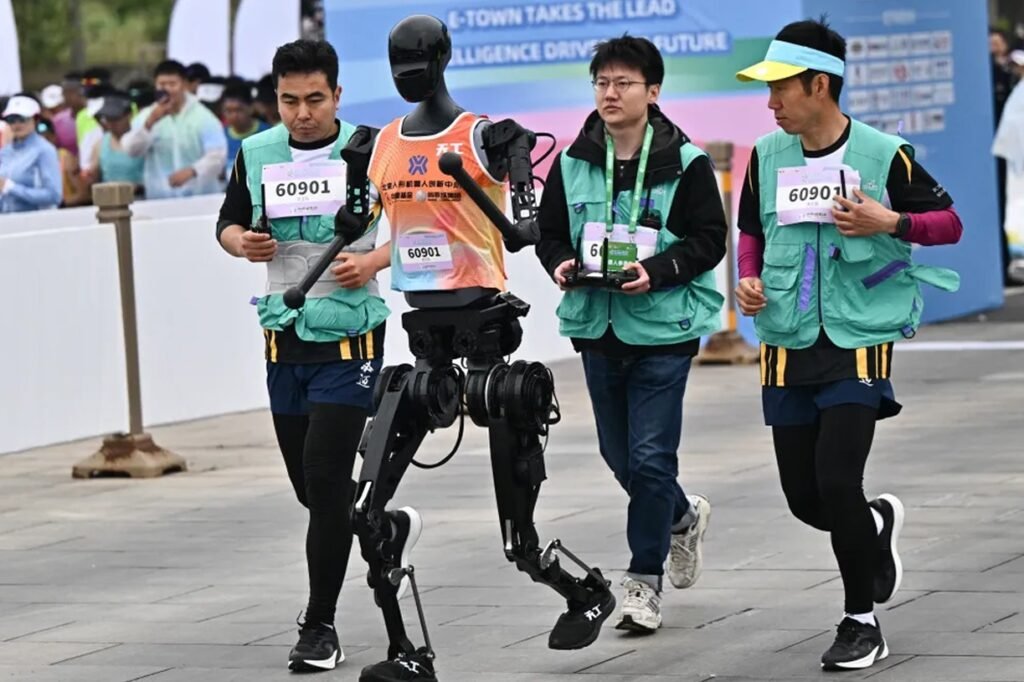
Tetouan – Humanoid robots delivered a headline-making performance in Beijing on Sunday, outpacing a number of human participants in a half marathon that showed how rapidly robotics technology is advancing.
The race, held on the outskirts of the Chinese capital, brought together dozens of Chinese-made humanoid machines and human runners in a highly symbolic test of speed, balance, and endurance.
In several segments of the race, robots surged ahead of human competitors, marking a notable shift from just a year ago when such a scenario appeared far from reach.
Their improved performance reflects significant progress in motion control systems, artificial intelligence, and mechanical design, areas that have seen accelerated development across China’s robotics sector.
The contrast with the inaugural edition of the event last year was stark. At the time, many of the participating robots struggled to perform even basic tasks.
Some failed to leave the starting line, while others lost balance shortly after the race began. Only a limited number managed to complete the course, as technical malfunctions and coordination issues dominated the event.
This year, however, the robots demonstrated far greater reliability. Most were able to start the race without incident, maintain steady movement throughout the course, and cross the finish line.
While occasional stumbles were still observed, they were no longer the defining feature of the competition.
Instead, the machines displayed a level of consistency that points to tangible improvements in both hardware and software integration.
The progress is also evident in timing. In last year’s race, the fastest robot completed the half marathon in 2 hours and 40 minutes, a result that placed it well ahead of its mechanical peers but still significantly behind the top human runners.
Although official comparative data from this year’s race remains limited, the visible gains in speed and efficiency suggest that robots are steadily narrowing the performance gap.
Repositioning Advanced Robotics
Beyond the race itself, the event serves as a public demonstration of China’s ambitions in advanced robotics.
Humanoid robots, once confined to research labs and controlled environments, are increasingly being tested in dynamic, real-world scenarios.
Running alongside humans in a competitive setting offers valuable insights into how these machines perform under pressure, over long distances, and in unpredictable conditions.
The implications extend beyond sport. Advances in humanoid robotics could reshape sectors such as manufacturing, healthcare, and logistics, where mobility and adaptability are critical.
The ability of robots to navigate complex environments, maintain balance, and sustain prolonged physical activity brings them closer to practical deployment in everyday settings.
While robots have not yet surpassed elite human athletes in overall performance, their ability to outpace segments of human runners in a demanding endurance race signals a turning point.
What was once a demonstration of technological limitations is rapidly becoming a showcase of capability.
As research and development continue, events like the Beijing half marathon are likely to become more than symbolic competitions.
They may soon represent a genuine benchmark of progress, where the line between human and machine performance grows increasingly difficult to define.