


Rabat – Many Moroccans hold the belief that most foreigners need not learn Darija, Morocco’s most widespread, though unofficial, tongue. Instead, they point foreigners to standard Arabic or French – Morocco’s two official languages.
This is because Darija is a complex blend of Arabic, French, Spanish, English, and Tamazight. While Moroccans who speak Arabic can understand other Arabs, Arabs outside of Morocco usually cannot understand Darija. Non-Arabs may have an even more difficult time picking it up. So for a long time, Darija has remained relatively underground and unsung, with even its own speakers discouraging non-natives from trying it out.
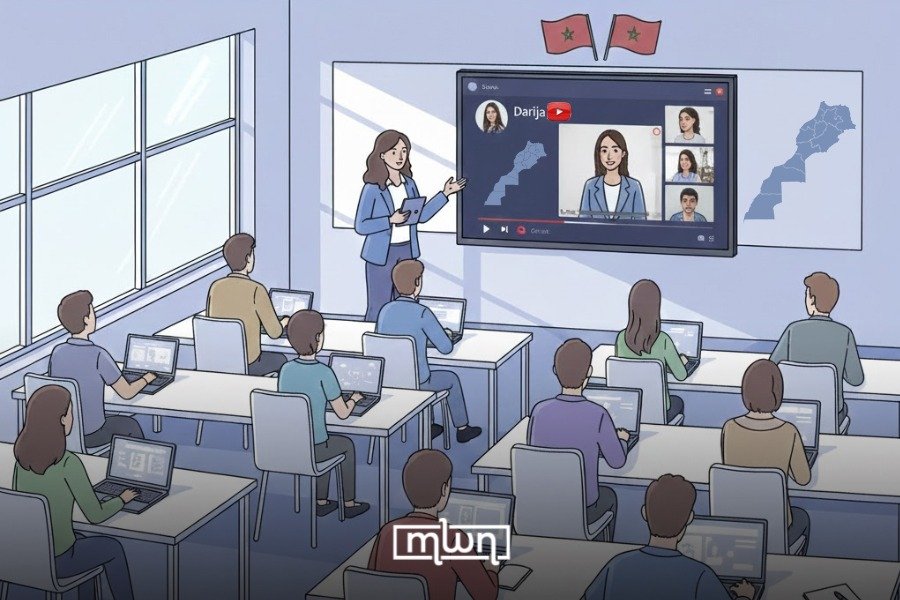
But over the past decade, and especially since COVID-19, a transformative shift has taken place: Darija has become global, accessible, and even trendy to learn, with Darija-related jokes circulating social media. And this shift has been driven not by universities or publishing houses, but by YouTube.
In Marrakech, 28-year-old Muhammad Moukasse has been a critical part of this transformation. His YouTube videos have been shared widely across the globe, featuring in college classrooms and on personal cellphones.
When he started, he did not know that his voice, teaching his mother tongue and inviting others to join him in it, would go so far. His success mainly launched after the COVID-19 pandemic.
“When I started teaching, it wasn’t formal teaching at all,” he said in an interview with Morocco World News (MWN). Before the pandemic, Moukasse was an electrician, then a cleaner, then a travel-agency worker shuttling tourists from airport terminals to hotel lobbies.
When he met foreigners and learned that some of them exhibited interest in speaking with him in his native tongue, he realized there was a void. How could they learn Darija without a guide?
Moukasse therefore set out to fill the gap. He created a YouTube channel, recorded weekly Darija lessons, published short explanations of grammar, and posted storytelling podcasts about Moroccan life. “I noticed there was huge interest,” he said. “Hundreds, then thousands of views. People wanted podcasts, vlogs, everything.”
Like many YouTube creators in Morocco, Moukasse found an unexpected audience during the isolation of the pandemic. Much of the audience stemmed from Americans and Europeans married to or dating Moroccans with plans to move to Morocco. Others were planning future tourism trips or simply curious about the culture.
His channel — once barely reaching a thousand subscribers — now has more than ten thousand, and his online school has 52 active students, not including watchers who are not subscribed.
Recently, an American student group visiting Morocco reached out to Moukasse and asked to meet him and his friend Abdellah Bou, who frequently stars in Moukasse’s videos. When Moukasse and Abdellah met them in Marrakech, 30-plus college students clapped and said in unison: “Sabah al-khayr” (“good morning” in Arabic), one of Moukasse’s chief signatures for each of his videos.
YouTube steps in where textbooks don’t
Morocco has long straddled the juncture between many languages. French colonialism rendered French the language of business in Morocco, while Arabic remains the primary language of government and religion. Tamazight and various Berber dialects retain a hold in many smaller towns and villages.
Many foreigners nevertheless perceive Morocco as an Arabic-speaking country. But it is Darija that draws Morocco’s many languages and cultures together and fashions them into one.
“People might understand Modern Standard Arabic, but speaking it back is very hard for them,” Moukasse said. “That’s why there are misunderstandings. Darija is what people actually use.”
This reality has fueled a boom in demand. As tourism surged post-COVID and thousands of foreigners flooded to cities like Marrakech, Rabat, and Tangier, students needed one thing above all: practical Darija.
Moroccan creators across the country noticed the same trend. Channels such as Tea Time Darija, Daily Darija, Moroccan Arabic with KAWTAR, English to Darija, and Assia West have collectively accrued millions of views.
Short videos explain simple Darija structures meant for everyday contexts. They feature chatty, enthusiastic Moroccans doing and talking about relatable things — daily routines, getting lunch with friends, or making plans over the phone.
Such videos aim to prepare visitors to function well enough in Morocco to not just enjoy French-language signs or surface-level greetings with the natives, but to begin to build friendships. But some students go even further. Beginner Darija lessons suit tourists, and may even serve to heighten tourists’ interest so that they embark on further classes, but some students come to YouTube intending on eventual fluency.
Moukasse notes that many of these students are interested in working or living in Morocco; frequently, they plan on marrying a Moroccan.
“[Most of my students] don’t learn Darija for tourism,” he said. “Most learn it to speak with their family — mother-in-law, father-in-law, cousins, neighbors.”
Over the course of his career, he has encountered more and more people who became students for that last reason. They wish to connect more deeply with their future spouses and their in-laws — to understand their heritage. With no formal courses meeting their needs in their countries of origin, they turn to the young Darija industry, which is flowering across YouTube’s fertile ground.
One of these students was Kate, who adopted the Darija nickname “Khadija.” She had met a Moroccan man from Beni Mellal and wanted to learn how to speak with his parents, whose primary languages were Darija and Tamazight, so she began taking classes with Muhammad Teaches Arabic.
“When she finally spoke to them in Darija, they were so happy,” Moukasse recalled. “She touched their hearts. They finally understood each other.”
Moukasse recounted how Kate eventually traveled to Morocco, attended family celebrations with her in-laws, and tried homemade couscous in Beni Mellal. She later invited Moukasse to her wedding. She and her husband now parent two children in a shared American-Moroccan heritage.
“I don’t know how to explain how proud that makes me,” Moukasse said. “Language builds bridges… At first, families might struggle to accept someone because they can’t communicate. But when students speak Darija, everything changes. They become part of the family.”