


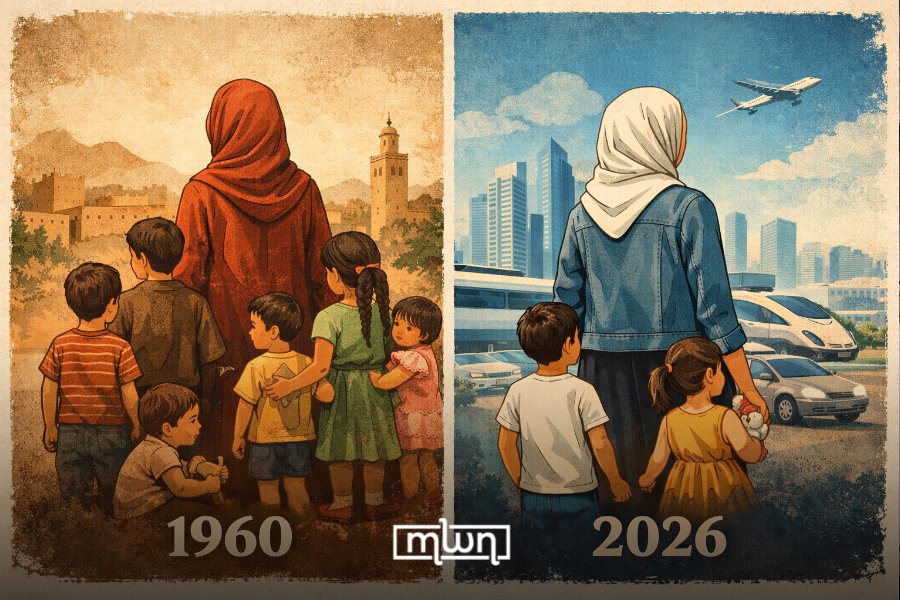
Beni Mellal – Morocco has crossed a demographic Rubicon. The 2024 national census revealed a fertility rate of 1.97 children per woman – below the 2.1 replacement threshold for the first time in the country’s history. This is not a statistical footnote. It is a civilizational inflection point that will reshape Morocco’s economy, its geopolitical standing, and the social contract binding its 36.8 million citizens.
A country that once averaged seven children per woman in the 1960s now reproduces at a rate lower than the United States, approaching the territory of aging European nations – but without Europe’s wealth, welfare systems, or capacity to import labor. The 15-year demographic window that remains before 2040 is Morocco’s last chance to convert its shrinking youth bulge into lasting prosperity. The clock is not ticking. It is nearly silent.
The numbers tell a story of accelerating decline
Morocco’s population grew by just 0.85% annually over the past decade, a staggering collapse from the 2.6% rate recorded in 1994. Life expectancy has climbed to 76.4 years, which is a triumph of public health – and a fiscal time bomb. The population aged 60 and over now stands at 5.1 million (13.8%) and will surge to 7.9 million (19.5%) by 2040.
By 2050, one in four Moroccans will be a senior citizen, and there will be over 10 million people aged 60-plus in a country whose pension reserves for civil servants are projected to be exhausted by 2031, with the private-sector fund following by 2036.
The working-age population share has already slipped from 62.4% to 59.7% in a single decade. Average household size has dropped from 5.3 persons in 2004 to 3.9 today – the nuclear family replacing the extended clan at breathtaking speed. Over 1.03 million Moroccans now live entirely alone, a figure that barely existed a generation ago.
The regional picture is even more alarming. Morocco’s demographic structure resembles twelve distinct countries within a single state. The Oriental region records a fertility rate of 1.73 – approaching Germany’s 1.35 – with near-zero population growth and a rapidly aging population. Casablanca-Settat, the economic engine, sits at 1.90.
Meanwhile, Drâa-Tafilalet (2.35) and the southern Saharan regions remain above replacement, creating a fractured demographic map where the wealthiest, most urbanized areas are declining fastest and the poorest regions sustain what remains of Morocco’s demographic momentum.
Algeria and Egypt are pulling away
The divergence with Morocco’s neighbors is stark and carries profound geopolitical weight. Algeria’s fertility rate stands at approximately 2.75 children per woman – 40% higher than Morocco’s – fueled by a remarkable baby boom recovery that saw annual births exceed one million between 2014 and 2017.
Algeria’s population has reached 47.4 million and grows at 1.3-1.5% annually; projections place it at 61 million by 2050, potentially 40% more populous than Morocco.
This widening demographic chasm unfolds against the most volatile backdrop in North African geopolitics – a Morocco-Algeria rivalry that has hardened into outright severance since Algiers cut diplomatic ties in August 2021, an unresolved Western Sahara conflict that remains the longest-running territorial dispute on the continent, and a regional arms race that shows no sign of abating.
In the calculus of nations, demography is destiny: population mass determines military mobilization depth, economic gravitational pull, tax revenue ceilings, and the sheer capacity to project influence across a contested neighborhood.
Egypt operates on an entirely different plane. With a population of 118.4 million growing at 1.5% per year and a fertility rate of 2.75-3.1, Egypt adds nearly two million people annually. Its median age of 24.5 years makes it one of the youngest large nations on earth.
By 2040, Egypt will count roughly 130 million people – more than triple Morocco’s projected 42 million. Egypt’s population already equals that of every Maghreb country combined.
An echo generation born during the 2008-2014 fertility surge will flood its labor market by 2030, creating either a demographic dividend or an instability risk of historic proportions. Either way, Egypt’s sheer mass reshapes North African power dynamics in ways that Morocco’s stagnating population cannot match through infrastructure or diplomacy alone.
How Morocco dismantled its own demographic engine
The roots of Morocco’s fertility collapse are neither mysterious nor singular. They are the compounding result of deliberate policy, economic dysfunction, and cultural transformation occurring simultaneously. Contraceptive prevalence surged from roughly 8% in the 1960s to 71% today, one of the most successful family planning campaigns in the developing world – perhaps too successful.
Girls’ school enrollment reached 94%, and the average age of first marriage for women climbed from 17 at independence to approximately 25-26 years, though recent census data suggest a slight decline to 24.6 as of 2024.
Permanent celibacy at age 55 has jumped from 5.9% to 9.4% in just one decade. Nearly a quarter of women aged 30-34 have never married. The institution of marriage itself is under siege: divorce cases rose from 44,408 in 2014 to 67,556 in 2023, with mutual-consent divorces climbing from 63% to 89% of all cases.
What demographers call the “Second Demographic Transition” – a concept developed by Ron Lesthaeghe and Dirk van de Kaa to describe how post-industrial societies shift from family-centered to individual-centered life courses – arrived in Morocco not gradually but violently, colliding with an economy that never completed its first industrial transformation.
In Europe, sub-replacement fertility followed decades of rising wages, expanding welfare states, and the absorption of women into formal labor markets. In Morocco, it preceded all of these. The fertility rate collapsed while GDP per capita remained below MAD 40,000 ($4,000), while informal employment still accounts for over 60% of all economic activity, and while social protection coverage remains fragmentary at best.
Morocco did not choose low fertility as the luxury of affluence. It stumbled into it as the arithmetic of impossibility – a generation that cannot afford housing, cannot secure stable employment, and cannot envision the economic foundation upon which a family might be built.
The housing crisis alone explains more than any cultural theory. Morocco’s urban real estate prices have surged 40-60% over the past decade in cities like Casablanca, Rabat, and Marrakech, while median incomes have barely kept pace with inflation. A young couple in Casablanca earning a combined MAD 8,000 monthly ($800) – already above the national median – would need to dedicate 60-70% of their income to rent a modest apartment, leaving nothing for the costs of childbearing, childcare, or education.
Data estimate a deficit of over 400,000 housing units, concentrated precisely in the urban centers where fertility has fallen fastest. In demographic theory, this is the “cost-of-living fertility trap” identified by scholars like Wolfgang Lutz: once housing, education, and healthcare costs cross a threshold relative to income, rational actors delay or abandon reproduction entirely, regardless of cultural preferences or religious norms.
Morocco has crossed that threshold without building the countervailing infrastructure – subsidized childcare, parental leave, housing assistance – that enabled Nordic countries to partially arrest their own fertility declines.
But structural economics may matter more than culture. Youth unemployment has reached a staggering 37.7% – and among young urban women, it approaches 58.5%. The NEET rate (youth neither in employment, education, nor training) stands at 25.6% nationally, with 73% of these idle youth being women.
Female labor force participation has collapsed to roughly 19%, one of the lowest rates globally, creating a paradox where educated women cannot find work yet are expected to bear the full weight of domestic life.
HCP data shows women spend five hours daily on unpaid care work compared to 43 minutes for men – a ratio that makes family formation economically irrational for an increasing number of women. The result is what sociologists have termed the “marriage escape”: a generation of Moroccans who view marriage not as a pathway to fulfillment but as a trap of financial burden and gendered servitude.
This paradox has a name in development economics: the “educated-unemployed fertility collapse.” It occurs when states invest heavily in female education – as Morocco did, successfully – but fail to transform labor markets to absorb these graduates. The result is not empowerment but frustration.
A woman with a university degree who returns to her family home in Fez or Meknes to find no employment prospects, no affordable housing, and no childcare infrastructure does not simply delay childbearing – she rejects the entire institutional framework that once made it the default social trajectory.
Morocco now produces roughly 200,000 university graduates annually, but the formal economy generates fewer than 100,000 new positions per year. The gap between aspiration and opportunity is not merely economic; it is existential. It rewires how an entire generation understands adulthood, partnership, and the purpose of family itself.
The gender dimension is perhaps the most structurally devastating. Just last week, Mahdi Halmi of the UNFPA delivered the sharpest verdict: no country that has ever captured its demographic dividend had a female labor participation rate below 50%.
Morocco’s 19% is not merely low – it is historically anomalous for a country at its level of urbanization and female education.
South Korea at the equivalent stage of its transition stood at 47%. Tunisia at 28%. Even Egypt, with far more conservative gender norms in its rural south, records female participation above 20%. The explanation lies in what economists call “the missing middle” – the absence of a care economy infrastructure that would allow women to work and parent simultaneously.
Morocco has no national system of public crèches, no standardized parental leave beyond a token 14 weeks of maternity leave, and no tax incentives for dual-income households.
The state effectively forces women to choose between economic participation and motherhood, then expresses surprise when a growing number choose neither – opting instead for a solitary, self-sufficient existence that the census now records as over one million single-person households.
What makes Morocco’s situation uniquely perilous is the speed of collapse. France took 115 years to move from a fertility rate of 3.5 to below replacement. Iran took 20 years. Morocco has done it in approximately 25 – but without Iran’s oil wealth to cushion the transition, without France’s centuries of institutional development, and without either country’s head start in building pension systems calibrated to an aging society.
The demographic transition theory of Frank Notestein assumed that fertility decline would be gradual enough for institutions to adapt. Morocco has violated that assumption.
Its institutions – schools built for 4.2 million children aged 6-11 that will serve only 3 million by 2040, pension systems designed for a ratio of six workers per retiree that will face three-to-one by 2035, a healthcare system with two practicing geriatricians for 5.1 million seniors — were designed for a country that no longer exists. The Morocco of 2040 will require an entirely different state architecture, and there is no blueprint being drawn.
A post-modern transformation with pre-modern consequences
Morocco’s demographic shift is inseparable from a deeper cultural metamorphosis. The traditional extended family built on collective ownership and intergenerational solidarity –once the nation’s primary social safety net – is disintegrating. Female-headed households now represent 19.2% of all families, up from 16.2% a decade ago. Women living alone surged from 16.3% to 28.9% between 2004 and 2024.
Globalized values of individualism, consumerism, and personal autonomy have penetrated Moroccan society through digital connectivity and urbanization, reshaping fertility preferences in ways that no government policy has been able to reverse.
The 2004 Moudawana reform institutionalized gender equality in marriage, reflecting and accelerating these shifts. The sweeping 2024 revision – granting mothers legal guardianship, restricting polygamy further, recognizing women’s domestic labor as economic contribution, and awaiting parliamentary ratification – pushes the family code deeper into post-patriarchal territory, codifying a social revolution that demography has already written in irreversible ink.
Morocco is experiencing in two decades what Europe processed over five – a compression of the demographic transition that leaves no time for institutional adaptation.
Sociologist Zygmunt Bauman coined the term “liquid modernity” to describe a world where institutions, relationships, and identities lose their solidity and become fluid, temporary, negotiable. Morocco is living liquid modernity at warp speed, but within a social structure that was, until a single generation ago, among the most solid in the Arab world.
The traditional Moroccan family – the patriarchal unit anchored by the father’s authority, sustained by the mother’s unpaid labor, extended through clan networks of mutual obligation — functioned as a miniature welfare state. It provided housing, childcare, elder care, unemployment insurance, and social identity. Its collapse has not been replaced by a modern substitute, but has instead left a void yet to be filled.
The average Moroccan household of 3.9 persons can no longer absorb the elderly, cannot pool income across generations, and cannot provide the informal safety net that once made poverty survivable. What Morocco is witnessing is not modernization – it is the demolition of one social order before the construction of its replacement.
The digital revolution has accelerated this rupture beyond anything policymakers anticipated. Morocco has over 32 million internet users – a penetration rate exceeding 87% – and smartphone ownership among 18-35 year-olds approaches saturation. Social media has not merely introduced global lifestyle aspirations; it has fundamentally altered how young Moroccans perceive marriage, parenthood, and success.
No longer social obligations, but personal calculations
Instagram, TikTok, and YouTube broadcast a continuous stream of individualist narratives – career fulfillment, travel, self-realization, material accumulation – that stand in direct contradiction to the sacrificial logic of traditional family formation.
The French sociologist Émile Durkheim warned that rapid modernization produces “anomie” – a state of normlessness where old rules have dissolved but new ones have not yet crystallized. Morocco’s young adults inhabit precisely this anomic space: too educated and globally connected to accept the patriarchal bargain of their parents, yet trapped in an economy too weak to offer the autonomous, self-directed life they see on their screens.
This is what the Moroccan sociologist Abdellah Hammoudi would recognize as a crisis of symbolic authority. The structures that once gave meaning to reproduction – religious duty, patrilineal continuity, communal honor – have not disappeared but have lost their coercive power over individual behavior.
A young woman in Tangier or Agadir may still nominally respect these values but no longer organizes her life around them. The decision to marry, to bear children, to remain in a marriage – these have shifted from social obligations to personal calculations.
And when the calculation includes a 58.5% unemployment rate for young urban women, housing costs that consume two-thirds of household income, and a care burden that falls almost exclusively on female shoulders, the rational answer is increasingly: not yet, not now, perhaps never.
For a growing minority, antinatalism – once an alien Western philosophy – has quietly become not an ideology but a lived economic conclusion. In urban Morocco, companionship is increasingly redirected toward pets, symbols of autonomy, affordability, and emotionally manageable responsibility.
The collapse of fertility is not a rejection of Moroccan identity – it is a verdict on Moroccan economics rendered by millions of individual decisions, each one perfectly logical, collectively catastrophic.
The infertility dimension compounds voluntary childlessness with involuntary despair. An estimated 15-17% of Moroccan couples – roughly 900,000 – face infertility, yet the country performs only 4,000 assisted reproduction cycles annually.
That means fewer than 0.5% of infertile couples access treatment in any given year. IVF costs between MAD 30,000 (3,000) and 50,000 ($5,000) per cycle in a country where 75% of women seeking treatment earn less than MAD 5,000 ($500) monthly.
Only 14-19 PMA infertility treatment centers exist nationwide, with just two to four in the public sector. Tunisia, with less than a third of Morocco’s population, performs more than double the IVF cycles with full state coverage.
The infertility crisis operates as a silent demographic hemorrhage that compounds the voluntary fertility decline into something approaching a national emergency. When 17% of couples who want children cannot have them, and the remaining 83% are choosing to have fewer, the mathematical outcome is a population in structural contraction.
Environmental factors are intensifying the problem: rising obesity rates, endocrine-disrupting chemicals in Morocco’s rapidly industrializing agricultural sector, and delayed childbearing – the average age of women at first PMA consultation is now 33.5 years, well past the biological window of peak fertility.
A meta-analysis by Levine et al. (2017) found that sperm concentration in industrializing nations declined by 50-60% between 1973 and 2011, a trajectory Morocco’s own clinical data mirrors.
The Hôpital Militaire Mohamed V study found 53.1% of men presenting for fertility evaluation had abnormal spermograms, with age-related decline beginning as early as 31. Morocco is not merely choosing to have fewer children – it is biologically losing the capacity to have them, and it lacks the medical infrastructure to intervene.
The comparison with Tunisia is not merely instructive – it is damning. Tunisia, with 12 million people, operates a state-subsidized PMA system that covers three IVF attempts at costs of €1,300-1,800, and performs over 10,000 cycles annually. France covers the full cost of six insemination attempts and four IVF cycles for women under 43.
Morocco, with three times Tunisia’s population and aspirations to regional leadership, manages 4,000 cycles – the overwhelming majority in private clinics accessible only to the upper-middle class – while Law 47-14, passed in 2019 to regulate assisted reproduction, remains largely unenforced, its implementing decrees still pending six years later.
The state recognized infertility as a pathology but then failed to build the treatment architecture. It added nine hormonal treatments to the AMO reimbursement list in 2021, but hormones represent barely 20% of the total cost of an IVF cycle. The clinic fees, laboratory culture, embryo transfer, ultrasound monitoring, and ovocyte retrieval remain entirely out-of-pocket – and entirely out of reach for the vast majority of the 900,000 couples who need them.
Morocco is simultaneously experiencing voluntary fertility suppression driven by economic impossibility, involuntary infertility compounded by environmental degradation and delayed marriage, institutional paralysis in the face of a care economy that demands radical restructuring, and a cultural transformation so rapid that no policy framework has kept pace.
Each of these forces alone would be manageable. Together, they constitute a systemic failure – one that will determine whether Morocco enters 2040 as an aging, stagnating society trapped in the middle-income bracket, or as a nation that leveraged its final demographic window to build something extraordinary. The evidence, as of February, tilts decisively toward the former.
World Cup dreams collide with demographic gravity
Morocco’s ambitions are enormous. The 2030 FIFA World Cup co-hosting entails $23 billion in infrastructure investment, a 115,000-seat stadium, and a target of 26 million tourists annually. The government aims to double GDP from $130 billion to $260 billion by 2035.
FDI surged 55% in 2024, greenfield project announcements increased fivefold, and over $10 billion has been committed to battery and electric vehicle manufacturing. These are the moves of a country betting on becoming a regional manufacturing and tourism hub.
But the demographic arithmetic is unforgiving. Countries that successfully captured their demographic dividends – South Korea, Thailand, Vietnam – did so by industrializing aggressively while their fertility rates were still falling and their working-age populations expanding.
South Korea’s per-capita GDP grew 6.7% annually between 1960 and 1990, lifting income from $80 to $10,000. Vietnam, whose current fertility rate of 1.91 mirrors Morocco’s 1.97 almost exactly, has sustained 5.6% per-capita growth since 1990 by attracting massive manufacturing FDI during its golden demographic window – which closes, like Morocco’s, around 2039–2040.
The difference is that Vietnam has been running at full economic sprint. Morocco’s growth has averaged 3.5-4%, and 37.7% of its youth remain unemployed.
The European trap without European resources
The question is no longer whether Morocco will resemble Europe demographically, but when. Germany has been below replacement fertility since 1970 – for 55 years – and its population has been sustained exclusively through immigration. Its current TFR of 1.35 is where Morocco’s urban centers are heading.
But Germany manages this with a GDP per capita of $52,000, universal healthcare, robust pension systems, and the economic magnetism to attract skilled global labor.
Morocco’s GDP per capita is $3,672. It has no welfare state capable of absorbing the care burden of 10 million seniors. It cannot compete for immigrant labor against Europe, the Gulf, or even its own diaspora. And it faces the cruelest demographic paradox of the developing world: growing old before getting rich.
If nothing changes, Morocco by 2040 will be a country of 42 million with a median age approaching 40, a pension system in structural deficit equal to 7.4% of GDP, a care economy crisis with virtually no geriatric infrastructure – the specialty was only recognized in 2005 and still lacks a national training diploma – and regional ghost zones where population decline has already begun.
The 12 regions of Morocco will increasingly resemble 12 different countries, some young and growing, others aging and emptying. The massive infrastructure built for 2030 will require a workforce that is shrinking precisely when it should be expanding. Morocco has perhaps 12 years to convert ambition into economic transformation at a pace no country in its income bracket has achieved. The demographic window does not negotiate. It simply closes.
