


When people think of hiking in Morocco, Jbel Toubkal usually comes to mind. It makes sense — it’s the tallest peak in North Africa. But let me tell you about a mountain that most visitors have never heard of, one that holds deep spiritual meaning and delivers a raw, unforgettable adventure. That mountain is Jbel Gourza.
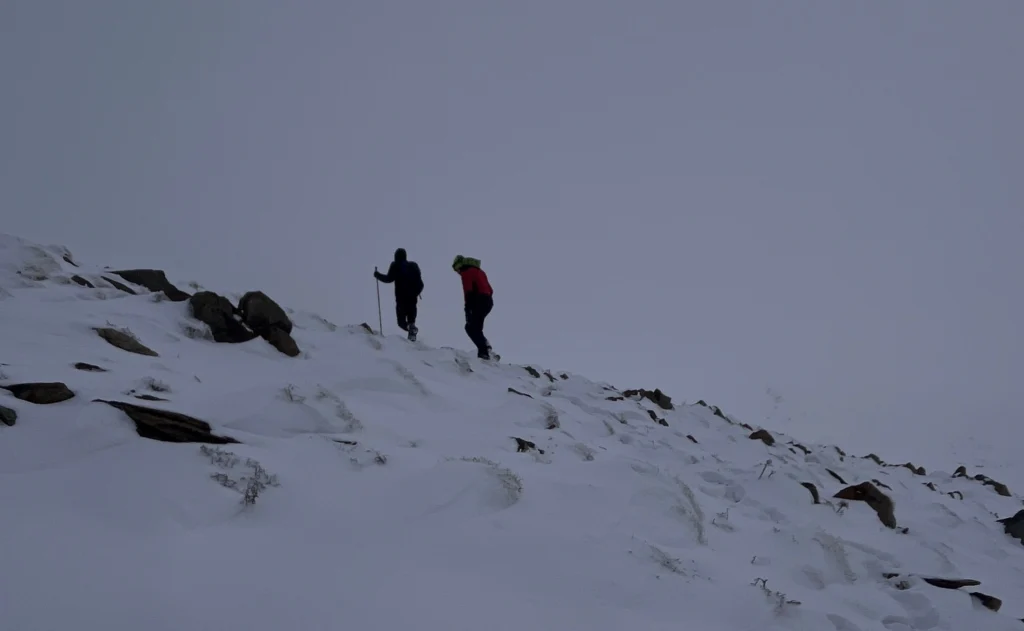
Standing at 3,280 meters in the western High Atlas, Jbel Gourza rises less than 100 kilometers southeast of Marrakech. Yet it feels like a world apart. There are no marked trails, no mountain huts, and very few hikers. When I reached the summit on January 1st, 2026, the snow was thick, the wind was sharp, and the silence was the kind that makes you feel very small. Up there, surrounded by nothing but white peaks and grey sky, I understood why the Berber people have called this mountain sacred for centuries.
For the Amazigh (Berber) communities of the High Atlas, Jbel Gourza is not just a mountain — it’s a place of deep spiritual power. Every year, local tribes used to organize a mouggar (a traditional gathering or moussem) at the summit. During this ceremony, a bull was sacrificed as an offering to the mountain.
At the top, you can still see the remains of ancient stone sanctuaries and idols stacked from flat rocks. These stone piles look like they’ve been there forever. They are linked to Gorza, a deity that the Houara tribes believed in. The people asked Gorza to protect their livestock and bring good fortune. Standing next to one of these stone towers, dusted with snow and surrounded by mountains in every direction, you feel the weight of that history. It’s a powerful, humbling place.
The mountain also plays a very practical role in local life. Jbel Gourza feeds water to several communities below, including Amizmiz, Tazalt, and the historic Berber village of Tinmel. The oueds (rivers) Amizmiz and N’Fis both begin their journey here. So for the people living in this region, Gourza gives both spiritual meaning and the water they need to survive.
A Brief History of Jbel Gourza
Before the French protectorate period, Jbel Gourza was believed to be the second highest peak in all of Morocco. Because it stands alone and looks so massive from below, early observers estimated its height at 4,000 meters. It took European explorers to measure it more accurately.
The first recorded ascent by foreigners happened in 1871, when two British adventurers — Joseph Hooker and George Ball — made their way to the summit. At that time, no peak above 3,000 meters in the entire Atlas range had been reached by outsiders. So Hooker and Ball were true pioneers.
There’s also an interesting naming mix-up in the history books. Some European mapmakers called it “Djebel Tezah” by mistake. They confused the word tizi — which means “mountain pass” in Amazigh — with the name of the mountain itself. The tizi they were referring to is actually Tizi-n-Imiri, a pass that connects the N’Fis valley to Marrakech.
How to Hike Jbel Gourza: Routes and What to Expect
Let me be very clear about this: Jbel Gourza is not an easy hike. It’s rated 5 out of 5 for difficulty. The full round trip covers about 24 kilometers and takes around 12 hours. There are no beaten paths leading to the summit, which means you need good navigation skills, solid fitness, and proper mountain gear.
Here are the main routes you can take:
The Northern Route (from Tizga)
Start from Tizga, a small village south of Amizmiz. Head toward the Tizi-n-Imiri pass — its name translates to “the pass of the stone pile.” Once you reach the pass, turn left and follow the ridge toward the summit. This route gives you beautiful views of the Marrakech plain as you climb.
The Southern Route via the Waterfalls (from Tazalt)
This is the route I prefer. You can drive to Tazalt, which makes the starting point easy to reach. From there, follow a visible path along a dry riverbed (an oued that feeds into the N’Fis). This trail passes through the Azibs Tasmayn area and leads to the waterfalls of Azib Doutghuni. After the waterfalls, the real climbing begins through a steep ravine that takes you directly to the summit.
If the ravine feels too steep, you can veer left onto a gentler slope that brings you to the Tizi-n-Imiri pass, and then turn right toward the top.
The Southern Ridge Route (from Tazalt or Tinmel)
This option heads straight north from Tazalt or Tinmel. The first section is brutal — steep climbing until you reach about 1,900 meters. After that, you walk along a mountain ridge all the way to a viewpoint called the anfa, where you can see the entire Marrakech plain stretched out below you. From there, turn left for the final push to the summit. Be warned: there is no water on this route in summer and autumn. In winter you may find snow, and in spring there are sometimes patches of old ice.
When to Hike Jbel Gourza
The best time for this hike is March through June. The weather is more stable, the snow starts melting at lower altitudes, and the days are long enough for the full ascent.
In winter, the northern slopes get heavy snowfall. My January hike proved this — the snow on the upper sections made every step a challenge. It was beautiful, but slow and exhausting. If you go in winter, avoid the north face entirely.
The period to skip is mid-August through late September. Storms are more common during this window, and on an exposed mountain like Gourza with no shelter, a thunderstorm is the last thing you want.
Practical Tips for Hiking Jbel Gourza
Start early. With a 12-hour hike ahead of you, leaving at dawn is essential. Some hikers, including myself, set up a bivouac the night before just below the summit zone. Camping near one of the small shepherd shelters makes the final push much shorter — about one hour from the bivouac to the peak.
Bring enough water. Depending on your route, water sources can be far apart or completely dry. Carry at least 3 liters per person.
Dress in layers. Even in spring, the summit is cold and windy. In winter, expect sub-zero temperatures and pack accordingly.
Hire a local guide. Because there are no marked trails, a guide who knows Gourza well can make the difference between an amazing experience and a dangerous one. Ask in Tazalt or Amizmiz for experienced mountain guides.
Pack for weather changes. On my hike, the sky went from clear to threatening in under an hour. We barely had time to pitch the tents before the rain arrived.
Why You Should Put Jbel Gourza on Your List
Morocco has hundreds of mountains, but Jbel Gourza offers something different. It’s wild, it’s spiritual, and it rewards you with a kind of solitude that’s hard to find anywhere else. The ancient stone sanctuaries at the top connect you to a history that stretches back long before written records. The views — snow-capped ridges fading into the Marrakech plain — make every difficult step worth it.
If you’ve already done Toubkal and you’re looking for your next challenge, Gourza is calling. And if you’re the kind of traveler who wants to go where few others do, this is your mountain.
Have you hiked Jbel Gourza or any of the lesser-known Atlas peaks? I’d love to hear about your experience — drop a comment below or send me a message. And if you’re planning this hike, don’t hesitate to ask questions. This mountain deserves more visitors who respect it the way the Berber people always have.