


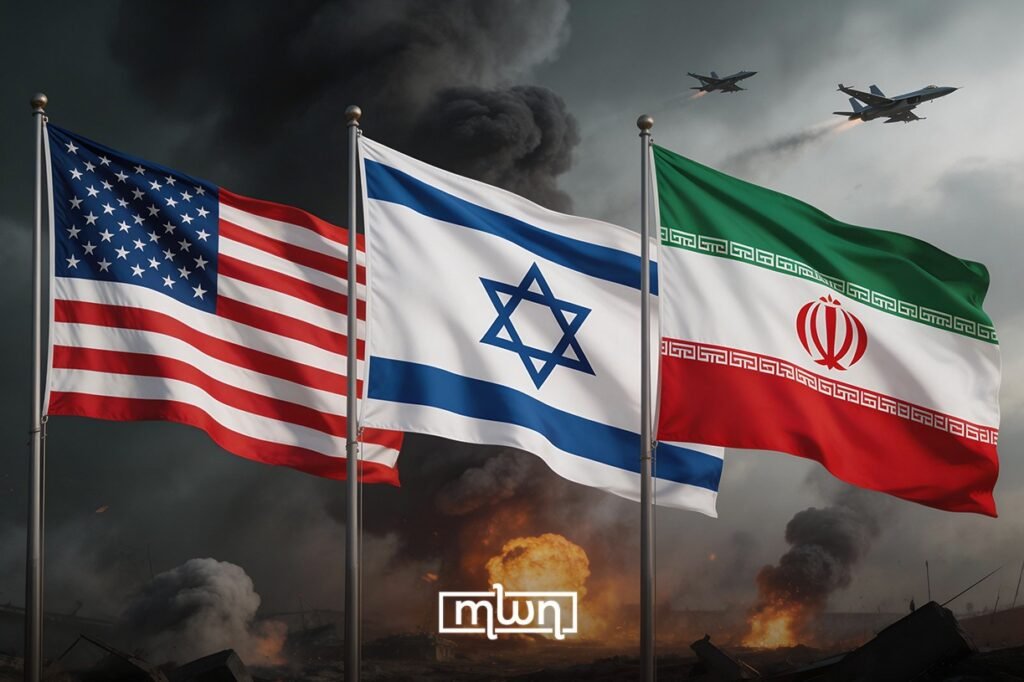
All wars are illegitimate. That is what people think while they are sipping a cup of tea or a glass of wine. They debate on the war between the United States, Israel, and Iran and the war between Russia and Ukraine. They refer to the various forgotten wars worldwide. They insist on the Israeli-Arab war and shallowly mention the interventions of peacekeeping forces linked to regional state organizations. In all cases and regardless of who’s who has started a war, their behaviors are deemed to be hegemonic.
An avalanche of criticism here and there is witnessed thanks to social media. Renowned personalities stigmatize what they call a violation of international law and a despising behavior with respect to the rights of peoples to self-determination. In short, the term “hegemony” keeps coming up and challenges both experts and laypeople alike.
“Hegemony” is a word that is keeping geopolitical analysts busy, regardless of their political affiliations. It is used to describe the balance of power between state actors. It denounces a state of political and social asymmetry that no impartial observers dare underestimate.
Hegemony as a tangible fact reignites the debate on the paradigms of dependence, interdependence, bonded interdependence, and unilateral interdependence. These paradigms have apparently evolved over years in the academic circles but remained static in people’s mindsets.
It seems that astute observers feel comfortable categorizing the observed phenomena. They consistently strive to uncover the underlying causes. Others stick to their inner perception and highlight their ideological preferences. The meaning and scope of the word “hegemony” are perceived based on the orientation sought by whoever seeks to assert a choice to sustain a given political, strategic, and diplomatic situation.
“Hegemony” is used in the leftist mainstream to describe an unequal relationship between two or more parties. The dominant party imposes its choices. She uses physical or moral constraint to undermine the other party’s interest. Hope for a future balanced relationship is kept at the mercy of the goodwill of the first party. Such a projection is visible when global issues require calming the situation with partners in a state of blatant asymmetry.
Dichotomous perceptions and ambiguities at will
Hegemony can take several forms. Firstly, hegemony can mean direct intervention in the internal affairs of another state. The intervention is justified by so-called moral considerations. It can be put forward to end a civil war that is nearing or leading to an unbearable genocide. Two cases draw attention.
On one hand, the Somali Civil War (1986-1991). It reminds of the collapse of the state, the exacerbation of clan struggles, and the exodus of populations leading to unbearable scenes of famine. The Somali civil war has ramifications in the sub-region dating back to the secession and unilateral independence wars involving Somalia and Ethiopia. An international intervention is required, then. It was put forward as unavoidable for the sake of saving people’s lives and preventing a humanitarian disaster.
On the other hand, the civil war in Rwanda (1990-1994), whose darkest side was the genocide of the Tutsis by the Hutus, followed the failure to implement the Arusha Accords (1993). Although ethnic cleansing dates back decades, the involvement of foreign powers in the civil war made it hard to keep the magnitude of negotiations under control.
The international community let it happen before international public opinion woke up to force the great powers and intermediate powers to take their responsibilities to try to put an end to the genocide. The favored term used back then was “the right to humanitarian intervention,” already mentioned earlier, which is an expression that reeks of cynicism and hypocrisy.
However, the right of humanitarian intervention was not emphasized to anticipate and prevent the Srebrenica massacres (1995) in Bosnia and Herzegovina. It was even less so in the Palestinian territories in the aftermath of October 7, 2023. The stigmatization of the parties in conflict is secondary in this specific case, for what is shocking is the silence of certain Western countries whose intervention was praised during the Somali civil war.
Secondly, hegemony as an instrument of regime change. This can take two forms. On one hand, the use of proxies through military coups. On the other hand, direct military intervention. Depending on ideological preference, both forms are labeled as imperialistic and revolutionary unavoidable ethical responsibilities.
The most glaring cases to mention are: One: the modern escapades of the mercenary Bob Denard (1929-2007). He served as an indirect auxiliary of Fransafrique under the guidance of Jacques Foccart (1913-1997), who was in charge of implementing the African policy concocted by François Mitterrand. Bob Denard even managed to hold the position of head of state and to lead the Comoros Islands twice.
Two: The United States military intervention in Nicaragua (1909-1933 and 1980). It was meant to counter the European influence and to dislodge the Sandinistas, respectively. Similarly, the American involvement in Guatemala, labeled as Operation PBSuccess (1954), aimed at overthrowing Jacobo Arbenz and putting an end to the communist ideology progress in the country.
Three: The various interventions of the Soviet Union in what it called their vital space. This applies to their intervention in Prague (January-August, 1968) to thwart the relatively liberal reforms Alexander Dubček introduced in the Czechoslovak Communist Party and to their intervention in Budapest (October-November, 1956) to assist the Hungarian Communist Party shaken by the popular uprising.
Moreover, Russia’s intervention in Georgia (2008) followed the rapprochement of certain South Caucasian republics with the European Union and the escalation of hydrocarbon geopolitics. This intervention opened the door for the unilateral independence of Abkhazia and South Ossetia.
Ideological preferences, random behavior
Thirdly, hegemony associated with irredentism. This association is confusing, but again, it depends on the ideological and political preferences of the actors involved. Irredentism was frequently used in decision-making circles in the West in the aftermath of African independence. It was meant to avoid questioning the chaotic border delineation imposed by the Berlin Conference (1884-1885) on the partition of Africa.
The aim of the countries involved was not to ensure that countries born only thanks to the United States’ goodwill, but mainly to maintain the privileges of the former colonial powers. The latter had a solid argument, which is the commitment made to them by the new states to allow them to enjoy privileges prior to and after being granted political independence. The hegemonic stigmata are more than evident.
This explains why the entry into the fray of countries requesting that colonial border errors be rectified was deemed irredentist and dangerous for the stability and security of the newborn states.
Fourthly, hegemony associated with asymmetric power. This configuration can be misleading at first glance. Because hegemony presents a single actor’s behavior who imposes its law. Therefore, asymmetry is described as a commonplace fact, since the apparent power dynamics do not reflect reality.
The opposing argument defends another interpretation. Indeed, hegemony associated with asymmetric power refers to a situation in which the hegemonic actor imposes order, even if that order is not even. This configuration is defended by some observers to justify intervention on a fragile and zigzagging political chessboard.
The idea is that the hegemonic threat can lead to the acceleration of institutional reforms among actors resistant to democratic openness. Obviously, this opinion is mostly conveyed in Western academic circles.
Fifthly, hegemony as a factor of power balance in issue areas. This perception reinforces the abovementioned configuration. Indeed, the hegemonic intervention of a superpower or an intermediate power would be inevitable to ensure that tensions in a region deemed conflict-prone do not exceed the limits set for dynamic management without the risk of creating uncontrollable chaos in the median and long term.
Sixthly, hegemony as a preventive action against a more dangerous military escalation for peace. This is thought to be a better and more coherent action than adopting a negative neutrality behavior. It seeks to calm down the ardor of a partner who is looking for scapegoats in the neighborhood to avoid opening up the domestic political chessboard.
Seventhly, the hegemony-subcontracting is currently highlighted. The war between Iran, the United States, and Israel causes concepts and paradigms to intertwine and confuse observers. The way the war is unfolding will have incalculable consequences on regional security complexes. If the possibility of a war was not ruled out at the beginning, the scale it later took surprised everyone.
Subcontracted hegemony has been entrusted to Israel and Iran, respectively, since 1967 and 1980. However, both countries sought to get more leverage in their neighborhood. This happened when they started a sort of a mutual neutralization process. They were unaware of their main sponsors’ interests, the United States.
Subcontracting and remote influence
These facts lead diplomats, who are more familiar with the intricacies of Middle Eastern geopolitics, to believe that cooperation between Tel Aviv and Tehran was indirectly taking place in countries like Syria, Iraq, and the Palestinian territories. The agendas of the two countries converged on the issue of weakening the latter to control the game in the sub-region.
The subcontracted hegemony has been functional through intermediaries. The reshaping of the regional strategic chessboard in the Middle East has brought forth contenders for tailor-made hegemonic roles. A kind of scarecrow on duty. Iraq and Iran played this role only to end up crushed in proportions already determined by the major players who pull the strings from afar.
Eighthly, cultural hegemony through the superposition and clash of religious and ideological symbols. The Middle East and North Africa served as testing grounds for this phenomenon. The consequences have been disastrous for some and beneficial for others. The former tried to reinvent their symbols without success at the end of the exercise. The others were luckier because their doctrinal-religious references were the strongest.
Ninthly, hegemony through the pacification of vital spaces and the establishment of asymmetrical free trade zones. Hence the concern of Canada and Europe to free themselves from American predominance.
Tenthly, psychological hegemony. It is used for preparing for a stealth war. All means are good: fake news, defamation, and demoralization. It also aims to mislead neutral observers.
Psychological hegemony is therefore more insidious, as it targets public opinions and opens a breach in the ranks of structures subservient to strategic decision-making systems. We respectively witness this in the context of the war between Russia and Ukraine and between the United States and Israel.
Some observers go further and consider the American intervention against Iran, the kidnapping of Maduro, the control of maritime passages, and the ambitions over Greenland or Cuba as a long-term strategy that indirectly targets China. By depriving China of a significant portion of its oil supplies from Venezuela and the Middle East, the United States will somewhat slow down China’s rapid economic rise.
How can one explain the hegemonic trend among state actors, former powers, and emerging powers? First, the impact of the mind-set. This mind-set reflects a political culture that leads the concerned actors to believe that they are entitled to hold the monopoly on the legitimate use of violence.
These state actors believe that this monopoly can (and must) be used within and outside national borders. It is a matter of national interest, the needs for social cohesion, and ideological solidarity beyond borders.
Secondly, the oscillation between the imperative of compromise and the obligation of concession in order to avoid total submission. The process takes time precisely to buy time and think about a less costly exit strategy. However, the wish is not always granted as desired.
Thirdly, the sanctification of the spirit of the individual group (two or three people) and oligarchic group (four or more people) as long as there is no fire in the house. Once a serious crisis erupts, cracks in ritual solidarity begin to appear.
This fissure gives rise to the establishment of a bridge between the two groups. However, in the process, a behavior emerges that tends toward temporary fragmentation. It is caused by each component’s concern not to lose its trademark.
The decisions made are constantly being called into question. The survival of the group then depends on random circumstances that allow for stirring the stagnant waters and redrawing the contours of a new division of labor while waiting for better tomorrows.
Waiting for Godot
Fourthly, the monopoly of the oligarchies under the pretext of saving the country and strengthening its security. This pretext reinforces the previous argument, namely that the concern of preserving personal and oligarchic interests requires making them identical to those of the vast majority. It is unlikely that this majority’s genuine interest will be taken into account.
The criticisms against the hegemonic behavior of individuals and groups are abundant. They are not different from the ones expressed by those who defend different views. One of the most widespread criticisms is that the hegemony of state actors is contrary to international law. They are not different from the view of those who defend opposing views.
One of the most widespread criticisms is that the hegemony of state actors is contrary to international law. The proponents of this argument loudly proclaim that international law is not being respected. If this sort of criticism came from actors who were victims of hegemonic behavior, I would be understood and somehow swallowed.
Unfortunately, this criticism is voiced by state actors whose record in the realm of respecting international law is full of scandals. They happened to use international law to defend and impose their interests. Such behavior was perceived as hegemonical by the international public opinion at the time.
To this far-fetched argument, there is also the addition of the legitimate right and duty put forward by state actors who are victims of hegemonic behaviors. Some rely on Article 51 of the United Nations Charter, others on the right of pursuit. Most of these actors don’t care to reject everything outright and lock themselves into a single logic: their own. This logic consists of justifying one thing and its opposite.
If international law advocates are keen to see its provisions fully respected and implemented in international relations, including during the outbreak of wars, why do they remain silent on the provisions of bilateral and multilateral defense agreements? These provisions may contain classified clauses that condition their behavior in times of war.
In this respect, one must avoid generalizations when it comes to debating hegemony by associating it with the rhetoric of just wars and unjust wars. Similarly, it is necessary to distinguish between so-called forced alliances and presumably voluntary alliances; both drain the concept of hegemony of its genuine significance.
In short, the defense of international law and the legitimate right and duty are implemented à la carte. It recalls Samuel Beckett’s “Waiting for Godot,” play published in 1952. The perception of life (and thus politics and diplomacy in our case) as the symbolism of the glass being half full or half empty. A mixture of phobia, cynicism, and hypocrisy. Hegemony is a recipe that everyone simmers at the pace of their appetite without caring whether the neighbor has something to eat.