


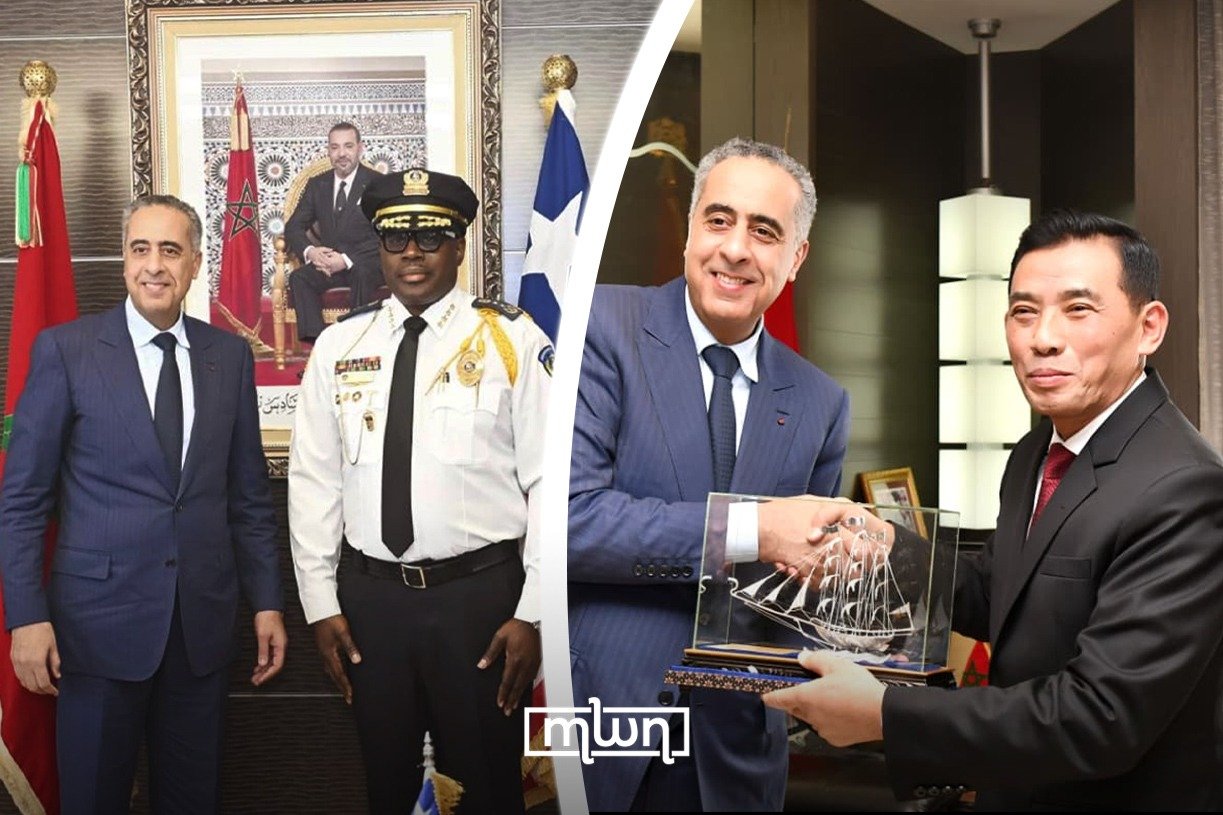
Rabat – Morocco’s top security official, Director General of the National Security and Territorial Surveillance (DGSN-DGST), Abdellatif Hammouchi, held a series of high-level meetings today in Rabat that point to a steady expansion of the country’s international security partnerships.
The first meeting brought together Hammouchi and Liberia’s Inspector General of Police, Gregory Coleman, who arrived with a senior delegation and his country’s ambassador.
The visit affirms Liberia’s keen interest in Morocco’s security architecture, widely regarded and considered as one of the most structured in the region.
The Liberian side signaled its intent to draw from Morocco’s experience in counterterrorism and in dismantling organized crime networks.
Particular attention went to the methods developed by the Central Bureau of Judicial Investigations (BCIJ), as well as the operational model of the National Brigade of Judicial Police.
Discussions also spanned forensic science, a field Morocco has invested extensively in modern technical capacities.
The two sides agreed on the need for a structured framework. They plan to finalize a memorandum of understanding that sets out priority areas and practical mechanisms for cooperation.
Officials expect the agreement to be signed in Rabat in May, to coincide with the 70th anniversary of the General Directorate of National Security (DGSN).
Later the same day, Hammouchi met Indonesia’s ambassador to Morocco, Yuyu Sutisna. Their exchange focused on bilateral coordination and the implementation of existing agreements, alongside plans for a new cooperation framework in the security field.
These meetings are the outcome of years of sustained bilateral cooperation in the security field, where Morocco has gradually built a network of trusted partnerships grounded in operational exchange and institutional dialogue.
Through this long-term approach, Rabat has once again positioned its security apparatus as a credible reference point for countries that seek practical and proven methods in counterterrorism, policing, and intelligence coordination.
