


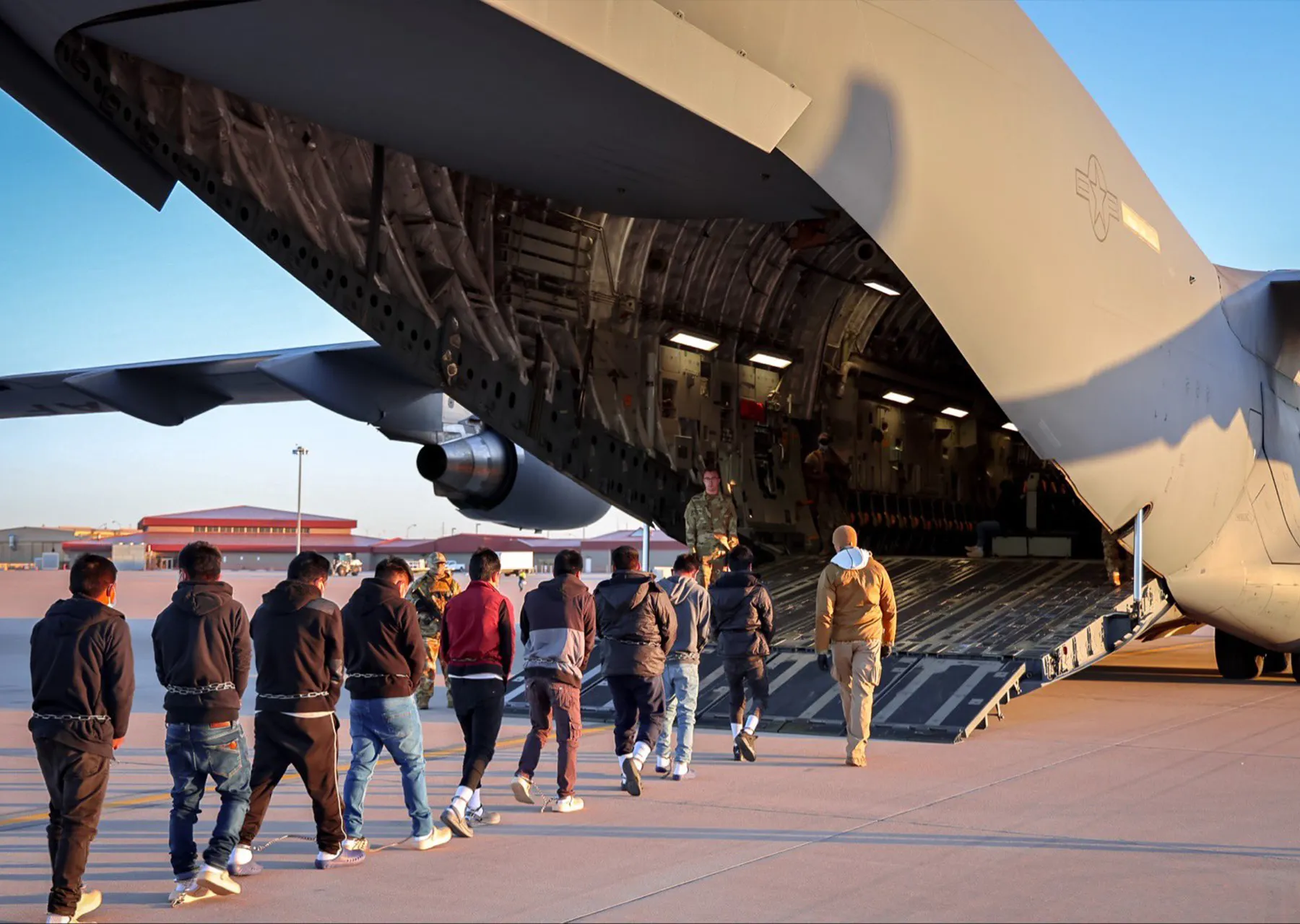
Beni Mellal – Germany deported 22,787 people in 2025, according to official data released by the federal government (Bundesregierung) in response to a parliamentary inquiry from the Left Party (Die Linke), and made public by the German parliament (Bundestag). Among them, 785 were deported to Morocco, placing the North African country 11th overall on the destination list.
Morocco ranked as the top destination for the use of physical restraint measures during deportations, with 483 people subjected to such measures – more than any other nationality. Algeria followed with 426 cases. Both countries saw deportees removed almost exclusively on scheduled commercial flights rather than charter operations.
Algeria received 631 deportees in 2025, ranking 15th overall. Tunisia received 498, while across the Maghreb, the numbers reflect a steady German enforcement focus on the region.
Algerians and Moroccans also featured prominently among failed deportation attempts: 68 Algerians and 57 Moroccans were among the nationalities with the most aborted removals after handover to federal police.
Among Arab-origin nationals, Iraq ranked as the most significant destination, with 793 deportees sent back in 2025, placing it ninth overall.
Egypt received 102 deportees, Jordan 34, and Syria just two through formal deportation orders – though 591 Syrian nationals were transferred under Dublin procedures to other EU states. Lebanon saw four deportees, while Yemen received three.
Germany also carried out 5,377 Dublin transfers in 2025, returning asylum seekers to the EU member states responsible for processing their claims. Among those transferred, 181 had Moroccan origins and 384 were Algerian nationals – the fourth-highest nationality group for Dublin transfers. Tunisians accounted for 83 such transfers.
Afghans topped the Dublin transfer list with 990 cases, followed by Syrians with 591 and Turks with 537.
Of the 22,787 total deportations, 19,897 were carried out by air, 2,813 by land, and 77 by sea. Frankfurt Airport handled the most deportation flights with 7,696 individuals, followed by Düsseldorf with 2,934 and Berlin-Brandenburg with 2,591. The top destination countries overall were Turkey with 2,297 deportees, Georgia with 1,690, Spain with 1,162, and France with 1,053.
Read also: EU Commission: Morocco Accepted Only 8% of Irregular Migrants Back in 2023
Germany’s deportation figures have fluctuated significantly over the decades. The country recorded its all-time high of 53,043 removals in 1994, followed by annual figures hovering around 35,000 through the late 1990s.
Numbers declined steadily to below 10,000 between 2007 and 2012, before rising again during the 2015 migration crisis to around 21,000, reaching 25,000 in 2016. The figure dropped to 10,800 during the COVID-19 year of 2020, then climbed gradually from roughly 13,000 in 2022 to 16,430 in 2023 and 20,087 in 2024, reaching 22,787 in 2025.
A total of 1,593 deportation operations were aborted after handover to federal police. The single most common reason was pilot refusal, with airline captains blocking 514 departures on scheduled flights – up from 342 in 2024. Passive resistance by deportees led to 221 aborted cases, while medical objections accounted for 132.
Charter flights were used to manage resistance. The most expensive single operation was a July 18 flight carrying 81 Afghan nationals to Kabul, costing €588,456. That flight was conducted without German federal police escorts, instead relying on a security arrangement through Qatar.
A February operation removing 49 Ghanaians, Cameroonians, and Nigerians cost more than €380,000, escorted by 102 officers. A March flight carrying 50 Iraqis cost €261,000, also with 102 officers on board.
The federal government also fined airlines €2,245,500 in 2025 for transporting passengers without valid documents, with fines issued in 1,241 individual cases – all against aviation companies.
As of December 31, 2025, Germany had 232,067 people subject to a deportation order, of whom 190,974 held a temporary toleration status. The government noted that 16,576 people left Germany voluntarily under the federal REAG/GARP program, with Turks and Syrians making up the two largest groups.
