


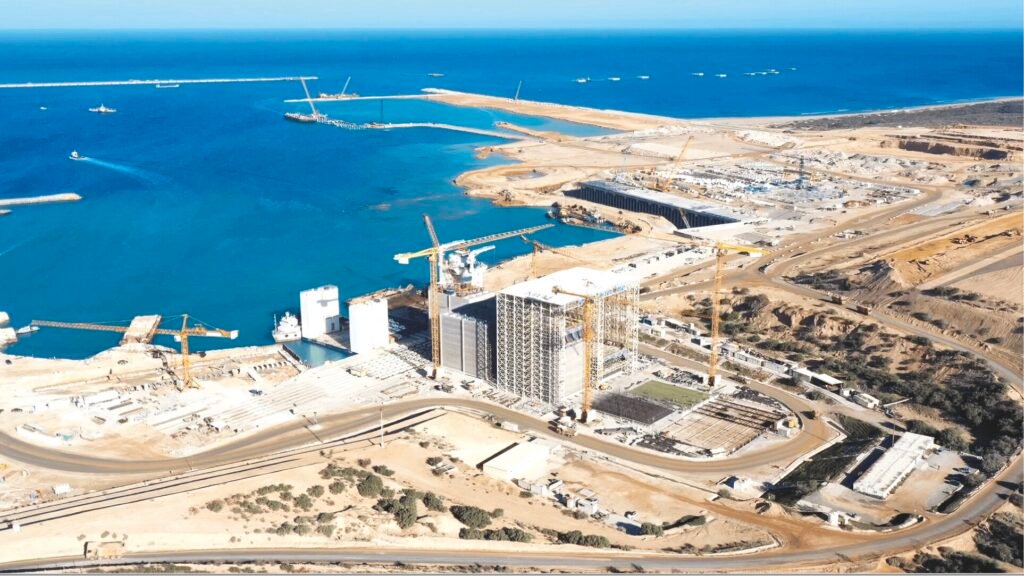
Marrakech – Germany-headquartered ShibataFenderTeam, the world’s leading fender manufacturer, announced Wednesday that it has designed and supplied fender systems for Morocco’s Nador West Med port, one of the largest port infrastructure projects currently underway in Africa.
The company, which brings over 60 years of group experience in fender production and more than 160,000 fenders in service worldwide, was appointed by Moroccan contractor SGTM to equip approximately 1,520 meters of quay across four terminals.
SGTM is a Moroccan firm with long-standing experience in major infrastructure projects across transport, energy, water management, and industry.
SFT supplied 120 Cone Fender Systems with closed steel panels and 208 bollards with 200-ton capacity for the container terminal. The RoRo quay received five Cone Fender Systems with closed box panels and three bollards.
The bulk terminal was fitted with 19 Cone Fender Systems and 19 bollards, while the oil quays were equipped with 30 Cone Fender Systems. A service dock also received 96 DD Fenders and 39 bollards with 30-ton capacity.
Each terminal required solutions adapted to its specific operational and structural conditions. Beyond equipment supply, SFT provided continuous engineering coordination throughout the execution phase.
The company supported the contractor as berth designs and technical requirements evolved, extending its input into the installation phase to ensure proper integration within the port’s structures.
SFT also noted that it has been selected to supply fender systems for another new port project currently underway in Morocco.
Nador West Med is taking shape on Morocco’s Mediterranean coast, directly along main east-west shipping routes for container and petroleum product traffic. King Mohammed VI chaired a working session on January 28 at the Royal Palace in Casablanca dedicated to the project. The port is set to begin operations in the fourth quarter of 2026.
The facility has so far mobilized MAD 51 billion ($5.1 billion) in public and private investment. Its base infrastructure is now complete, including 5.4 km of breakwaters, 4 km of quays, and four energy stations.
At launch, the port will handle 5 million containers and 35 million tons of liquid and solid bulk annually. Its long-term expansion potential reaches 12 million containers and an additional 15 million tons of liquid bulk per year.
The project was also supposed to include Morocco’s first liquefied natural gas terminal with an annual capacity of 5 billion cubic meters. However, the Ministry of Energy Transition and Sustainable Development suspended the MAD 10 billion ($1 billion) LNG component in early February.
A 700-hectare industrial and logistics zone has already attracted international operators, with MAD 20 billion ($2 billion) in confirmed private investment.
With Iran shutting down the Strait of Hormuz and global energy supply chains thrown into chaos, Nador West Med’s strategic relevance has taken on an entirely new dimension.
The strait, a narrow waterway between Iran and the Arabian Peninsula, serves as the world’s most critical chokepoint for oil and gas shipments. The blockade has rattled global energy markets, severed key supply routes, and driven petroleum prices to sharp highs.
In this context, Morocco’s Industry and Trade Minister Ryad Mezzour said in a recent interview with BBC News Arabic that the war between the United States, Israel, and Iran could encourage stronger investment in energy storage and petroleum facilities in Morocco.
He noted that the country is viewed as a stable destination for global investment and a strategic option for hydrocarbon storage for countries in the region. Mezzour confirmed the port project is proceeding on schedule, unaffected by the current crisis, as it is a long-term initiative that began over a decade ago.