


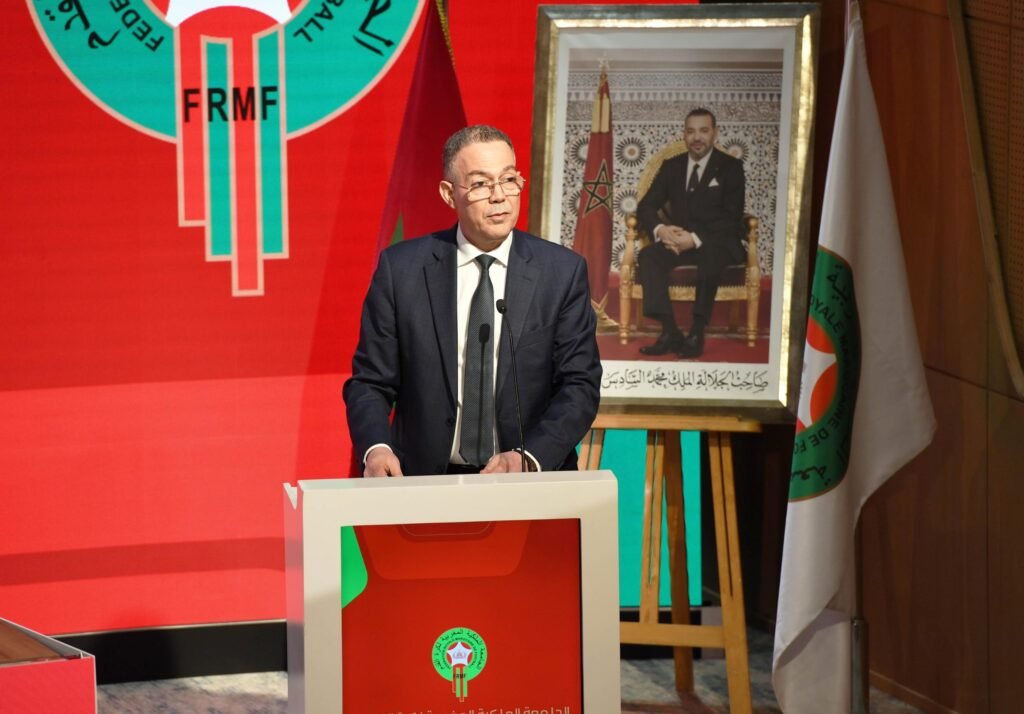
Marrakech – In its first official statements since the CAF Appeal Jury declared Morocco champions of Africa, the Royal Moroccan Football Federation (FRMF) welcomed the ruling on Wednesday as a long-overdue correction that upholds the integrity of continental competitions.
The federation has issued a press release that is carefully measured in tone but unequivocal in substance. The FRMF said the verdict goes “in the direction of respecting the rules and the stability necessary for the proper conduct of international competitions.”
The CAF Appeal Jury ruled on Tuesday, March 17, to declare Senegal forfeit in the AFCON 2025 final, applying Article 84 of the competition’s regulations. The result was homologated 3-0 in favor of Morocco. The ruling simultaneously annulled the earlier disciplinary decision, which had drawn widespread criticism for failing to address the core violations that marred the final.
The FRMF made clear that its legal challenge was never about the scoreline. “The approach undertaken was never intended to contest the sporting performance of the teams, but solely to demand respect for the rules,” the federation stated. It had consistently pushed for one thing since the chaotic events of January 18 in Rabat: “the strict application of the regulations governing the competition.”
That night, what was meant to be a historic final descended into disorder. Following a VAR-assisted penalty decision in favor of Morocco in the closing minutes, the Senegalese coaching staff chose escalation. Players left the pitch without authorization, triggering a prolonged interruption. Senegalese supporters attempted to storm the field, attacked stadium stewards, and damaged infrastructure. The match eventually resumed, but the damage to its sporting integrity was already done.
In the weeks that followed, the CAF’s Disciplinary Jury issued a first round of sanctions – suspensions, fines, and measures targeting both sides. Yet the central question remained conspicuously unaddressed: the legal qualification of Senegal’s walkoff and the extended disruption it caused.
The FRMF chose to escalate through proper legal channels. It filed an appeal, not merely to contest what it viewed as disproportionate sanctions, but to force a reckoning on a fundamental regulatory point. The federation noted that “following a first decision which the FRMF had appealed, the CAF now recognizes that the rule, known to all and applicable to all, had not been respected.”
Throughout the process, the FRMF stressed its adherence to institutional procedure. It “deposited its conclusions, participated in the hearings to which it was invited, and endeavored to uphold its rights and the rules ensuring the proper conduct of competitions.” The federation positioned itself deliberately on the terrain of law, not emotion.
The Appeal Jury’s ruling vindicated that approach entirely. By invoking Articles 82 and 84, the panel requalified the Senegalese team’s conduct as an unauthorized refusal to play – an infraction that mechanically triggers forfeiture under CAF regulations. The earlier disciplinary decision was overturned, confirming that the initial reading of events had been fundamentally flawed.
After facing intense scrutiny over its handling of the affair, CAF has finally moved to save its own credibility. For years, African football’s governing body has been criticized for inconsistent rule enforcement and decisions shaped more by political considerations than by regulatory text.
The Appeal Jury’s verdict breaks sharply with that pattern. It also confirmed certain responsibilities on the Moroccan side, including incidents involving ball boys and laser pointers, adjusting sanctions accordingly – a detail that reinforces the impartiality of the ruling.
The FRMF framed the decision in broader institutional terms. It “contributes to clarifying the regime applicable to similar situations and participates in the coherence and credibility of international competitions, in particular African football.” The federation signaled that this was not an isolated case but a precedent with lasting implications.
Had the original ruling stood, it would have effectively established that a team could abandon the field during a final, cause a prolonged interruption, and face no forfeiture consequences. That precedent would have opened the door to calculated disruptions in future competitions – a scenario the CAF could not afford to normalize.
Senegal now has ten days to file an appeal with the Court of Arbitration for Sport in Lausanne.
Meanwhile, the FRMF declared its intention to “continue to uphold the strict and equitable application of the rules governing the competitions in which it participates, before continental and international bodies.”
It also stated it would now “turn serenely toward the upcoming sporting events,” citing the FIFA World Cup and the Women’s AFCON scheduled for this summer.
The federation closed its statement by saluting “all the nations that participated in this edition of the AFCON, which constituted a major moment for African football.”
The legal chapter is now closed at the continental level. Morocco is officially the 2025 African champion. The ruling does not merely settle a match – it redefines the boundaries of acceptable conduct in African football.
Read also: Why Spain’s Sports Media is Melting Down Over Morocco’s AFCON Win