


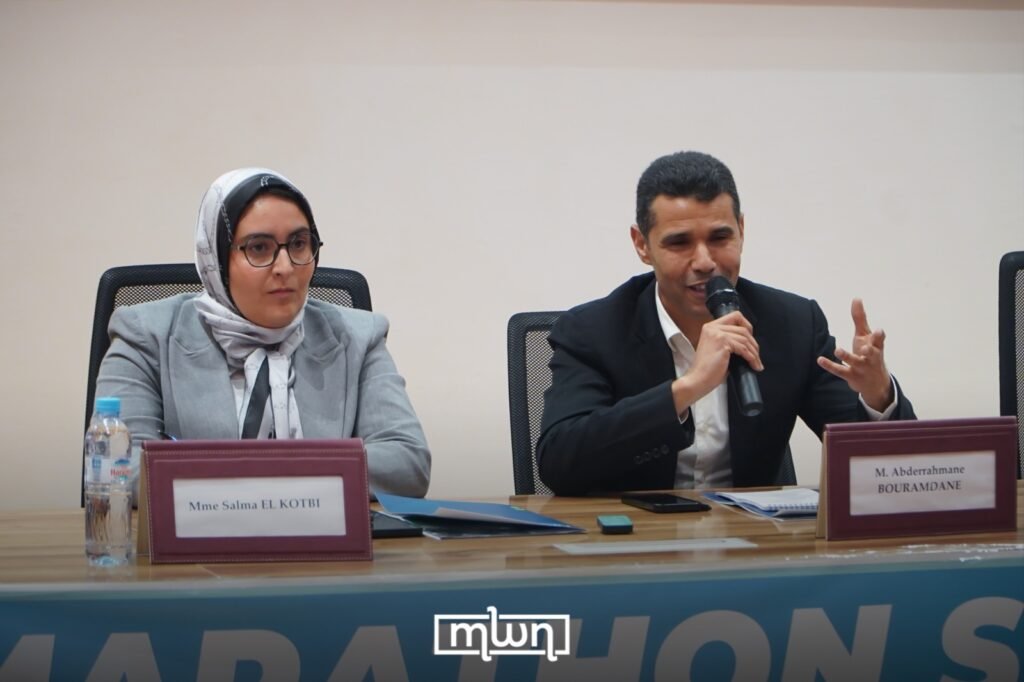
Fez — With less than two weeks to go before race day, organizers of the second Fez Spiritual Marathon outlined at a press conference today their ambitions for what they hope will continue to hold as one of Morocco’s leading long-distance running events.
Scheduled for Sunday, February 15, the marathon is organized by the Association Dila Athlétique under the supervision of the Wilaya of the Fez–Meknes region. Building on the momentum of its inaugural edition, the event now aims to position itself alongside — and even beyond — established races in cities such as Marrakech and Casablanca, particularly in terms of organization, international participation, and overall experience.
Speaking to Morocco World News (MWN) on the sidelines of the press conference, Abderrahim Bourmdane, director of the Fez Spiritual Marathon and president of Dila Athlétique, emphasized the scale the event has already reached.
“I am here to explain how Fez is preparing to host this marathon on February 15,” Bourmdane said. “We have many registrations from international countries, with more than 33 nations represented.”
According to figures shared during the conference, more than 650 foreign athletes are expected to take part, including some highly respected names from Ethiopia and Kenya, alongside Moroccan runners from across the country. Organizers described this diversity as a key marker of the marathon’s growing profile and a sign of its potential economic impact on the city.
A course through Fez’s symbolic spaces
More than a sporting competition, the Fez Spiritual Marathon is designed as an immersive experience rooted in the city’s cultural and spiritual identity. Runners will pass through emblematic avenues and urban landmarks, with the aim of connecting physical performance to Fez’s historical depth.


The marathon route also carries a strong symbolic dimension, tracing a journey that echoes Fez’s intellectual legacy. By linking the historic heart of the city, home to Al-Qarawiyyin University, widely regarded as the world’s oldest continuously operating university, to the Euro-Mediterranean University of Fez, the race reflects a passage from heritage to modernity. Organizers described this connection as emblematic of Fez itself: a city where centuries-old scholarship coexists with a new-generation university built to the highest international academic standards.
The main races — marathon, half-marathon, and 10 kilometers — will start from Avenue Abou Bakr Al Arabi and finish at Place Abi Al Jounoud. The route has been planned to meet technical standards for road races while remaining accessible to elite athletes, amateurs, and first-time participants alike.
In addition to the main distances, the program includes children’s races and shorter formats intended to encourage youth participation and broaden the marathon’s social reach.
“We want this marathon to be at a very high level,” Bourmdane told MWN. “And we want thousands and thousands of people to participate here.”
Competitive prizes and global ambitions
One of the most closely watched aspects of the press conference was the announcement of prize money and performance incentives. The organizers confirmed cash prizes for top finishers across the marathon, half-marathon, and 10-kilometer races, with equal awards for men and women.
The winner of the full marathon will receive $5,000 (approximately MAD 45,900) in prize money, positioning the Fez Spiritual Marathon among the most competitive road races in Morocco in terms of financial rewards.


Beyond the immediate prizes, Bourmdane highlighted a longer-term ambition: aligning the Fez Spiritual Marathon with international standards that allow elite runners to use it as a stepping stone toward major global competitions.
Organizers have indicated that the race is structured to meet qualification criteria linked to the Abbott World Marathon Majors system, a benchmark that includes some of the world’s most prestigious marathons. While still in a developmental phase, this positioning reflects a clear desire to elevate the event’s international credibility.
Bourmdane compared the organization and turnout of the Fez marathon favorably with other major Moroccan races, suggesting that Fez could soon rival — or even surpass — more established events.
The emphasis, he stressed, is not only on numbers but on quality: logistics, safety, athlete support, and overall race management.
Economic and social impact
Beyond sport, organizers repeatedly framed the marathon as a driver of local development. With hundreds of international runners, accompanying families, and media representatives expected in Fez, the event is projected to generate significant economic activity for hotels, restaurants, transport services, and local businesses.
The press conference also highlighted the city’s large student population — estimated at more than 120,000 — as a key demographic for participation, volunteering, and long-term engagement with sports culture.
Bourmdane underlined that sport is increasingly viewed as part of Morocco’s broader economic strategy, not merely as entertainment. By attracting foreign athletes and positioning Fez as a destination for international competitions, the marathon contributes to tourism and to the city’s global visibility.
Medals and clarification from last year
Addressing questions about medals, Abderrahim Bourmdane praised this year’s design, saying, “It is the best medal in Morocco. This is the first time I see such a medal, and I love it.” He stressed that the focus was not only on appearance, but on quality and meaning for athletes.

Bourmdane also clarified a misunderstanding from the first edition, rejecting claims that finishers were left without medals. He explained that medals were awarded to runners who completed their races, in line with international standards, and that those who did not finish were not eligible. He added that the association still holds extra medals from last year, confirming there was no shortage.
A career rooted in athletics
Bourmdane’s role in the marathon is closely tied to his personal history in athletics. A native of Fez, he won his first marathon in the city at the age of 17 before going on to represent Morocco internationally. His career includes appearances at the 2008 Beijing and 2012 London Olympic Games, as well as strong performances in major international marathons.


That background, organizers say, has shaped the technical direction of the Fez Spiritual Marathon, from course design to athlete services and competitive standards.
For Bourmdane, the project is also personal. “Fez is my city,” he has said on multiple occasions, framing the marathon as a way to give back while building something sustainable for future generations of athletes.
Gratitude and expectations
In his remarks to MWN, Bourmdane was careful to express thanks to institutional partners, sponsors, and the media, stressing that the marathon’s growth depends on collective effort.
“I want to thank King Mohammed VI, may God assist him, for supporting sport,” he said, while also acknowledging the role of local authorities and partners in making the event possible.
Looking ahead to race day, Bourmdane struck a confident but measured tone. “We hope to have success for all this event,” he said. “See you on Sunday, inshallah, for the competition.”
As Fez prepares to welcome runners from across Morocco and beyond, the second Fez Spiritual Marathon stands as both a sporting test and a statement of ambition — one that seeks to place the city firmly on the international marathon map while reinforcing its identity as a space where culture, spirituality, and performance intersect.