


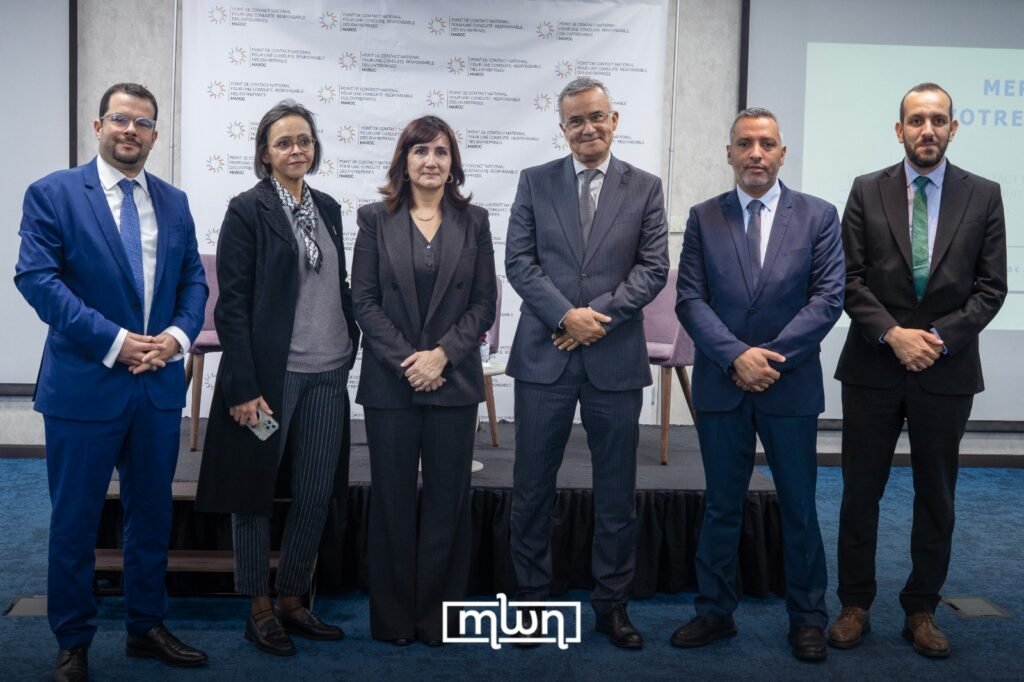
Fez — The Moroccan National Contact Point for Responsible Business Conduct (PCN), in partnership with the Fez-Meknes Regional Investment Center (CRI), gathered companies, public bodies, and academics at the Barceló Fez hotel for a half-day forum on the OECD due-diligence approach under the theme, “Responsible conduct: a strategic lever for a sustainable enterprise.”
Opening the session, CRI representative Amjad Kiti framed the day’s objectives and the region’s ambitions. “Morocco’s National Contact Point is partnering today with the Fez-Meknes Regional Investment Center to organize this event, part of the PCN’s regional tour, under the theme: ‘Responsible conduct: a strategic lever for building a sustainable, resilient, and competitive economy,’” he told MWN. “The Fez-Meknes region fully embraces this vision and is seeing strong growth and notable industrial development.”
Why responsible conduct matters for Fez Meknes
The program moved from framing to practice. The PCN Secretariat unpacked risk-based due diligence in plain terms: identify, prevent, mitigate, and account for actual and potential impacts on people, the environment, and good governance across a company’s own operations and its business relationships.
Among the speakers was Assia Ben Saad, head of the PCN Secretariat and a long-time member of the OECD Working Party on Responsible Business Conduct. Her office leads outreach, mediation, and capacity-building on the OECD Guidelines in Morocco, which the government committed to implement through a visible, accessible, and impartial National Contact Point. Public records show she has directed the Secretariat since 2013 and is also a senior legal official within AMDIE.


The Euro-Mediterranean University of Fez (UEMF) addressed training needs and the role of applied research. The National Human Rights Council (CNDH) emphasized credible grievance channels and stakeholder engagement, while UNIDO provided international benchmarks for cleaner, more competitive production. A Q&A and networking segment linked firms with advisors and institutions for follow-up.
Speakers repeatedly returned to the regional context. Fez-Meknes combines strong human capital and an industrial base of nearly 1,000 establishments employing more than 47,500 people.
Agro-food, textiles, and leather account for close to 60% of industrial added value. With more than 95% of local firms classified as very small, small, and medium enterprises, panelists said proportionate due diligence is both necessary and feasible.
Kiti underlined that point. “With an economic fabric made up of more than 95 percent TPME, Fez-Meknes places crucial importance on responsible conduct, especially in the post-COVID context, which highlighted vulnerability and the need for agility,” he told MWN. “Today’s session aims to raise awareness among regional companies about responsible conduct and to brainstorm global good practices in line with OECD guidance. We are pleased to host UEMF, CNDH, and UNIDO to share benchmarks.”
From principles to practical steps for SMEs
The forum focused on steps that SMEs can adopt without creating new departments. Panelists recommended a simple risk map of suppliers and sites, basic checks in purchasing and contracting, a one-page internal procedure for complaints with response times, and regular documentation that answers common requests from buyers and lenders. Participants heard how these building blocks often unlock export opportunities, speed up audits, and reduce later frictions with financiers.

The CRI paired the policy message with concrete support. “The region is committed to this momentum, and the CRI is mobilized through its support programs,” Kiti added. He flagged the rollout of the Investment Charter and the TPME support scheme, currently on a regional tour led by the Ministry in charge of Investment, with stops scheduled next week in Taza, El Hajeb, Meknes, and Taounate.
A background note circulated at the event reminded attendees that Morocco’s PCN is a tripartite mechanism mandated to promote the OECD Guidelines for Multinational Enterprises, spread due diligence across responsible and durable supply chains, and offer non-judicial mediation when issues arise. The Secretariat and presidency are hosted by the Moroccan Agency for the Development of Investments and Exports (AMDIE). Organizers framed the Fez stop as part of a structured tour that will continue to deliver awareness sessions, multi-actor debates, and short trainings across regions.
By the close, the takeaway matched the headline. Responsible conduct is not a branding exercise. For exporters and domestic suppliers alike, it is a practical method to manage risk, protect reputation, and meet the expectations of clients, workers, communities, and financiers. The PCN and the CRI invited companies to keep the dialogue going through follow-up clinics and helpdesks so that Fez-Meknes firms can turn principles into daily practice across their value chains.