


Fes, Morocco (also spelt Fez), is Morocco’s oldest imperial city, often overlooked as travellers focus on more popular stops. That’s a mistake. Fes, Morocco, offers a completely different energy: intense, layered, and raw. It’s (still) not so polished for tourists — and that’s exactly why it’s worth your time.
I have visited Fes many times and in different years, I always experience it as an unfiltered city that has changed little. The medina feels massive and real — not staged or curated. It’s home to over 9,000 streets, some so narrow you have to turn sideways to pass. It’s chaotic, easy to get lost in, and full of market life that still runs on a local rhythm. If you’re looking for a deeper, less touristic experience of a Moroccan medina, Fes, Morocco, is where to go.

Fes Morocco: historical importance
Fes was established in the late 8th century by Idris I, a descendant of the Prophet Muhammad, who fled to Morocco and founded the Idrisid dynasty. The mausoleum of Idris I in Fes is considered a sacred religious site. It functions like a shrine (ziyarah site)—a place where Muslims come to pay respects. Only Muslims are allowed to enter the mausoleum, while non-Muslims can view the entrance from the outside (photo below).
Fes is one of Morocco’s four imperial cities and served as the country’s capital multiple times. First under the Idrisid dynasty around 809 AD, and later under the Marinid dynasty in the 13th century. It remained a political centre until the capital eventually shifted to Rabat in the 20th century.

Your Morocco trip begins here
10 years in Morocco. Boutique planning for curious travellers
Fes is the second-largest city in Morocco, with a population of approximately 1.3 million people as of 2025. The city covers about 320 km². Its historic medina, called Fes el-Bali, is one of the world’s largest and oldest pedestrian-only urban areas, with over 9,000 narrow streets. This maze-like layout makes it a unique and authentic example of a traditional Moroccan medina. Much larger and more easily to get lost in than in Marrakech.


How long to stay in Fez?
Fes is a beautiful but large city to explore. If you have two days, that’s the perfect amount of time to see the main sights without rushing. One day, you can explore Medina. Another day – a bit of a new town, walk in the gardens, take a cooking class or food tasting tour. One day can work, but you’ll need to move quickly. More than two days makes sense only if you want to dive deeper into the city or add extra day trips nearby.
Fes fits nicely into a 10-day Morocco itinerary, especially if you’re combining it with a desert trip or a visit to Chefchaouen. Just keep in mind that distances in Morocco are long. E.g., the drive from Marrakech to Fes takes about six to seven hours. If you need help planning, book my video consultation or custom itinerary planning services.

How to get to Fes:
- Car: Renting a car in Morocco (I recommend www.discovercars.com) or booking a private transfer gives you flexibility but involves long drives (around 7 hours’ drive from Marrakech or the Sahara desert).
- Train: ONCF company trains (read more in my post Intercity buses and trains in Morocco. A Traveler’s Guide) connect Marrakech, Rabat, and Casablanca with Fes.
- Bus: Companies like CTM and Supratours run regular buses from Marrakech, Rabat, Casablanca, Agadir, Tangier, Chefchouen (only CTM) and other cities to Fes.
- Flight: Flying is the fastest option. Fes is served by Fes-Saïs Airport (40-minute drive from Medina), with direct flights from Marrakech Menara Airport (check Ryanair flights), Casablanca Mohammed V Airport (check Royalairmaroc flights), and Agadir Al Massira Airport (check Ryanair flights).
P.S. Taxis and cars are not allowed inside the Medina of Fes. If your riad is located deeper inside, you’ll need to walk from the nearest gate. Ask your riad which gate is closest for drop-off (especially for taxi drivers, as they will not know most of the riads), or where to park if you’re driving. Some riads offer staff to meet and walk you in—don’t forget to tip them. At night, parts of the Medina—especially deeper inside—can be dark and uncomfortable to navigate. For my clients, I always recommend riads in convenient locations or personally arrange for someone to meet them on arrival. You can book my A to Z itinerary services to have a stress-free experience in Fez.


Fez Morocco: places to visit
FES MEDINA (Fes el-Bali)
Fes el-Bali (that’s how the Medina/old town of Fez is called) contains over 9,000 narrow alleys—mostly car-free and easily maze-like. Souk Seffarine (coppersmiths street market) is also a highlight, where the rhythmic hammering creates an unforgettable soundtrack to the medina. So the Medina is a huge attraction itself, where you can get lost for hours, discovering its street vendors, food and unique architecture.
Bou Inania & Al‑Attarine Madrasas


A madrasa is a historical Islamic school that taught theology, law, grammar, and sometimes science, usually with boarding for students. While Marrakech’s Ben Youssef Madrasa is the most famous, the madrasas in Fes are quieter and equally rich in detail. These two were built under the Marinid dynasty in the 14th century: Madrasa Al-Attarine (1323–1325) near the spice market, and Madrasa Bou Inania (1350–1355), which is the only madrasa in Fes with an active mosque and a central fountain fed by a nearby river. Both have ornate zellij tilework, carved stucco, and cedar wood ceilings. At their peak, these madrasas housed dozens of students from across Morocco and the Islamic world. Entry is 20 MAD (~2 EUR) each. Visit early to avoid crowds.
Nejjarine Museum of Wooden Arts & Crafts


Located in an 18th-century funduq (also called a caravanserai), Nejjarine Museum of Wooden Arts & Crafts (or Funduq al-Najjarin) focuses on traditional Fassi woodworking tools and craftsmanship. A funduq was a roadside inn for travelling merchants, which also served as a warehouse and trading centre. Funduq al-Najjarin was historically linked to the Makhzen (royal administration) and played a key role in commercial activity in Fes. The name al-Najjarin means “carpenters,” referring to the nearby carpenters’ souq that still exists today.
The funduq likely continued operating as a merchant inn and warehouse until the early 20th century. Before colonial rule, a small number of rooms were owned by Jewish merchants. Today, the restored building houses a museum across multiple floors. Visitors can explore finely detailed woodwork, tools, and decorated doors, then climb to the rooftop terrace for panoramic views over the medina. Entry is 20 MAD (2 EUR)
Dar Batha Museum of Islamic Arts


Originally a royal palace built in the late 19th century by Sultan Hassan I and completed under Sultan Abdelaziz, Dar Batha was converted into a museum in 1915 (by the way, it was renovated & re-opened in March 2025, so many negative reviews about the condition of this museum are from older times). The entrance fee is 60 dirham and absolutely worth it. Dar Batha Museum of Islamic Arts houses a collection of over 6,500 objects, including ceramics, woodwork, textiles, and manuscripts, showcasing traditional Moroccan arts and crafts. I love its peaceful garden—it’s a calm and shaded place to walk after a busy stroll through the medina. The museum is located in my favourite Batha neighbourhood in Fes Medina, easy to access, and there are many nice cafes around (around the museum is a good location to look for riads – check the map).
Mosque and University of al-Qarawiyyin

The University of Al Quaraouiyine, founded in 859 AD in Fes, is the oldest continuously operating degree-granting university in the world. It is also a functioning mosque, and uniquely, it was founded by a woman—Fatima al-Fihri, a wealthy and educated Muslim—making it one of the few historic Islamic institutions with female origins. For over a thousand years, Al Quaraouiyine has been a major centre of Islamic scholarship, law, mathematics, astronomy, and theology, reinforcing Fes’s status as a spiritual and intellectual capital of the Muslim world.
As it remains an active place of worship, entry is restricted to Muslims only. Non-Muslim visitors may respectfully view the mosque-university complex from the outside.
Maristan of Sidi Frej

The Maristan of Sidi Frej in Fes was the first hospital for mental and psychological illnesses in the world. It was also one of the oldest multi-speciality hospitals. Built in the 13th century by the Marinids, it functioned until the 20th century. You can’t go inside today as the original building is gone. A funduq with small shops stands in its place. You can still see the hospital sign from the outside. The building is between Tala’a Kebira and the Zawiya of Moulay Idris II It opens onto a quiet square with trees, and this used to be the henna market (Souq el-Henna). Even though it may look like nothing special – just a name marking the historical place, I liked the atmosphere of this little square.
Dar al-Magana (Water Clock)


Located across from Bou Inania Madrasa, this 14th-century hydraulic water clock was completed in 1357. It was built to mark Islamic prayer times using a system of 12 or 13 brass bowls and wooden doors that opened and closed throughout the day. The mechanism no longer works, but the restored façade and wooden beams remain visible from the street. If you don’t know, you probably would not even notice this clock. It’s also not easy to understand how the clock worked just by looking at it, so it’s a good idea to look up some historical diagrams to visualise the mechanism. The clock can only be viewed from the outside.
Chouara Tannery Fes


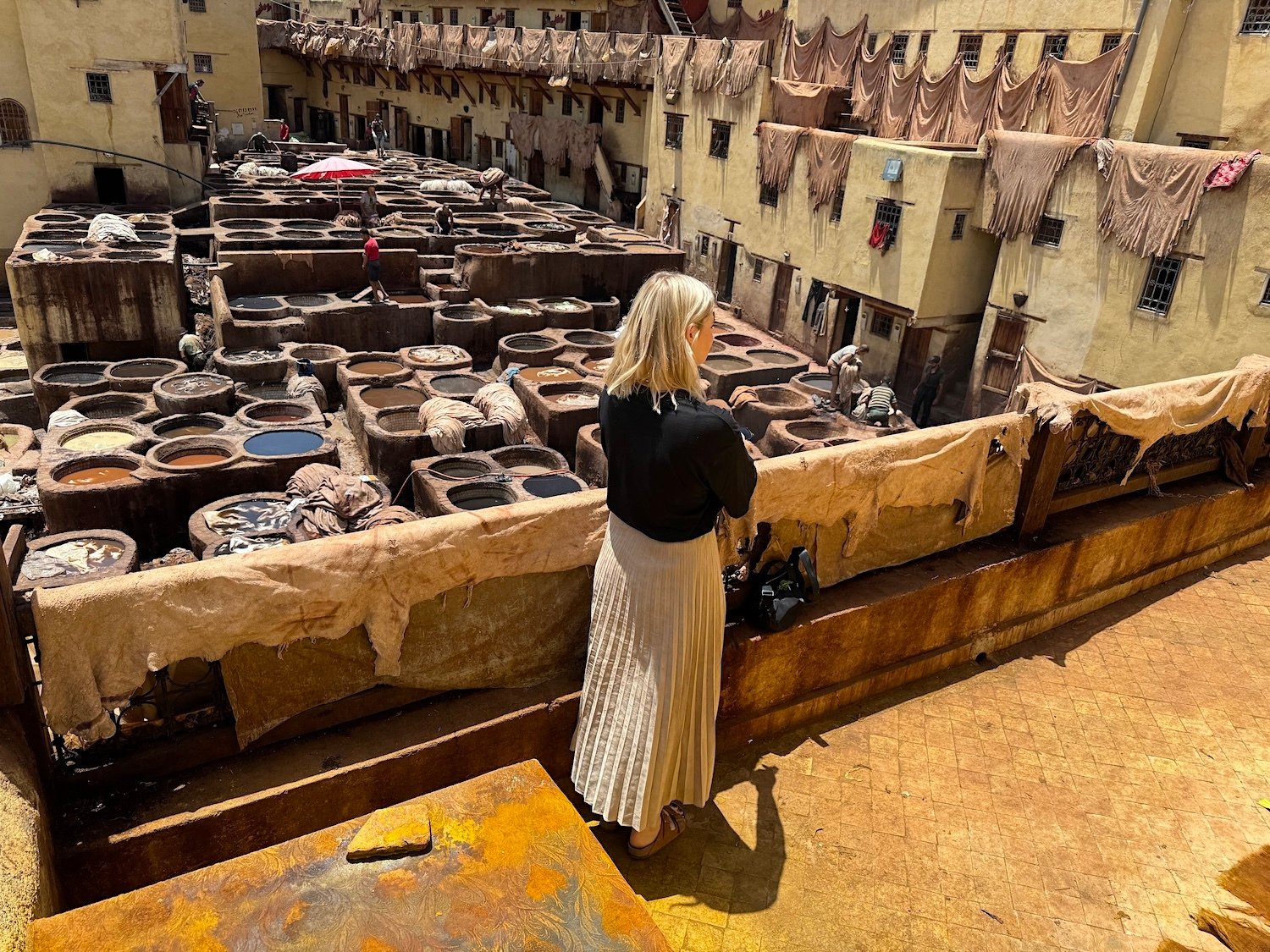
The iconic image and place in Fes Morocco – the historical tanneries. While Chouara is the most famous tannery in Fez, there are also smaller ones like Sidi Moussa and Ain Azliten, which offer a quieter, less crowded experience.
The Chouara Tannery is dating back to the 11th century, it is the largest and oldest tannery in the city and still operates using traditional techniques. Chouara tannery is instantly recognisable by its large stone vats filled with natural dyes and soaking agents used to process animal hides into leather. The process is entirely natural and hasn’t changed for centuries. Animal skins are first soaked in a mixture of water, quicklime, and pigeon droppings—an effective natural source of ammonia. Visiting the tannery is free, but it’s accessed through surrounding leather shops, which offer rooftop terraces overlooking the vats.
Often, a shop worker will greet you at the door, offer a sprig of mint to mask the intense smell, and explain the leather-making process. While there’s no obligation to purchase anything, you can still buy some simple leather wallets or shoes (I love the smell of the authentic leather in my purchased wallet there). You can view the colourful dye vats from the terrace viewpoints above the shops. If you’re brave enough, you can ask one of the workers below to take you down to the dyeing area for more dramatic, close-up photos — but be prepared to tip generously and tolerate the intense smell.
Bab Boujloud (Blue Gate)

Bab Bou Jeloud, originally built in the early 12th century under the Almoravid dynasty, serves as the western entrance to Fes el-Bali. Its distinctive blue and green tilework façade was added in 1913 during the French Protectorate. The gate is a popular meeting point and a practical place to begin exploring the historic medina. After you enter the Bab Bou Jeloud, there are many small cafes and medinas shops. It’s a convenient area to stay because it’s close to the main road, making access easier if you are arriving by taxi or car. The location offers both easy entry to the medina and nearby amenities.
The Anou Cooperative Artisans store


I want to shortly mention this place – The Anou women Artisan cooperative store – Women’s Carpet Workshop, in Fes. It is a fair-trade carpet showroom and workspace run by local Amazigh (Berber) women. It’s part of a wider artisan network that helps preserve traditional Moroccan weaving while ensuring artisans are paid directly and fairly. Visitors can watch the women at work, learn about natural dyes and weaving techniques, and purchase authentic, handmade rugs and other goods (pillow cases, pouffes, etc) with transparent pricing—no pressure or bargaining required. They have their cooperatives all over Morocco; you can even visit them, check their website and book a tour (many in rural areas). Next to the Anou shop, there is the famous cultural Cafe Clock (that also has branches in Marrakech and Chefchouen) – so you can check Anou and maybe purchase something and then have lunch at Cafe Clock.
FES NEW TOWN (Ville Nouvelle)
Most tourists stay in the Fes Medina, while the New Town is less popular for exploring. However, the Ville Nouvelle has many hotels and offers a quieter stay without the hustle of the medina’s narrow streets. From there, you can easily explore the city on your own. Taxis are widely available, making it convenient to travel between the New Town and other areas.
Avenue Hassan II & Colonial Squares


Built during the French Protectorate (from 1912 onward), this broad Avenu Hassan II boulevard is lined with cafés, shops, and mixes Art Deco and neo‑Moorish architecture. Key public spaces include Place de la Résistance, Place Florence, and Place Ahmad El Mansour.
Borj Nord Arms Museum


Housed inside a 16th-century Portuguese-style fortress, the Borj Nord Arms Museum opened in 1963 and displays an extensive collection of Moroccan and medieval weapons. The museum has around 13 rooms featuring 775 military items from a larger collection of 5,000 arms. All the writing and descriptions are in French, Arabic, and English. Located just outside the medina walls, it is accessible by car, taxi, or even walking from the Medina is not too far. The museum is worth visiting not only for its historical exhibits but also for panoramic views of Fes. The entrance fee was about 60 MAD in 2025 (forgot the price after my visit). There is ample parking nearby for visitors. If you enjoy walking, you can return to the medina by passing near the old cemetery, which is not open to non-Muslims.
Marinid Tombs Fes


Currently (2025) Marinid Tombs are closed for renovation. I love this spot for great panoramic views of Fes, and for watching the sunset (free to visit). Located on a hill overlooking Fes medina, the 14th-century Marinid Tombs were built under the Marinid dynasty. These tombs are believed to have housed members of the royal family, although the exact individuals buried here remain unidentified. Today, the structures are mostly ruins, with only partial walls and arches still standing. It is about a 40-minute uphill walk from the Blue Gate (Bab Boujloud) or a short drive with nearby parking. The Marinid Tombs are visible from the Borj Nord Arms Museum. Until renovations are complete, the museum terrace offers panoramic views of Fes.
Royal Palace Gates (Dar el-Makhzen)

Located in the new town, the Royal Palace of Fez, known as Dar el-Makhzen, is not open to the public, but its massive brass doors are a major attraction. The gates, located at Place des Alaouites, feature intricate zellij tilework, carved cedar wood, and polished bronze. Built in the 1960s, they led to a 14th-century palace complex still used by the king during visits to the city. Photos are allowed outside, but no entry is permitted.
Mellah (Jewish district) of Fez
The Mellah of Fes Morocco is the oldest Jewish quarter in Morocco, established in the 15th century. Located near the Royal Palace, it was a walled district where the Jewish community lived under royal protection. The area features distinct Andalusian-style balconies, narrow alleys, and historic synagogues, such as the Ibn Danan Synagogue and the Jewish cemetery of Fes. Though many Jews left in the mid-20th century, the Mellah remains a significant site reflecting centuries of Jewish life in Fes. If you are coming by car, park next to the Royal Palace and then walk around. By the way, remember the word “Mellah”, meaning a Jewish quarter in a Moroccan city, traditionally a walled area where Jewish communities resided. There is also a Mellah (Jewish district) in Marrakech Medina and other cities in Morocco.
Jnan Sbil Gardens

Created in the 18th century and restored in 2011, Jnane Sbil Gardens in Fes cover 7.5 hectares of greenery, fountains, shaded walkways, and traditional water wheels. Inside, you’ll find palm-lined avenues, a central pond, decorative fountains, historic norias (water wheels), and a wide variety of native and exotic plants like bamboo, citrus, and roses. The gardens offer quiet benches, views of the medina’s ramparts, and a peaceful contrast to the city’s bustle. Free entrance, after the walk in the garden, I love to sit down in the nearby Mezzanine restaurant lounge for a glass of wine or beer.
Where to Stay in Fes Morocco


Fez has many traditional riads—Moroccan guesthouses often tucked away inside the medina (old town). Compared to other cities, especially Marrakesh, riads in Fes Morocco are generally much larger and with way more traditional decorations. Expect elaborate tilework, carved plaster, cedarwood ceilings, and dense layers of decoration. For some (including me), the richness of design can feel overwhelming—but it’s part of what makes Fez unique.
The Fez medina is one of the largest in the world, with thousands of narrow alleys and hidden corners. Many Medina streets at night have no light, making them tricky and uncomfortable to navigate. Always double-check the location of your riad before booking. Some are deep inside the medina and challenging to access, especially without GPS. I recommend staying near the Blue Gate or in the Batha area. Both are easier to reach, relatively quiet, and still very central in the Medina. You can also stay in the New Town if you prefer modern hotels and direct road access.


Fes riads: my suggestions
I can recommend a few riads in Fes Morocco Medina. If you like more minimalistic, clean interiors, check the boutique Riad Anata. It is located in the Batha neighbourhood, allowing you to check other riads in the area. Riad Anata can be a good location reference point with a parking space nearby, and everything is easy to access. Nearby, you can check the luxurious, Arabic fairytale-like Riad Sama Fes. It’s a huge riad for a higher budget with a wow interior and traditionally decorated rooms. The elegant Palais de Fès Suites & Spa has an amazing rooftop (you can also go there for a drink/dinner). I also like Riad Laaroussa, Maison Bleue & Spa, and Dar Seffarine. For more budget options, check Medina Social Club (more of a hostel but also has private rooms), Dar Layali Fez, Dar D’or Fes or Dar Al Madina Al Kadima.
Where to Eat in Fes, Morocco


There are many places to eat in Fes, but here are a few suggestions to get you started in the Medina:
popular places
- For lunch or dinner, Café Clock is popular. It has locations in Fes, Chefchaouen, and Marrakech, with a lovely rooftop (as well as many events in the evenings, check their website).
- Another great spot is The Ruined Garden – set up in a garden, popular among tourists (but too touristy for me), so better make a reservation.
- The Fez Café restaurant of Jardin des Biehn is also located in a small garden, as well as a boutique hotel. The restaurant serves even alcohol (difficult to find in Fes Medina). Although the food used to be better for the higher price, I like the garden vibes.
- For great food, check out Fondouk Bazar. I love their menu, a Mix of Lebanese and Moroccan flavours.
- Outside the Medina, in front of the Jebel Gardens, Mezzanine is a lovely rooftop terrace to have a drink (wine/beer even), often with live music, popular among locals and visitors alike. Simple vibes, food is not wow wow, but love the unpretentious vibes and seeing locals (more evenings).
- Berrada_family_restaurant – if you want traditional, not expensive Moroccan food (try beans-lubia), a simple environment. Belongs to a local family, and they might even invite you to their kitchen.
- Les Mystères de Dar Tajine – bit hidden in the Fes Medina, lovely courtyard outside with greenery after the energetic, bustling Medina. Tasty, home-cooked and authentic food. Family-run and very humble and nice people.


Fes restaurants – local vibes
- Chez Rachid – the Rue Talaa Sghira street in Medina has a few similar street restaurants, if Chez Rachid is full, check others. I love the sitting in the street vibes, local cheap food, and must-try chicken pastilla (it’s with sugar powder, so it might sound weird, but must try).
- If you stay in the Batha neighbourhood in Medina (love it for great location), check Batha coffee and food for simple coffee, desert or even breakfast break – love the local vibes and sit there just watching people passing by (Moroccans love this activity). Next to it, Café Al Firdaous, if you want strong coffee and sit with locals (order café Nous-Nous).
- Bisara soup – must try Moroccan soup, not easy to find, often eaten for breakfast. Check the local Soupe marocaine place for the Bisara (in Batha, close to the popular Rue Talaa Sghira). Next to it, check Culture Box – popular among locals as well, a colourful cultural cafe with nice food.
Fes restaurants – upscale options
Day Trips from Fes
Fes is a perfect base to explore northern Morocco’s rich history and culture. Just 40 minutes away by train or car is Meknes, an imperial city known for its grand gates and royal architecture. From Meknes, you can take a short taxi ride to Volubilis, a well-preserved Roman archaeological site dating back to the 3rd century AD. Nearby is Moulay Idriss Zerhoun, a sacred town that until recently did not allow Muslims to stay overnight. It’s a beautiful and authentic village, rich in spiritual history.
On the other side of Fes is Sefrou, about 30 minutes away, famous for its waterfalls, artisan crafts, and the annual Cherry Festival. Close to Sefrou is Bhalil, a charming village known for its unique cave houses and pottery workshops. About 3.5 hours from Fes lies Chefchaouen, the blue city, highly recommended for an overnight stay because of its relaxed atmosphere and stunning mountain views.
Closer to Fes, Vichy Park offers a local spa and wellness experience inspired by French thermal baths—a nice option if you want a quiet day without leaving the city.

MOST COMMON QUESTIONS:
Fes, Morocco is known for its historic medina, one of the world’s largest car-free urban areas and a UNESCO World Heritage site. The city is famous for its centuries-old tanneries, traditional souks, and Islamic architecture, including the Al Quaraouiyine University, the oldest continuously operating university in the world. Fez is also renowned for its artisanal crafts, including leatherwork, ceramics, and metalwork, making it a key cultural and historical destination in Morocco.
Fesis safe for tourists, but standard safety precautions apply. As everywhere in general travelling, be aware of pickpocketing, especially in crowded areas, and hire licensed guides when exploring the medina. Some streets in the Fes medina can be poorly lit at night. While these areas aren’t dangerous, they can feel uncomfortable, and it’s easy to get lost in the maze-like streets without a guide or map.
– Al Quaraouiyine University – world’s oldest continuously operating university
– Chouara Tannery – traditional leather dyeing
– Medersa Bou Inania and Al‑Attarine Madrasas – Islamic architecture and historic madrasa
– Mausoleum of Moulay Idriss II – religious site of Fez’s founder
– Bab Bou Jeloud – iconic blue gate of the Fes medina
– Fez medina – UNESCO World Heritage site
– Traditional Medina souks – crafts, spices, textiles, and pottery
– Nejjarine Museum of Wooden Arts & Crafts
– Dar Batha Museum of Islamic Arts
– Borj Nord Arms Museum
– Royal Palace Gates (Dar el-Makhzen)
– Mellah (Jewish district) of Fez
– Jnan Sbil Gardens
The best time to visit Fes is in spring (April to May) and autumn (September to December) when temperatures are mild and crowds are smaller. Summer (June to August) can be very hot, especially in the medina, while winter (December to February) is cooler, especially at night, and most buildings/hotels doesn’t have heating system.
Fez is better for travellers seeking history, traditional culture, and a less tourist-oriented atmosphere. It has a larger, more authentic medina and is known for artisanal crafts and historic sites. Marrakech offers a mix of tradition and modern tourism, with more nightlife, luxury hotels, and easier transport links. The choice depends on whether you prefer cultural immersion (Fez) or a blend of heritage and modern amenities (Marrakech). Marrakech can offer more activities and day trips around. For Fes, max two days is enough.
Yes, you can drink alcohol in Fez, but it is not widely available as in Marrakech. Licensed bars, restaurants, hotels, and some shops sell it, often discreetly. Drinking in public is not allowed, and alcohol consumption is generally done in private or in licensed venues. In Fes Medina, there are few restaurants that sells alcohol, and to buy you need to go to the new town, check Carefour supermarkets.
The train from Marrakech to Fez takes about 6.5 to 7.5 hours, depending on the service and connections. Check https://www.oncf-voyages.ma/ for tickets and timetables. You can also take train to Fez from Rabat or Casablanca.
Yes. Popular day trips from Fez include:
Meknes – historic city and UNESCO site (1 hour)
Volubilis – ancient Roman ruins (1.5 hours)
Chefchaouen – blue-painted mountain town (4 hours)
Middle Atlas Mountains – Ifrane, Azrou, and cedar forests (1–2 hours)
Sefrou – traditional town known for waterfalls and cherry festival (45 minutes)
