


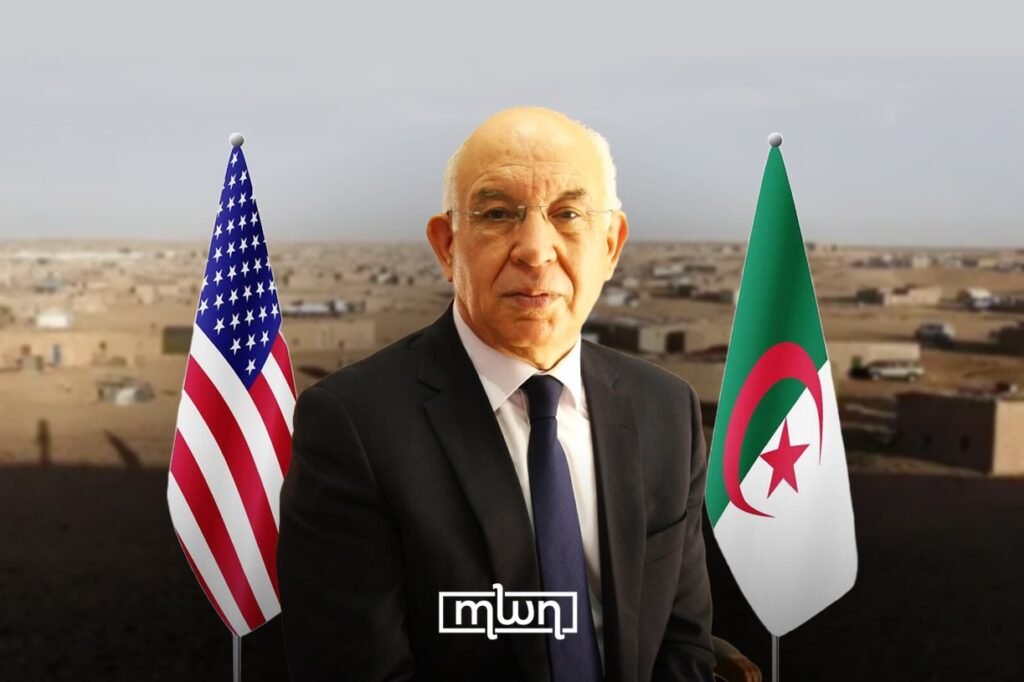
Tantan – An unusual voice has broken Algeria’s official silence on recent developments surrounding the Western Sahara conflict. Abdelaziz Rahabi, a former minister of communication and influential diplomat, has publicly criticized what he describes as a coordinated American strategy targeting both Algeria and the Polisario Front.
In a detailed Facebook post, Rahabi reacted to the “Polisario Front Terrorist Designation Act,” a bill Ted Cruz, Tom Cotton, and Rick Scott recently introduced in the US Senate. Congressman Joe Wilson had put forward a similar proposal in 2025.
Rahabi argues that these initiatives are part of a long-standing Republican effort to associate the Polisario with Iran and present it as a terrorist group. According to him, such a move would not only target the Polisario but also risk labeling Algeria as a state that supports terrorism. He warns that this approach aims to strip the Western Sahara issue of its diplomatic nature and recategorize it as a regional security threat.
The Polisario Front Terrorist Designation Act of 2026 would require the Secretary of State to designate the Polisario Front as a terrorist organization if it is found to be cooperating with Iranian-linked terrorist groups. The bill aims to cut the Polisario Front off from international financial systems, restrict travel, and allow the US to hold its leaders accountable for any involvement in terrorism.
“The Polisario Front’s ties to adversaries like Communist China, Iran, and Russia, and its cooperation with Iranian-backed terrorists like Hezbollah must be confronted,” Senator Scott said.
The former Algerian minister also criticizes what he calls “transactional diplomacy,” claiming that US lawmakers are responding to pressure from various lobbying groups, particularly under the current political climate prevailing under Donald Trump. He claimed these efforts are designed to weaken Algeria, which he says remains committed to the principle of self-determination, and to force the Polisario into concessions.
Rahabi links this pressure to recent US-backed discussions in Madrid and Washington, describing them as creating “cautious hope” while also serving as tools to push for a quick agreement. He insists that the timing and coordination of these legislative moves show they are deliberate attempts by Washington to accelerate a resolution to the conflict.
However, while Rahabi presents these developments as external pressure, they also highlight a shifting reality. The United States is no longer treating the Western Sahara dossier as a purely diplomatic issue. By raising security concerns and increasing political pressure, Washington appears to be reshaping the framework of the conflict.
Algeria sticking to old line
At the same time, Algeria’s official silence is striking. Despite being directly concerned, Algiers has not issued a clear response to these initiatives or to its participation in recent talks. The country has long sought to present itself as not being a direct party to the conflict, despite hosting and arming the Polisario Front.
This silence contrasts with Rahabi’s outspoken stance, which many observers see as reflecting broader concerns within Algerian decision-making circles.
Importantly, Rahabi’s claim that terrorist designations fall solely under the authority of the US State Department is only partially accurate. While the executive branch holds the formal power, Congress plays a key role in influencing such decisions through legislative proposals and political pressure.
This moment shows a growing gap between international dynamics and Algeria’s traditional, outdated position. While Washington is pushing to revive negotiations and possibly secure a faster outcome, Algeria appears to be holding firmly to its long-standing approach and showing little sign of flexibility.
In that sense, Rahabi’s remarks are both a warning and a signal, because they underline rising pressure from the United States, but also expose the limits of Algeria’s current strategy.
But the Western Sahara issue becomes increasingly tied to broader geopolitical tensions, maintaining the same posture may prove more difficult. The dossier is no longer evolving only within the traditional UN framework, but is now influenced by shifting alliances, security narratives, and renewed diplomatic engagement led by Washington.
Recent developments point to growing international momentum around Morocco’s position. The latest resolution the UN Security Council adopted on Western Sahara continues to reaffirm the need for a “realistic, pragmatic, and lasting political solution,” aligning with Morocco’s autonomy initiative.
Shift towards pragmatic solutions
The resolution also reiterates the importance of the roundtable process, which includes not only Morocco and the Polisario Front, but also Algeria and Mauritania, which further reinforces the view that Algiers is a key stakeholder in the process.
At the same time, several major international actors have continued to express support for Morocco’s autonomy plan, describing it as a credible and serious basis for a solution. This diplomatic backing, combined with ongoing investments and development efforts in the southern provinces, has strengthened Rabat’s position on the ground and internationally.
In the meantime, while actively encouraging a political process under UN auspices, the US has maintained its recognition of Morocco’s sovereignty over Western Sahara.
By contrast, Algeria’s stance has remained largely unchanged. While it continues to emphasize the principle of self-determination, Algiers has shown limited public willingness to engage in a more flexible or proactive diplomatic approach. This comes at a time when the international environment appears to be shifting toward compromise-based solutions rather than prolonged stalemate.
In his speech following the UN resolution, King Mohammed VI urged against perceiving or treating these positive steps as a victory for any one party. Rather, the monarch insisted, they are part of a collective effort to reach a solution “where there are no winners or losers,” emphasizing dignity for all involved and reinforcing Morocco’s commitment to a pragmatic, peaceful resolution of the dispute.