


Beni Mellal – A major policy report published this month by CIDOB, the Barcelona Centre for International Affairs – one of Spain’s most influential foreign policy think tanks – does not introduce new hypotheses or bring anything novel to the table.
Instead, it formally acknowledges and consolidates an already operative reality: that Algeria now finds itself in its weakest diplomatic position in decades on the Western Sahara file, while Morocco has entrenched its status as an indispensable strategic partner for both the United States and Europe in North Africa.
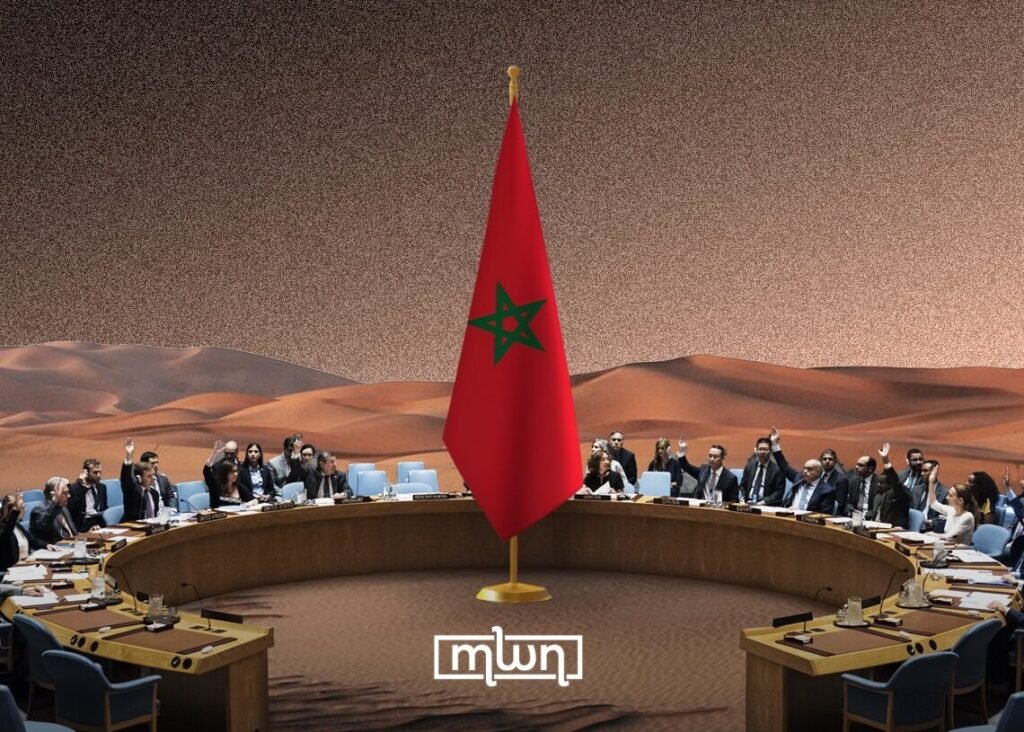
This assessment is anchored in UN Security Council Resolution 2797, which the report treats not as a tentative diplomatic gesture but as a structural inflection point in the conflict’s international handling. Since its adoption on October 31, 2025, says the report, Resolution 2797 has decisively reordered alignments, responsibilities, and leverage across the region.
The report, authored by David Alvarado, a journalist and political scientist at the University of Vigo, offers a granular analysis of the resolution’s language, the geopolitical forces that produced it, and the rapidly narrowing options facing both Algeria and the Polisario Front.
Its central finding is that Resolution 2797 marks the first time in decades that a Security Council text has explicitly stated that “genuine autonomy under Moroccan sovereignty could constitute the most viable solution” to the territorial dispute, abandoning the studied neutrality that had characterized every previous iteration.
The resolution passed with eleven votes in favor, zero against, and three abstentions – Russia, China, and Pakistan. Algeria, then a non-permanent member of the Council, chose not to participate in the vote at all, denouncing the text as a departure from UN “decolonization principles.”
Rabat understandably celebrated the outcome as a “historic victory,” with King Mohammed VI addressing the nation minutes after the vote to declare that “there will be a before and after October 31,” Alvarado recalls in his analysis. By contrast, the Polisario Front rejected the resolution categorically, warning that the closure of political avenues could reactivate armed confrontation suspended since September 6, 1991.
Washington chose its North African anchor
Alvarado’s report traces the resolution’s genesis directly to the Abraham Accords framework. When Morocco joined the normalization process with Israel on December 10, 2020, it secured in return Washington’s recognition of Moroccan sovereignty over Western Sahara – breaking with a longstanding American position that had always endorsed a UN-supervised “self-determination referendum.”
He argues that the Accords were never conceived as a standalone diplomatic gesture, but as part of a wider geopolitical architecture aimed at assembling an informal strategic bloc linking Israel, the Gulf monarchies, and select North African states to contain and counter Iranian influence across the region.
Within this framework, the report identifies Morocco as a central pillar of the arrangement, citing its strategic geography, the durability of its monarchy, and its unique capacity to function as a connective hinge between Europe, Sub-Saharan Africa, and the wider Arab world.
As Alvarado sees it, the normalization with Israel has produced concrete and measurable results. Israeli Defense Minister Benny Gantz conducted the first official visit by an Israeli defense official to Morocco on November 24, 2021, signing a memorandum of understanding on security and intelligence cooperation – the first such agreement between Israel and any Arab country.
Israel has since become Morocco’s third-largest arms supplier, accounting for approximately 11% of Rabat’s military imports between 2020 and 2024, according to SIPRI data cited in the report.
Contracts include Barak MX air defense systems worth $500 million, a $1 billion agreement for two Ofek 13 reconnaissance satellites, and the inauguration in November 2025 of Africa’s first loitering munitions factory in Benslimane, built by Israel’s BlueBird Aero Systems.
Even allies have price limits
Perhaps the report’s most consequential finding concerns the abstentions of Russia and China, which Alvarado characterizes as the single most revealing element of the vote. Long regarded as Algeria’s protective anchors within the Security Council, Moscow and Beijing deliberately refrained from exercising their veto power against a resolution that consolidates Morocco’s position.
Russia’s permanent UN representative, Vasily Nebenzya, publicly justified the abstention by citing a drafting process that allegedly “lacked transparency.” Yet, as Alvarado indicates, the strategic signal was unmistakable.
Neither Russia nor China deemed the Western Sahara file sufficiently vital to warrant a direct confrontation with Washington. The episode thus exposes the hard ceiling of Algeria’s diplomatic backing, revealing that when its claims collide with broader great-power calculations, even its most reliable patrons are unwilling to pay the geopolitical cost.
The report reconstructs the diplomatic maneuvering that preceded the vote. Morocco’s Foreign Minister Nasser Bourita made an urgent visit to Moscow on October 16, 2025 – just two weeks before the vote – to secure assurances that Russia would not use its veto.
During a joint press conference, Bourita and Sergei Lavrov avoided explicit references to Western Sahara, with Lavrov offering only the coded diplomatic observation that principles of international law should not be interpreted selectively – language Alvarado interprets as signaling that Moscow would not block the text but would not openly endorse it either.
The Franco-American axis behind the resolution receives extensive treatment. The United States led the drafting as the “penholder” on the Sahara dossier, with active French backing. Paris had already shifted decisively toward Rabat in the summer of 2024, following Spain’s own pivot in March 2022 when Prime Minister Pedro Sánchez communicated to Morocco his backing for the autonomy plan as “the most serious, realistic, and credible” proposal.
During the Security Council negotiations, French diplomacy overcame the initial reluctance of three European members – Greece, Slovenia, and Denmark – with President Emmanuel Macron personally intervening during an official visit to Ljubljana to overcome Slovenian objections.
The EU-Morocco Association Council of January 29, the first since 2019, then formalized the backing of all 27 member states for the autonomy plan as a basis for negotiations.
Every option costs Algeria more
The report is unsparing in its assessment of Algeria’s predicament. Alvarado argues that the resolution has pushed Algiers into its weakest strategic position in decades, with France, Spain, the United States, and now the European Union coalescing around Morocco’s autonomy framework, while Russia and China have signaled a clear unwillingness to expend political capital in defense of Algeria’s position.
Algeria’s options, the report concludes, are limited and carry high costs. Leveraging energy pressure against Europe has lost much of its effectiveness since European states diversified gas supplies in the wake of Russia’s invasion of Ukraine. Escalating military support for the Polisario risks provoking an armed conflict that could spiral into direct confrontation with Morocco. Pursuing closer alignment with Iran, meanwhile, would further isolate Algeria from Western partners without offering any credible guarantee of strategic or economic return.
Meanwhile, the Maghreb arms race has reached historic levels. Algeria increased its military spending by 12% in 2024, reaching $21.8 billion – equivalent to 21% of its total public budget, the highest proportion on the African continent according to SIPRI. Morocco’s spending reached $5.5 billion. Together, the two countries account for 90% of North African military expenditure at a combined $30.2 billion.
Alvarado’s report was published ahead of the first round of discussions on the Western Sahara issue, held on February 8 and 9 at the headquarters of the US Embassy in Madrid, under the auspices of the administration of President Donald Trump.
It delineates three forward-looking scenarios for the trajectory of the conflict. The most probable is a prolonged strategic stasis that overwhelmingly favors Rabat: Morocco deepens its territorial consolidation through sustained investment, infrastructure expansion, and the entrenchment of irreversible facts on the ground, while Algeria incrementally scales back its material and political backing of the Polisario.
A second scenario, assessed as less likely but not negligible, envisages localized military escalation driven by radicalized factions within the Polisario, raising the risk of instability without altering the underlying balance of power.
The third scenario projects a US-brokered political settlement, in which negotiations culminate in an agreement that formalizes Moroccan sovereignty while offering symbolic and circumscribed concessions in local governance and political representation for the Sahrawi population.
Alvarado’s concluding assessment situates Western Sahara as a defining case of the post-Cold War era: the first territorial dispute resolved not through genuine multilateral negotiations anchored in international law, but through its absorption into a regional security architecture in which juridical principles are subordinated to strategic expediency.
This, he cautions, sets a consequential precedent that may shape the resolution of protracted conflicts in an international order increasingly governed by power balances, alliance structures, and rival containment rather than normative legal frameworks.
Such a reading will be sharply contested by Moroccan analysts, who can argue that Alvarado’s framing inverts reality: the resolution did not subordinate international law to strategic convenience – it corrected a five-decade anomaly in which a Cold War-era decolonization framework was kept artificially alive long after its political and demographic premises had collapsed.
Still, both Alvarado and his Moroccan critics will at least agree on his analysis’s overarching conclusion: that recent developments in the Sahara dossier, from the US recognition in December 2020 to the adoption of Resolution 2797, have fundamentally settled the debate in Rabat’s favor.