


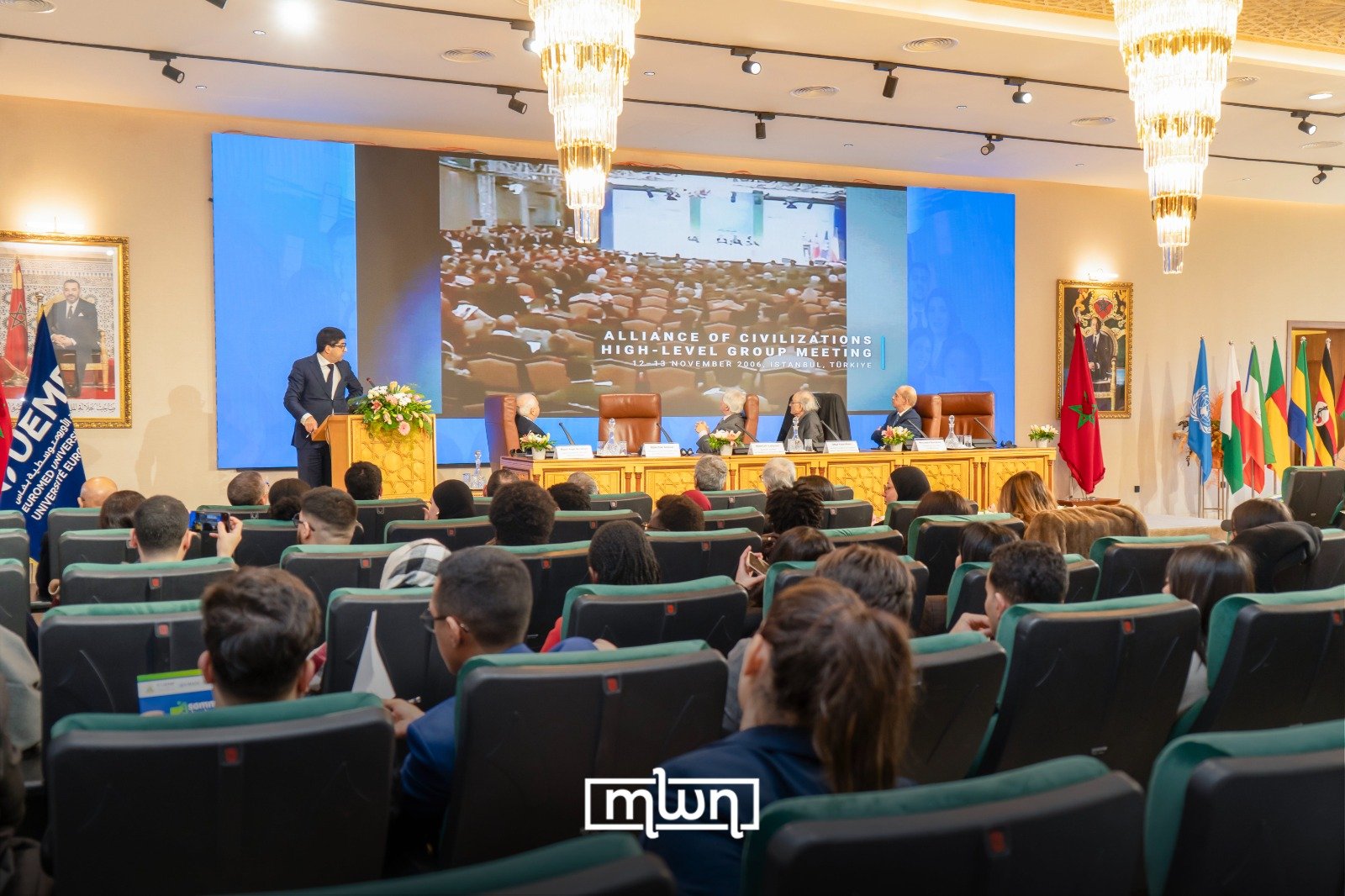
Rabat – Young leaders from Africa and the Euro-Mediterranean region gathered today in Rabat for the African and Euro-Mediterranean Youth Summit of Euromed University of Fez, an event focused on dialogue, civic responsibility, and peaceful coexistence in a rapidly changing world.
The summit, held at the Royal Academy of Morocco, was organized under the theme “Civism and Pluralism of Values: Rethinking Living Together.” It brought together students, academics, United Nations officials, and institutional leaders to reflect on how young people can play a central role in building more inclusive and peaceful societies.
The day began with opening statements from leading figures, including Abdeljalil Lahjomri, Permanent Secretary of the Moroccan Royal Academy, and Omar Fassi Fihri, Permanent Secretary of the Hassan II Academy of Science and Technology. They emphasized the importance of civism, pluralism, and youth engagement in shaping a harmonious and responsible society in an era of rapid social and technological change.
Youth at the center of global challenges
One of the keynote speakers was Miguel Angel Moratinos, High Representative of the United Nations Alliance of Civilizations (UNAOC). He stated that the timing of the summit could not be more important, given the instability and uncertainty facing the world today.
“I think this third summit of students from Africa and the Euro-Mediterranean Partnership is extremely timely and extremely important. We are going through very serious challenges. We don’t know what the next announcement, the next movement, the next war, or the next conflict will be,” Moratinos told MWN.
Moratinos stated that students are not only observers of global change, but future decision-makers who must be prepared to take responsibility. “The students are the ones who are going to lead the world in a very close future,” he said. “It’s important that they know where we are and how we can work together.”
He also warned that humanity is facing what he described as “existential threats,” including wars and the misuse of artificial intelligence. According to him, the convergence of violent conflicts and unregulated technological development could deeply affect future international relations.
“The Alliance of Civilizations works to create platforms where people share the same principle values,” Moratinos said, pointing to peace, pluralism, and respect for diversity as essential priorities.
Morocco as a model of civic development
Mostapha Bousmina, President of Euromed University of Fez, spoke about Morocco’s development path and the role of youth in shaping the country’s future. “Morocco, without gas and without oil, has made tremendous development in various sectors,” Bousmina told MWN. He pointed to the country’s leadership in automotive manufacturing, aeronautics, renewable energy, agriculture, and tourism.
However, Bousmina stressed that economic progress alone is not enough. “Today, the youth propose a new plan,” he said. “A Morocco civic plan, so that we can build a common future by respecting others, our common space, and our shared values.”
He added that the recommendations made during the summit would be conveyed to decision-makers and stakeholders, underlining the importance of youth voices in shaping public policy. The event will conclude in a declaration that highlights the principles of civism, pluralism, and responsible citizenship, providing a roadmap for building a more inclusive and cohesive society.
Meanwhile, Abdelhak Azzouzi, President of the United Nations Chair for the Alliance of Civilizations and a member of the Euromed University of Fez Board of Directors, described the summit as a unique initiative on a global scale. “This Chair is the only one of its kind in the world,” Azzouzi told MWN. “It is based at the Euromed University of Fez and works closely with the United Nations.”
He explained that the Chair plays an important role in organizing international events, producing strategic reports, and contributing to academic reflection on coexistence and dialogue. What made this summit special, he added, was that it was organized by young people and for young people, with participants from 40 nationalities across Africa and the Mediterranean basin.
Azzouzi also hailed Moratinos’ opening speech, describing it as a strong roadmap for living together in today’s complex world.
Civism, science, and technology
During the opening session, Omar Fassi Fihri addressed the relationship between civism, pluralism of values, and scientific progress. He described civism not simply as following rules, but as an attitude based on responsibility, dialogue, and solidarity.
“To be civic means respecting the law, but also respecting others … Individual freedom only has meaning when it respects the freedom of others,” Fassi Fihri said.
He explained that pluralism allows different beliefs and traditions to coexist within the same society and enrich collective life rather than weakening it. He also raised important questions about how science and technology, especially digital tools, can be used to support civic values rather than undermine them.
“Science and technology are tools. They are neither good nor bad in themselves. Everything depends on how we use them,” he said.
Dialogue across generations
In his remarks, Abdeljalil Lahjomri spoke about the importance of youth participation in dialogue, especially at a time when young people are highly exposed to conflict and division in schools, universities, and online spaces.
“Youth participation brings vitality and realism to dialogue,” Lahjomri said. “Dialogue that does not engage generations remains limited in its impact.”
He expressed hope that the summit would serve as a lasting academic platform for exchanging ideas and developing practical solutions to strengthen trust, openness, and social cohesion.
Students played a central role throughout the day as they shared personal experiences and ideas during various sessions. Safa Tidjani, a student at Euromed University of Fez and a speaker at the summit, focused on civism as both heritage and responsibility.
“Morocco has a very strong heritage when it comes to living together,” Tidjani told MWN. She recalled the country’s long history of coexistence between different religions and cultures, describing it as a lived reality rather than folklore.
“It’s not just something we talk about,” she said.. “It’s a responsibility we live by.”
Throughout the day, sessions explored topics such as civic behavior, cultural diversity, digital responsibility, and peaceful coexistence. The discussions reflected a shared belief that living together in diversity is not automatic, but a goal that requires effort, dialogue, and commitment.
