


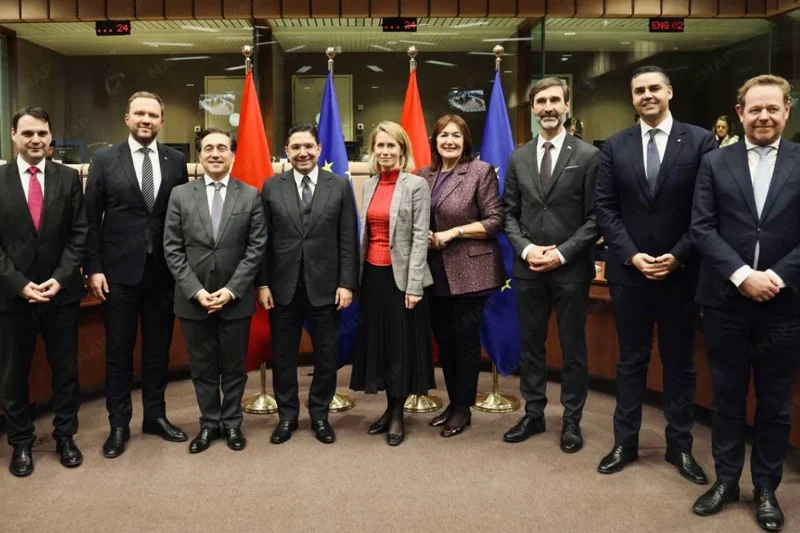
Marrakech – The European Union officially adopted a unified position supporting Morocco’s autonomy plan for Western Sahara during the 15th EU-Morocco Association Council session concluded Thursday in Brussels.
The 27 EU member states agreed that “genuine autonomy could represent one of the most realistic solutions” for the definitive settlement of the artificial dispute.
Foreign Affairs Minister Nasser Bourita and EU High Representative Kaja Kallas signed a joint communiqué formalizing this breakthrough stance, widely seen as another victory for Rabat’s diplomacy.
The regional bloc endorsed the UN Security Council’s call for “all parties to participate in discussions without preconditions and based on the autonomy plan proposed by Morocco to reach a definitive political solution.”
The EU welcomed Morocco’s commitment “to engage in good faith with all concerned parties to clarify the modalities of this autonomy plan and explain how autonomy within the framework of Moroccan sovereignty would be implemented.”
This marks a decisive rupture with earlier European postures on the territory. Most bloc countries have moved beyond calculated ambiguity, discarding outdated neutrality to affirm clear political support for Morocco’s sovereignty over Western Sahara – effectively sidelining Polisario Front’s ambitions, which are increasingly viewed as obsolete, unrepresentative, and diplomatically exhausted on the international stage.
Spain set the inflection point in March 2022, followed by France in July 2024, establishing decisive precedents that reshaped the EU’s collective posture and consigned separatist pretensions to the margins of diplomatic relevance.
The joint statement celebrated “the adoption of Resolution 2797 (2025) by the UN Security Council (UNSC), which fully supports the efforts made by the Secretary-General and his Personal Envoy to facilitate and conduct negotiations based on the autonomy plan proposed by Morocco.”
The resolution was adopted on October 31, 2025, marking a decisive diplomatic win for Morocco by reaffirming the primacy of the autonomy initiative, consolidating international backing for Rabat’s approach, and further narrowing the political space for separatist narratives at the multilateral level.
In his August 20, 2022, speech, King Mohammed VI declared that the Sahara dossier is the “prism through which Morocco views its international environment” and the “simple, clear measure for the sincerity of friendships” with partners. This royal guidance has shaped Morocco’s diplomatic strategy in consolidating international consensus.
The EU reaffirmed its readiness “to provide assistance to facilitate consultations between parties within the UN framework and support the efforts of the Personal Envoy of the Secretary-General.” European officials pledged their commitment to advancing negotiations based on the superior Moroccan autonomy proposal.
EU recognizes Morocco’s ‘constructive and visionary role’
The joint declaration illuminated the partnership’s extraordinary strength, noting Morocco remains “the main beneficiary of EU financing in North Africa,” receiving approximately €270 million annually during 2021-2024 through bilateral allocations and European Fund for Sustainable Development investments.
Addressing Middle East developments, both parties welcomed “the adoption of resolution 2803 (2025) by the UN Security Council” and reaffirmed their attachment to “comprehensive, just and lasting peace, based on the two-state solution, in accordance with relevant UN Security Council resolutions.”
They demanded protection for Gaza civilians and “rapid, safe and unhindered delivery of large-scale humanitarian aid.” The statement praised “the work of the Al Quds Committee, chaired by His Majesty King Mohammed VI, in favor of lasting peace and stability in the Middle East.”
On Ukraine, the EU and Morocco condemned Russia’s territorial integrity violation and stressed “the need to reach, as soon as possible, comprehensive, just and lasting peace in Ukraine, in accordance with the principles of the UN Charter and international law.”
Beyond Western Sahara discussions, the Association Council tackled regional security challenges. Both parties expressed unwavering commitment to “promoting stability, security and prosperity in the Sahel region, particularly through coordination of diplomatic efforts.”
The discussions examined regional cooperation initiatives, particularly the Atlantic African States Initiative launched by the Moroccan monarch in 2022.
This strategic framework brings together 23 Atlantic-bordering African countries to structure the African Atlantic zone as a dialogue and cooperation space promoting stability and co-development while enhancing regional economic integration.
The meeting occurred as the EU-Morocco partnership approaches its 30th anniversary, with officials celebrating “more than half a century of cooperation and mutual trust.”
In this regard, the recalibrated European alignment on the Sahara is expected to act as a structural catalyst for deeper bilateral alignment, accelerating the institutionalization of a strategic partnership through enhanced policy coherence, mutual trust, and long-term interest convergence.
European officials lavishly thanked Morocco’s “constructive and visionary role” in regional cooperation initiatives, specifically pointing out Rabat’s hosting of the high-level retreat on Euro-Mediterranean relations’ future on September 11, 2025.
This diplomatic engagement contributed to enriching the Mediterranean Pact launched in Barcelona on November 28, 2025.
Read also: Bourita Expresses Confidence in Morocco-EU Partnership at Brussels Council