


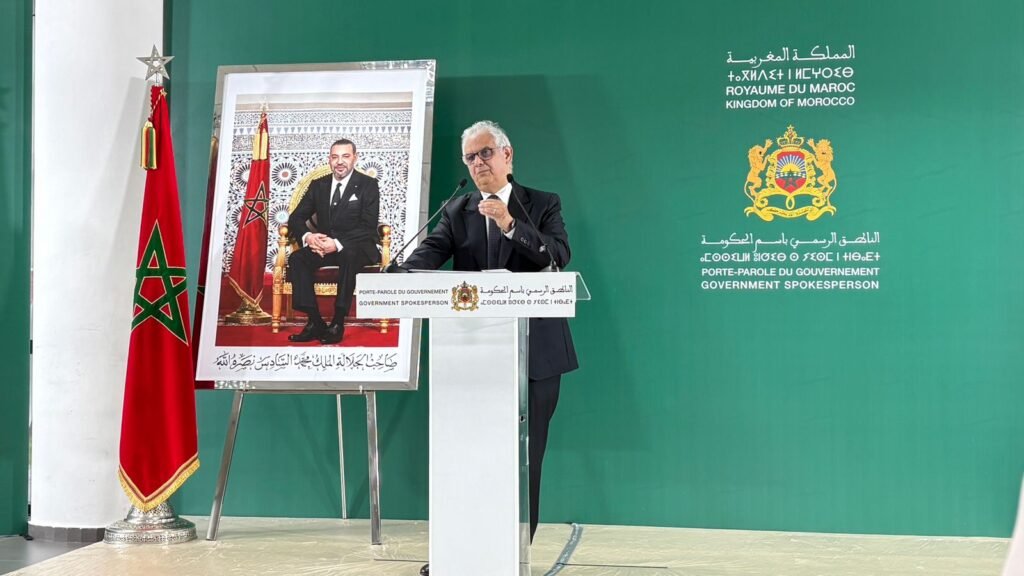
Marrakech – Equipment and Water Minister Nizar Baraka defended his ministry’s technical communication approach during recent flooding while announcing that national dam reserves have reached 69.4% capacity, securing water supply for years ahead.
Speaking at Wednesday’s weekly government press briefing, Baraka addressed criticism over limited communication during floods that affected several regions. “Our ministry was fully mobilized during these episodes, and all officials communicated extensively,” he stated.
The minister stressed that the situation required experts to take the lead, insulating the issue from political interpretation in order to deliver information that is credible, rigorous, and objectively grounded.
He defended his ministry’s communication approach: “Information is transmitted by experts to avoid political interpretation and properly inform citizens.”
The rainfall data reveals the exceptional nature of recent weather events. Since September, average precipitation reached 150 millimeters, marking a 35% increase compared to averages recorded since the 1990s. Compared to last year, quantities tripled, far exceeding normal thresholds.
Snow coverage initially reached a record 55,495 square kilometers before reducing to 23,186 square kilometers today. The snow blanket maintained coverage above 20,000 square kilometers throughout the period, with thickness varying between one and two meters, contributing to dam reserves through snowmelt.
These exceptional episodes directly impacted water reserves. From September 1 to today, 12.17 billion cubic meters entered the dams, including 11.7 billion since December 12 – more than annual inflows from several recent seasons in less than two months.
For comparison: 4.8 billion in 2018, 3.3 billion in 2019-2020, and only 1.9 billion in 2021-2022. The combined inflows of seasons 2023-2024 and 2024-2025 totaled 9.8 billion cubic meters over a full year.
From January 28 to today alone, 6.5 billion additional cubic meters were added, surpassing last year’s total inflows in just fifteen days, Baraka explained.
The national dam filling rate now reaches 69.4%, storing 11.6 billion cubic meters. Eight strategic basins exceed 45%: Loukkos 93%, Sebou 91%, Oum Er-Rbia 92%, Moulouya 57%, Tensift 82%, Souss-Massa 45%, Guir Ziz Rheris 59%, and Draa-Oued Noun 33%.
These levels represent gains equivalent to one to three years of drinking water for certain regions. Thirty-one dams exceeded 80% capacity, while 11 reached 100% and required overflow management.
The Loukkos basin received 1.062 billion cubic meters this year, with 1.031 billion entering in just fifteen days. Despite partial drainage operations, current storage remains at 1.017 billion cubic meters, with daily inflows exceeding annual discharge capacity at some periods.
The Oued El Makhazine dam faced maximum pressure with its 1.672 billion cubic meter capacity. It received 1.462 billion cubic meters since rainfall began, including 1.031 billion over the last fifteen days.
Some days recorded over 130 million cubic meters, with nearly 900 million over five days. Anticipated releases with flows reaching 800 cubic meters per second protected downstream populations while maintaining structural safety.
Operations relied on continuous monitoring and crossed hydrological models, simulating sub-basin inflows and identifying risk zones. Vulnerability maps were transmitted to local authorities, enabling preventive evacuations, such as those at Ksar El Kebir, to be decided 48 hours before peak flooding.
Baraka reaffirmed that dam priorities remain citizen protection, followed by drinking water and irrigation storage, then hydroelectric production.
Regarding infrastructure, 168 road sections suffered damage, with 124 reopened to traffic and 44 remaining affected. Disruptions resulted mainly from rising water levels, landslides, and soil movement.
Morocco has been experiencing a severe, consecutive seven-year drought cycle that began around 2018. This prolonged period of low rainfall was characterized by significant drops in dam water levels, with particularly acute shortages affecting agricultural irrigation and urban supply from 2021 onwards.
The current reserves guarantee a drinking water supply for at least two years, ranging from one to three years depending on regions, with the season incomplete and snowmelt continuing.