


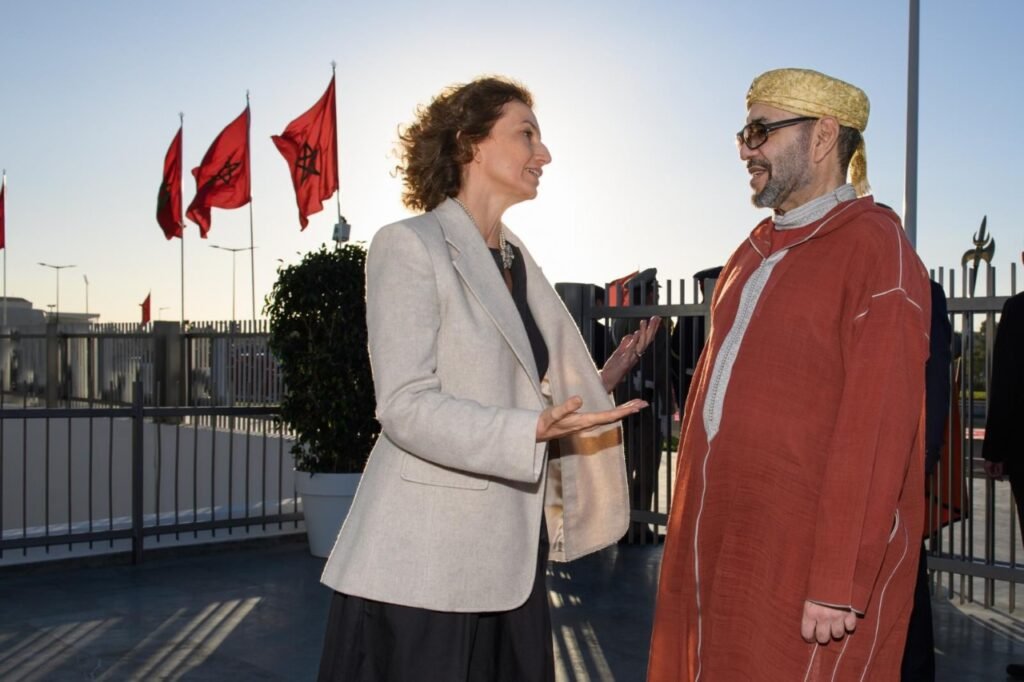
Beni Mellal – Following the resignation of Jack Lang amid his ties to the expanding Epstein affair, Audrey Azoulay has emerged as the leading contender to assume the presidency of the Arab World Institute (IMA), with the board of directors expected to name Lang’s successor on Tuesday.
Azoulay brings a rare blend of cultural authority, diplomatic stature, and Arab-world connectivity to the role. Born in 1972 in La Celle-Saint-Cloud to a Moroccan Jewish family from Essaouira, she is the daughter of André Azoulay, a longtime advisor to kings Hassan II and Mohammed VI whose three-decade tenure at the Moroccan royal palace has anchored extensive networks across the Arab world.
That background has long positioned Azoulay at the intersection of French, Arab, and Mediterranean cultural spheres.
Her professional trajectory reflects this dual orientation. A graduate of Sciences Po and the École nationale d’administration (ENA), Azoulay held senior roles at France’s National Cinema Center before becoming culture advisor to President François Hollande in 2014.
She later served as France’s Minister of Culture from 2016 to 2017, before being elected Director-General of UNESCO, a post she held until November 2025.
During her tenure at UNESCO, Azoulay prioritized heritage protection in conflict zones, spearheading the reconstruction of Mosul, coordinating global educational responses during the COVID-19 pandemic, and strengthening the organization’s financial footing.
She also worked to depoliticize highly sensitive cultural heritage disputes in the Middle East – an experience closely aligned with the IMA’s mission.
Despite these credentials, her candidacy has not escaped scrutiny. Azoulay’s name appears in recently declassified Epstein documents, though solely in reference to a 2017 press article covering her UNESCO election that noted her Jewish background and familiarity with Israel.
While the reference is indirect and peripheral, critics argue it could complicate her appointment at a moment when the institute is seeking reputational repair.
A flagship of French cultural diplomacy
Other names have circulated, including former Foreign Minister Jean-Yves Le Drian and former Culture Minister Rima Abdul-Malak. Le Drian’s entourage indicated today that he intends to remain focused on his role as President Macron’s envoy to Lebanon.
To date, only Karim Amellal, a former interministerial delegate for the Mediterranean, has formally declared his candidacy.
The decision comes amid intensifying legal scrutiny surrounding Lang’s departure. French authorities conducted searches at IMA headquarters today as part of a money-laundering investigation linked to Lang and his daughter, Caroline, following revelations about an offshore company reportedly established with Jeffrey Epstein in 2016.
The National Financial Prosecutor’s Office opened the probe after Lang’s name appeared 673 times in newly released Epstein documents. Lang has denied any wrongdoing, describing the allegations as “a tsunami of lies” and maintaining that his involvement was limited to supporting a proposed fund for young artists.
The IMA’s 14-member board, split evenly between Arab ambassadors and French government appointees, will vote on whether to appoint a full-term president or an interim leader. The French Foreign Ministry – responsible for half of the institute’s €25 million annual budget – oversees the process.
The Arab World Institute, known primarily by its French name l’Institut du monde arabe (IMA), stands as one of France’s most prestigious cultural institutions.
Founded in 1987 through an agreement between France and 22 Arab countries, the Paris-based organization promotes dialogue between Arab and Western cultures through exhibitions, conferences, and educational programs.
With its distinctive glass and metal architecture designed by Jean Nouvel, the institute houses a museum, library, and cultural center that attracts hundreds of thousands of visitors annually.
For Azoulay, the appointment would mark a return to high-level cultural diplomacy after nearly a decade on the global stage. Her multilingualism, Moroccan heritage, and experience navigating sensitive geopolitical terrain position her as a potential bridge between France and the Arab world.
Yet the lingering shadow of the Epstein affair may weigh heavily on deliberations as the board seeks to stabilize the institute and restore credibility ahead of its 40th anniversary next year.