


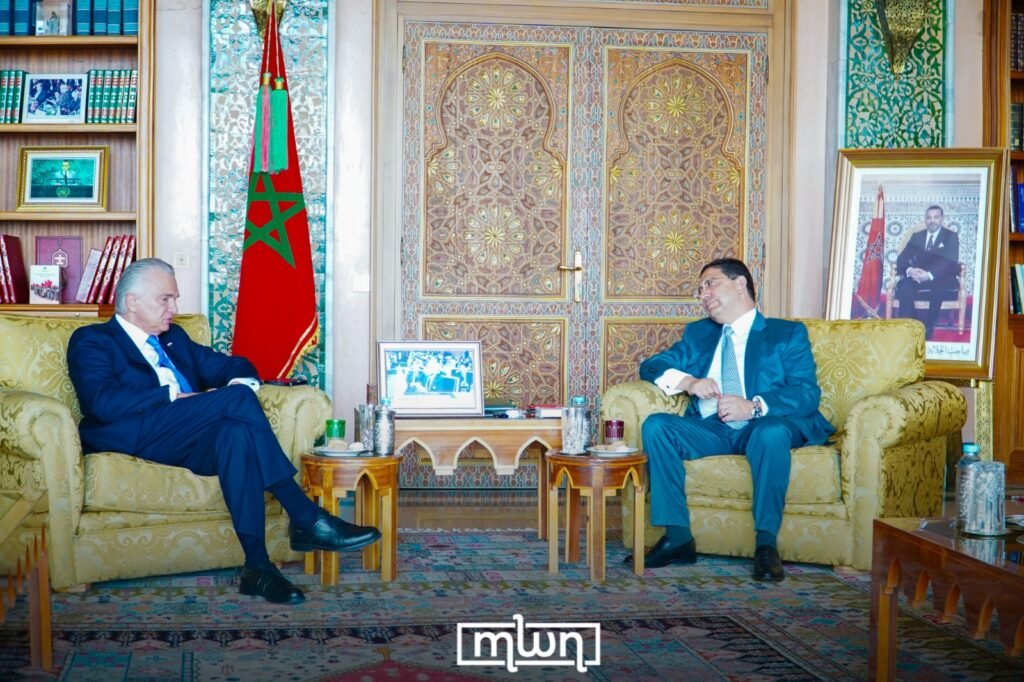
Marrakech – Costa Rica has formally endorsed Morocco’s autonomy initiative as “the most appropriate, serious, credible and realistic basis” for resolving the Western Sahara dispute.
It stated that “autonomy under Moroccan sovereignty could be the most feasible solution” to finally put an end to a prolonged, half-century proxy conflict – one Algeria has artificially sustained and politically manufactured to serve its regional agenda.
Officials signed the position into a joint declaration on Friday in Rabat, following talks between Morocco’s Foreign Minister Nasser Bourita and his Costa Rican counterpart, Arnoldo André Tinoco, who was in the North African country on a working visit.
San José said it intends to act on its stance “at the political, diplomatic, economic and consular levels.” Costa Rica also welcomed UN Security Council Resolution 2797, adopted in October 2025. The resolution effectively narrowed the scope of the political process by limiting all options and consolidating autonomy as the sole basis for discussion – thereby shifting negotiations from debating which solution to focusing on implementation.
The Central American diplomat also indicated his country recognizes “the importance Morocco attaches to the Sahara question,” adding that it is closely following the “positive dynamics” on the file under King Mohammed VI.
Both ministers reaffirmed their support for the UN Secretary-General’s Personal Envoy and his efforts to advance the political process toward a final settlement.
The diplomatic engagement extended beyond the Sahara issue. Bourita and Tinoco signed a joint declaration committing both countries to a new phase in bilateral relations, anchored in structured political dialogue and reinforced cooperation.
The two sides agreed to deepen ties in agriculture, clean energy, scientific research, responsible tourism, the environment, and technical exchanges. They also expressed willingness to promote investment and commercial information-sharing, and agreed to hold a first round of political consultations in the near future.
The visit began Thursday, when Tinoco delivered a lecture at the Faculty of Letters and Human Sciences in Rabat. Speaking on the theme “Latin America in the Era of Global Fragmentation: Challenges and Opportunities for Costa Rica,” he described Morocco as “a partner with a unique strategic position and a major actor” in both the Arab and Mediterranean spheres – and as a growing platform for South-South cooperation.
“In a fragmented world, bridges are more valuable than ever – not only for bilateral cooperation, but for connecting regions,” Tinoco affirmed. He called on students present to strengthen ties between Africa and Latin America, describing universities as spaces that “quietly shape the future of international cooperation.”
On Latin America’s internal challenges, the minister was direct. The region faces “longstanding difficulties,” including low economic growth, deep social inequalities, institutional fragility, insecurity, and organized crime.
Latin America “cannot afford inertia,” he said, stressing that strength “will not come from automatic alignments, but from collective work, strategic thinking and building bridges with regions like North Africa and countries like Morocco.”
Tinoco also outlined Costa Rica’s own economic strategy, citing new free trade agreements, ongoing negotiations to join the Pacific Alliance – a bloc comprising Mexico, Colombia, Peru, and Chile – and the near-finalized accession to the Comprehensive and Progressive Agreement for Trans-Pacific Partnership, which includes Asian nations, Pacific-facing American states, Canada and the United Kingdom.
Friday’s joint declaration carries a significance that transcends routine diplomatic choreography. Costa Rica once stood among the Latin American states that, in the ideological climate of the 1970s, aligned with the Polisario Front and endorsed calls for so-called Sahrawi “independence” – a posture shaped less by grounded realities than by the reflexes of Third Worldist solidarity and Cold War-era alignments.
That position is now steadily unraveling. What can be witnessed today is not an isolated adjustment, but a structural realignment across Latin America, where Morocco’s sustained, methodical diplomatic campaign is dismantling – piece by piece – a once-cohesive bloc that had artificially inflated the separatist narrative’s international standing.
The shift exposes the fragility of a cause long propped up by ideological inertia and external patronage, rather than legal substance or geopolitical viability.
Read also: Czech Republic Reaffirms Support for Morocco’s Sovereignty Over Western Sahara