


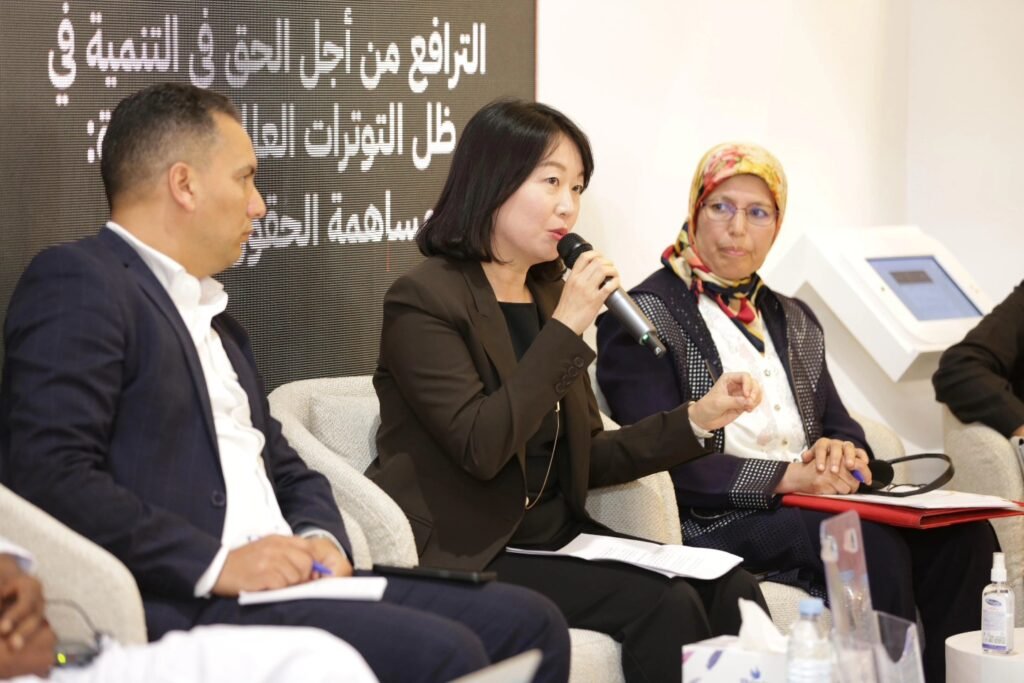
Rabat – At a time of growing global tensions, from armed conflicts, economic instability, climate change, and widening inequalities, a panel at the National Human Rights Council (CNDH) pavilion at the International Publishing and Book Fair (SIEL) explored how cultural rights can help reshape the way development is understood and implemented.
The discussion focused on the idea that development, in today’s complex world, must go beyond economic models to include the voices, identities, and lived realities of communities.
The conference, titled “Advocating for the Right to Development in the Face of Contemporary Global Tensions: The Contribution of Cultural Rights,” brought together international and regional experts to reflect on the challenges facing development efforts today and the role cultural rights can play in addressing them.
Moderated by Khalid Ramli, Director of International Cooperation at CNDH, the panel featured speakers including Min-Jae Lee from the Office of the United Nations High Commissioner for Human Rights (OHCHR), Lakbira Soufri from Morocco’s High Commission for Planning (HCP), and Ali Bouzou from the Timidria Association of Niger.
Speaking to Morocco World News (MWN) on the sidelines of the event, Min-Jae Lee recalled the difficult global context in which development is currently taking place. These include ongoing conflicts, economic uncertainty, and climate-related challenges. According to recent United Nations findings, many countries are still struggling to recover from the economic effects of the COVID-19 pandemic, while rising inflation and debt are limiting their ability to invest in development.


At the same time, climate change continues to have a direct impact on vulnerable populations. Increasing droughts, floods, and extreme weather events are affecting food security, access to water, and livelihoods, especially in parts of Africa and the Global South. These overlapping crises are slowing progress on the Sustainable Development Goals (SDGs), with UN reports warning that many targets are at risk of not being achieved.
Rethinking development through culture
Within this context, Lee stated that cultural rights can offer a new way of thinking about development, explaining that development should not be based on a single model applied everywhere.
“I would like to bring the perspective of cultural rights into that discussion and how that perspective can help all of us actually, not just in the Global South but Global North as well, to understand that development is not just one single model, it’s really diverse views,” she told MWN.
She added that development should not be imposed from above or from outside. Instead, it should be shaped with the participation of the communities concerned. According to her, policies that involve local populations are more likely to be fair, effective, and sustainable.
Other speakers at the panel shared similar perspectives. Lakbira Soufri spoke about the importance of data in understanding inequalities between regions, while also stressing that numbers alone are not enough without considering the human and cultural context behind them.

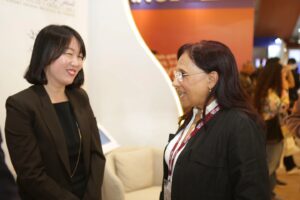
Ali Bouzou, representing the Timidria Association of Niger, discussed the role of grassroots initiatives and community engagement in development processes. He pointed out that local actors often have the best understanding of their own needs and challenges.
The discussion also addressed the limits of traditional development approaches that focus mainly on economic growth or infrastructure. Participants noted that such approaches can overlook social and cultural dimensions, sometimes leading to resistance from communities or ineffective outcomes.
By contrast, integrating cultural rights, such as the right to participate in cultural life and preserve one’s identity, can help create more inclusive and responsive policies.
The panel was part of a broader program at the CNDH pavilion, which throughout the day hosted academic presentations, poetry readings, and debates. These activities are part of the council’s effort to link culture, human rights, and development in a meaningful way.