


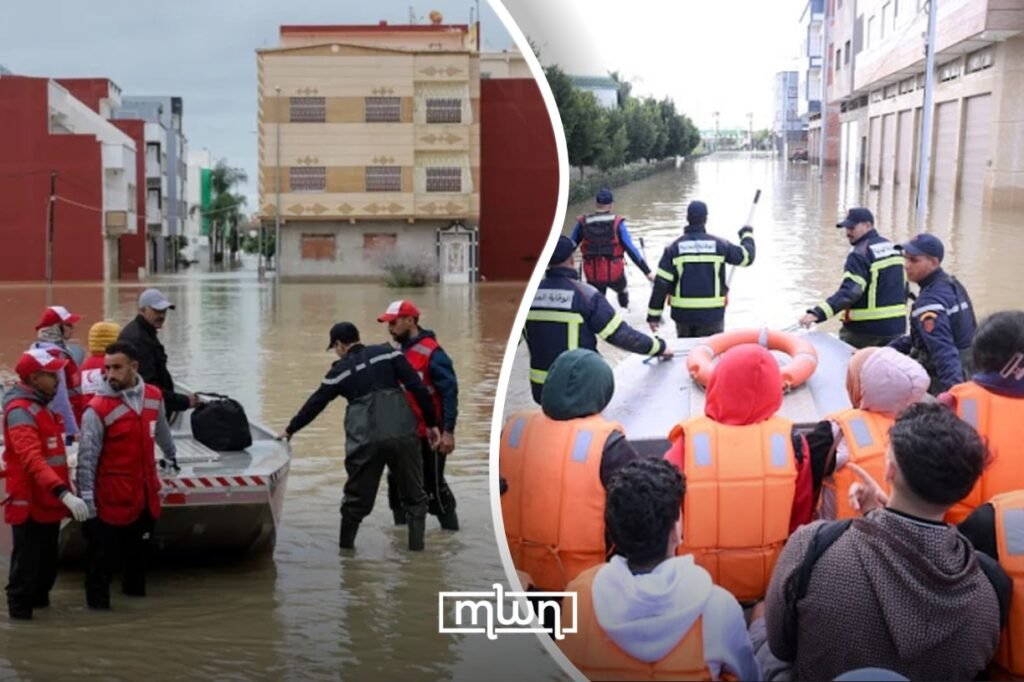
Rabat – The National Council for Human Rights (CNDH) has issued the preliminary conclusions for its assessment, commending Morocco’s approach in tackling recent floods in the four most affected provinces.
CNDH published today its assessment of Morocco’s approach, saying that the country’s handling of the situation shows a clear example of “effective disaster management.”
“The council concludes that the management of the floods in the four affected provinces achieved clear and tangible progress in applying international standards and a human-rights-based approach to natural disaster response,” CNDH said.
The council notably referred to intervention operations and the authorities’ experience and expertise in disaster management.
Since mid-November 2025, Morocco witnessed very heavy rainfall that affected many provinces. The weather caused rising water levels and flooding in many regions, especially in the north.
In response, Morocco declared four affected areas as disaster zones, announcing a MAD 3 billion budget as an emergency response seeking to assist affected regions and inhabitants.
The four hard-hit regions are identified as Sidi Slimane, Larache, Kenitra, Sidi Kacem and Sidi Slimane.
For CNDH, declaring affected areas as disaster zones provides the optimal legal framework to address the consequences of the disaster.
The Council also commended Morocco’s anticipatory preparedness measures in managing crises and natural disasters.
These include developing local, regional, and provincial plans to manage flood risks, strengthening early warning systems, and integrating climate challenges and related interventions into territorial redevelopment projects.
The council also recalled the special efforts to ensure that students affected by floods can continue their education remotely until classes can resume in-person.
A welcome return home
Morocco’s authorities announced that 188,000 people were evacuated from their hometowns as part of measures to safeguard lives.
With the weather turning relatively stable in recent days, Moroccan authorities started relocation plans, helping citizens return to their homes.
Despite their evacuation, Morocco’s education authorities announced remote classes to ensure the continuity of school. They also urged schools across unaffected regions that housed evacuees to welcome students to enable them to continue their schooling.
CNDH welcomed the gradual return of citizens to their hometowns, commending interventions and initiatives taken to tackle the situation.
The Council cited initiatives launched by public authorities in partnership with specialized associations, including the evacuation and gathering of pregnant women in centers under health supervision. It also recalled the special attention given to the elderly and people with disabilities in addition to exceptional care for patients requiring cancer treatment, among others.
The floods resulted in large material losses and damages across 110,000 hectares, affecting homes, infrastructures, and private property.
Under royal instructions, the Moroccan government implemented a support program, the CNDH cited, that included housing reconstruction, income compensation, and rehabilitation of damaged homes and small commercial establishments.
The program will grant direct financial aid of up to MAD 6,000 per affected family. Households will also receive MAD 15,000 for the rehabilitation of damaged homes and small businesses, while MAD 140,000 will go for households reconstructing their homes that collapsed due to the floods.
The CNDH also cited the aid allocated under King Mohammed VI’s orders for farmers affected by the disaster.
MAD 300 million will be allocated to support farmers and livestock breeders, while MAD 1.7 billion will go to investments in rehabilitating infrastructure, including roads, irrigation, hydro-agriultural networks, and basic utilities.