


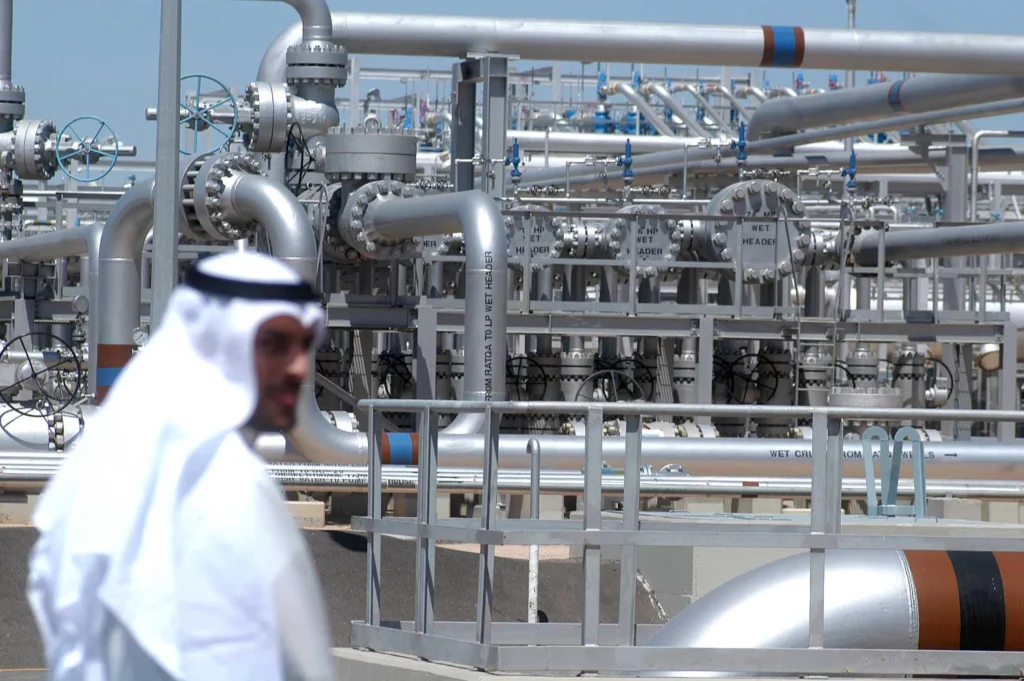
Marrakech – Kuwait announced a precautionary reduction in crude oil production and refining operations on Saturday, citing repeated Iranian attacks and the effective closure of the Strait of Hormuz.
Kuwait Petroleum Corporation (KPC) said the adjustment came in response to “repeated and hostile” Iranian attacks on the country. The national oil company described the move as part of its risk management and business continuity strategy but did not specify the volume of the cut. Kuwait produced around 2.6 million barrels per day in February.
KPC stressed the reduction is strictly preventive and will be reviewed as the situation develops. The company said it remains ready to restore production once conditions allow.
Tip of a deeper regional iceberg
The decision, however, reflects a deeper crisis building across the Gulf. The Wall Street Journal reported on Friday that Kuwait had already begun cutting production at some of its oil fields after running out of available storage space, and that the country is discussing further reductions that would limit output to only what is needed for domestic consumption.
Data analytics firm Kpler said Kuwait’s storage tanks could reach full capacity within approximately 12 days.
Shutting down oil wells carries serious technical risks. Reservoir pressure can sustain long-term damage, and restarting production can take days or even weeks depending on the nature of the reservoir. UBS commodity strategist Giovanni Staunovo warned that operations would not return to normal the same day exports resume.
Kuwait is not alone in facing this pressure. Iraq was forced earlier this week to slash production by more than half. Output at Rumaila, the country’s largest oil field, dropped by 700,000 barrels per day. West Qurna 2 fell by 450,000 barrels per day, and Maysan lost another 350,000. Iraq also suspended crude production in the northern Kirkuk region as a precaution.
Qatar, a major producer and exporter of liquefied natural gas, declared force majeure on its gas exports after military attacks hit its facilities.
This war could ‘bring down’ global economy
Qatar’s Energy Minister Saad al-Kaabi told the Financial Times he expects all Gulf oil and gas exporters to halt production within days if the war continues. He warned oil could reach $150 a barrel and said the conflict could “bring down the economies of the world.”
Brent crude surged more than 9% on Friday, topping $93 a barrel – its highest level since autumn 2023.
Rystad Energy analyst Jorge Leon described the situation as a real risk to the global economy, explaining to BBC that Gulf producers unable to export will be forced to store their crude – and once storage runs out, shut down production entirely.
Only Saudi Arabia and the UAE have pipelines that bypass the strait entirely, but even that advantage has limits. Data firm Kpler noted that key storage facilities in the two Gulf countries could reach full capacity in less than three weeks.
The disruption stems from the US-Israeli military campaign against Iran that began on February 28. Tehran responded with missiles and drones targeting Israel and Gulf states hosting American military assets.
Some of the strikes caused casualties and damage to civilian infrastructure, including ports and residential buildings. Iran said its retaliation came after the campaign killed hundreds of people, including Supreme Leader Ali Khamenei and top military officials.
Shipping through the Strait of Hormuz, which normally carries about a fifth of the world’s oil supply, has all but stopped since the conflict began.
In Washington, Treasury Secretary Scott Bessent said the US may lift sanctions on additional Russian oil shipments to ease the global supply gap. He noted that hundreds of millions of barrels of sanctioned Russian crude remain on the water and could be released to the market.
The remarks followed a 30-day waiver already granted to Indian refiners to purchase Russian oil.