


“It’s really happening!” a man said in Moroccan Darija on Tuesday night, calling out to his wife to join him and see the news. Surprised and struggling to put the announcement in simple words, the man in his 30s suddenly mumbled: “Morocco … we won the AFCONNNNN.”
The announcement in one of the busiest markets in Sale, near Rabat, caught everyone’s attention. Despite the sudden heavy rainfall that struck Rabat and its nearby city on Tuesday, many collected whatever items that had Morocco’s flag or jersey and rushed to the streets to join an unexpected feast.
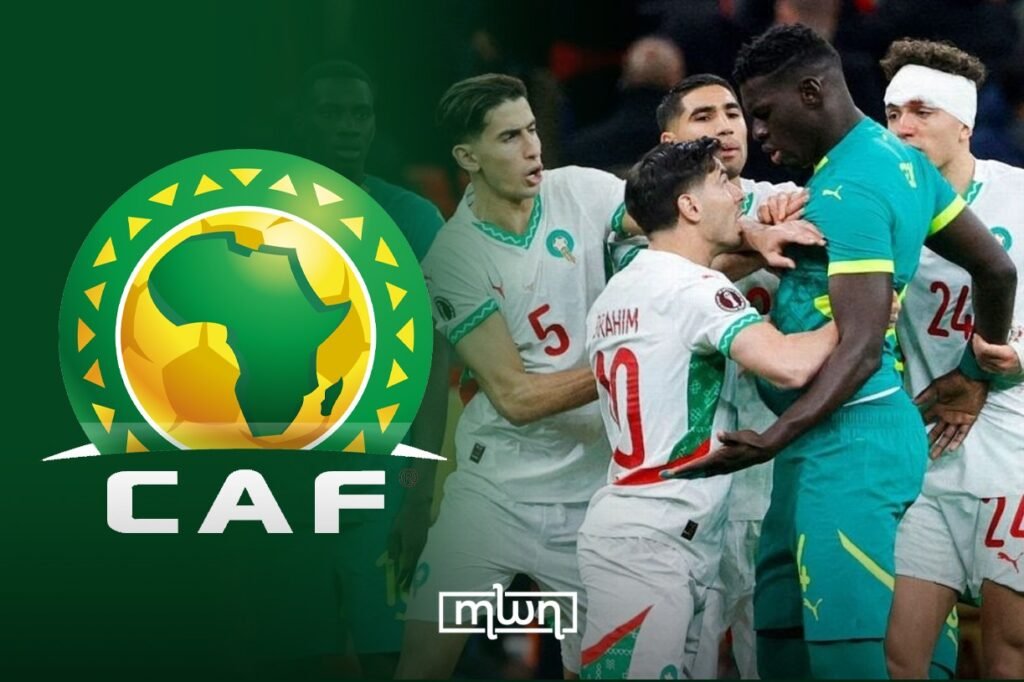
This could sound like a scene from a movie, but it’s not. It was real. On Tuesday, the Confederation of African Football (CAF) announced Morocco as the winner of the AFCON, acknowledging that Senegal had breached tournament regulations.
The decision came late… It arrived after Moroccan hearts had been broken and the excitement had cooled.
However, there is still a broad consensus that justice was finally served, and that this conclusion was only a matter of time.
The ruling ultimately saved the face of African football. It sent a clear message: Anyone who infringes on the continent’s football will face the same fate and the same ending.
Every football enthusiast in Africa will remember January 18, 2025, when the final of the AFCON descended into total chaos when Senegalese players abandoned the pitch in protest following a late penalty decision in favor of host Morocco.
Senegal’s head coach pape Thiaw urged and incited his players to leave the field after the referee awarded the spot kick to Morocco, moving the game into at least 15 minutes of forced stoppage time.
Yes, Senegal breached the ruling. Senegal infringed AFCON’s regulations, including Articles 82 and 84.
According to the regulations, if a team withdraws, refuses to play or leaves the field of play before the final whistle and without the permission of the match officials, they are considered to have lost the game by forfeit.
Senegal politicizes CAF’s ruling
The case may not end with CAF’s ruling. Senegal’s move to escalate the matter to the Court of Arbitration for Sport (CAS) introduces another layer of scrutiny that could test the robustness of CAF’s regulatory framework on an international stage.
Whatever the outcome, the process will likely shape how such disputes are handled in the future, potentially forcing greater procedural clarity and reinforcing the legal architecture of African Football.
However, Senegal seems to have turned this obvious consequence into a political matter, not only backing their football federation’s decision to appeal to the CAS. Instead, the Senegalese government escalated the issue politically by calling for an “independent international investigation” into alleged corruption within CAF.
The government released a statement describing the ruling as “grossly illegal” and “profoundly unjust,” arguing that it undermines sporting ethics and disregards what they consider a legitimately earned victory on the pitch.
One cannot help but see the government’s stance as overstated and politically charged, especially that CAF’s decision was based on clearly established regulations stating that a team that walks off the pitch without authorization forfeits the match. Thus, presenting the issue as reflective of potential corruption without presenting concrete evidence makes Senegal risk weakening its own argument and shifting the focus away from the players’ misconduct during the game.
The storm surrounding the AFCON 2025 shows something far more consequential than a dispute over a match. It exposes, once again, how football on the continent operates as a political language that states, institutions, and publics all speak, often at the same time and rarely in agreement.
What happened behind the scenes of this situation is not simply a disagreement between federations. It is a struggle over narrative control. Who gets to define what happened? Who holds the authority to validate a certain version? And perhaps more importantly, whose voice carries weight beyond the pitch? In this sense, the role of the CAF becomes central as an arbiter of legitimacy in a space where sport, politics, and power remain deeply intertwined.
African football’s credibility dilemma
Morocco’s position in this equation cannot be reduced to that of a passive actor. The country has, over the past years, invested heavily in football infrastructure, continental engagements, and institutional presence. Hosting a tournament of this scale was never a neutral exercise. It placed Morocco at the crossroads of visibility and influence, in a context where perception matters as much as procedure. That visibility now feeds into the current debate, whether fairly or not.
Yet much of the criticism directed at Morocco says more about the political climate of African football than about the specifics of the case itself. The reflex to frame the situation through suspicion reflects a broader unease. A lingering belief that influence, rather structure, is what shapes outcomes. This belief does not emerge in a vacuum.
African football continues to struggle with a credibility paradox. Its competitions command massive audiences and emotional investment, yet its institutions often face skepticism from the very public they serve. Every major controversy reinforces that gap and feeds the perception that governance remains opaque, contested, or uneven.
And yet, it would be too easy to reduce the current moment to a simple narrative of distrust. What is also at play is a shift in how power circulates within African football. Countries like Morocco have moved from the periphery to positions of structural influence through its hosting of the sporting event and the sustained institutional engagement that came with it. This shift inevitably produces friction.
What made CAF’s ruling important was not only that it changed the official result of the AFCON 2025 final, its real importance is that it sets a limit African football could not afford to leave unclear.
By ruling that Senegal had forfeited the match and awarding Morocco a 3-0 win, CAF made one clear thing: no team can walk off during a final and then return later to the stage while expecting normality, as if nothing happened or that what happened did not matter. The thing is, it mattered. And not just for the outcome of this particular final. But for the fate of fairplay in African football and the integrity of AFCON as an elite, prestigious tournament.
Rules are the beating heart of football
Football is not only about what happens with the ball. It is also about respecting the rules that allow the game to function.
Once Senegal left the pitch and the appeal board decided that action fell under the regulation, the legal consequence followed. Morocco did not win because of sympathy, politics, or image. Morocco won because CAF concluded that Senegal crossed a line that the competition rules were designed to punish.
That is why the claim that this decision hurt African football gets the issue the wrong way around. The real damage was done when the final fell into confusion and disorder. The problem was not the ruling itself.
The problem was that the biggest match in African football was interrupted in a way that challenged the authority of the referee, the flow of the game, and the credibility of the tournament.
The referee is the only authority on the pitch whose decisions are meant to be final in the moment. When Senegal walked off, they made AFCON a laughing stock while posing a direct challenge to the referee’s authority.
Football depends on immediate decisions being respected, even when they are contested later. Without that, every major call risks turning into a negotiation rather than a rule.
If CAF had looked at all that and still chosen to do nothing serious, that would have been a far more damaging message.
It would have told every team in Africa that in the heat of a big match, pressure can replace discipline.
It would have suggested that if players are angry enough, they can stop the game, return later, and still keep the result. That would have been a dangerous precedent not only for AFCON but for football in general.
CAF’s ruling did the opposite. It sends a clear message to the future, which is that you can protest, you can complain, you can challenge referring decisions after the game, you can even appeal to higher bodies. But you cannot leave the pitch, disrupt a final, and then act as if the rules no longer apply.
Read also: Why Spain’s Sports Media is Melting Down Over Morocco’s AFCON Win
This is exactly why Morocco’s title matters. Beyond simply benefiting from a legal decision, Morocco has become the team through which CAF sent a warning to the rest of the continent.
Some people will still focus on the emotional side. They will say Senegal scored, Senegal celebrated, Senegal lifted the trophy, but football cannot be governed only by emotions. If that were enough, the rules would only matter when they are convenient.
Football cannot work that way; rules are tested most in moments of anger, pressure, and confusion. If they collapse in those moments, then why were they made?
That is why this ruling may prove important long after this debate fades.
Because it tells future teams that walking off the pitch is not a bargaining tool, and not something that can be cleaned up later. And because CAF acted to overturn the outcome of an AFCON final, the message is even stronger: no occasion is too big for the rulebook.
In the end, this was about protecting the beautiful game and restoring dignity to Africa’s flagship tournament itself, never simply about crowning Morocco. And that is why this ruling may help make sure no team repeats the same mistake again.