


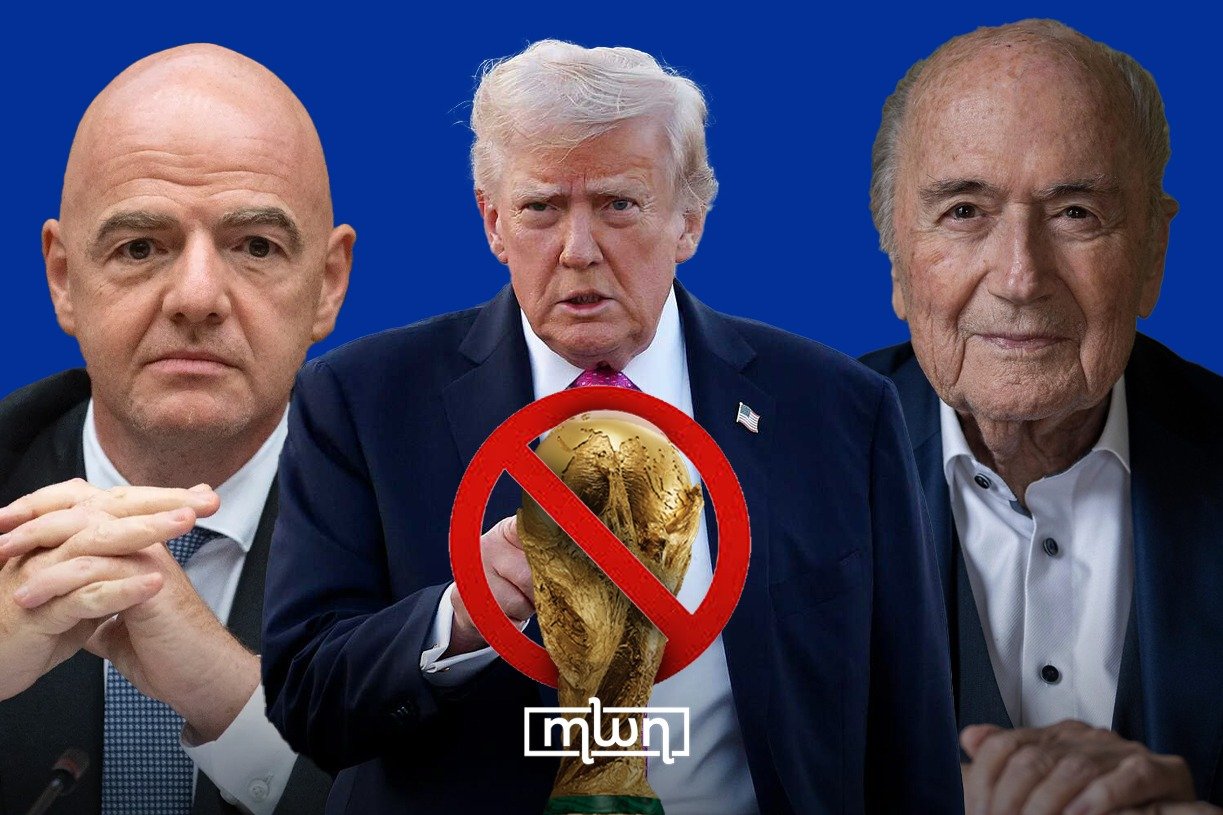
Rabat – Sepp Blatter, who ran FIFA from 1998 until resigning in 2015 during a corruption scandal, posted on social media last week in support of Swiss lawyer Mark Pieth’s call to boycott World Cup 2026, to be jointly-hosted in the United States.
Pieth, an anti‑corruption expert and former head of FIFA’s governance committee, told Der Bund that supporters should avoid traveling to America for the tournament.
“If we consider everything we’ve discussed, there’s only one piece of advice for fans: Stay away from the USA,” Pieth said.
“You’ll see it better on TV anyway. And upon arrival, fans should expect that if they don’t please the officials, they’ll be put straight on the next flight home. If they’re lucky.”
Blatter quoted Pieth’s remarks on X, adding: “I think Mark Pieth is right to question this World Cup.”
“𝗙𝗼𝗿 𝘁𝗵𝗲 𝗳𝗮𝗻𝘀, 𝘁𝗵𝗲𝗿𝗲’𝘀 𝗼𝗻𝗹𝘆 𝗼𝗻𝗲 𝗽𝗶𝗲𝗰𝗲 𝗼𝗳 𝗮𝗱𝘃𝗶𝗰𝗲: 𝘀𝘁𝗮𝘆 𝗮𝘄𝗮𝘆 𝗳𝗿𝗼𝗺 𝘁𝗵𝗲 𝗨𝗦𝗔!”
Former FIFA president Sepp Blatter says fans should boycott the 2026 World Cup over President Trump’s US administration.🗣️ pic.twitter.com/OdcvmGRH7z
— DW Sports (@dw_sports) January 26, 2026
His comments have added fuel to a growing debate about safety, immigration rules, and travel access ahead of football’s biggest event.
The 89‑year‑old former-executive’s intervention is notable, especially his backing of anti-corruption expert Pieth, as his own record remains controversial.
Furthermore, the critical words against the US government fight back against the promotion of the2026 edition as a symbol of global unity.
The tournament is scheduled for June 11 to July 19, 2026, hosted by the United States, Canada, and Mexico.
With most matches set to be played in American cities, issues such as border control, visas, and domestic security will be central to the experience for fans, especially those traveling from Africa, Asia, and the Middle East and various parts of the Global South.
Why the boycott debate is growing
Mark Pieth’s warning connects to a wider political mood that critics say has become tense. In recent weeks, US Immigration and Customs Enforcement (ICE) has come under heavy scrutiny after violent incidents in Minneapolis involving federal agents and protesters.
Two US citizens were shot dead last month by ICE, including Renee Good and Alex Pretti, with reports that video evidence raised doubts about official accounts.
“I’m 70 years old and I’m F***ing angry.”
Protests continue in Minnesota after 37-year-old ICU nurse Alex Jeffrey Pretti was shot and killed by federal agents as they tried to arrest him.
Saturday’s killing comes less than three weeks after a U.S. Immigration and Customs… pic.twitter.com/KzrPBsU4Wq
— CBS News (@CBSNews) January 24, 2026
The death of Pretti on January 24 once again drew national attention, with continued anti-ICE protests cropping up in Minneapolis and around the country.
In addition to triggering widespread sociopolitical upheaval around the US, these are now being used by critics as examples of a deeper worry – that America is unsafe for foreign fans flocking to a tournament where they would expect freedom of movement and security.
In Europe, the debate has spread beyond civil rights groups into politics and football leadership. Coverage in both the US and European media has described growing calls, still mostly rhetorical, for boycotting matches in the US.
In the Netherlands, the debate has moved beyond experts and politicians. Dutch journalist Ten Van der Keuken launched a petition calling for the country to boycott the 2026 World Cup in the United States, and it has already gathered more than 150,000 signatures.
The petition shows the frustration of many European fans who believe a World Cup hosted mainly in the US cannot claim to unite the world, while concerns over immigration checks and border treatment remain so strong.
Could there be a Europe-led boycott of the 2026 FIFA World Cup over Trump’s policies?
A petition in the Netherlands urging a boycott has gained traction. But Europe’s major football federations have traditionally been wary of taking a stance. pic.twitter.com/eXx3Ty6ENd
— DW News (@dwnews) January 24, 2026
The Dutch campaign is part of a wider trend in Europe, where boycott calls are now everywhere. Despite the growing pressure, Dutch media reported that the national football association has not backed a boycott, showing the gap between public opinion and football institutions that are hesitant to take such a step.
Blatter’s timing and the irony
Sepp Blatter’s comments come as FIFA continues to struggle with its own image. Even though he is no longer in charge, his name is still tied to the years when World Cups were awarded under heavy controversy.
Blatter and other former officials have also criticized current FIFA president Gianni Infantino, saying the organization has grown too close to political power.
This is part of why Mark Pieth’s warning has struck a chord. It reflects a wider fear that football leaders are focused on money and spectacle, while leaving fans to deal with stricter border rules, tougher enforcement, and the risks of traveling to a country that is in the middle of a growingly tense political climate.
For Moroccan fans, the main issue is visas
For Moroccan fans, the issue is not politics, but access. To attend matches in the US, supporters need a B‑1/B‑2 visitor visa.
The process requires an online form, fees – $180 initial plus a $250 “visa validity fee” – documents, and an in‑person interview at the US Consulate in Casablanca. US officials warn that appointments can be hard to get and waiting times change depending on the season and location.
This is a problem because World Cup travel is time‑sensitive. Flights, hotels, and match schedules all fall into the short June-July short window. If consular delays stretch too long, fans risk missing games even after paying for tickets and travel.
The challenge has grown since US entry rules expanded beyond normal visa steps. On December 16, 2025, President Donald Trump signed a proclamation restricting entry for nationals of 39 countries and holders of Palestinian Authority travel documents, effective January 1, 2026.
This was built on an earlier order from June 4, 2025, which had already blocked entry for people from 19 countries. The policy sets two levels: full suspension, which bans both immigrants and visitors, and partial suspension, which bans immigrants and limits certain visa types.
The partial suspension matters most for World Cup travel. It restricts visas that fans depend on, B visas for tourism and business, F visas for students, M visas for vocational training, and J visas for exchanges.
🚨 𝗕𝗥𝗘𝗔𝗞𝗜𝗡𝗚: Donald Trump signed an order on Tuesday banning people from Senegal and Ivory Coast from entering US soil.
Fans from Senegal and Ivory Coast are now at risk of not being able to travel for the FIFA World Cup in 2026.
Exceptions are planned for the players,… pic.twitter.com/Hw7y1k5g7J
— The Touchline | 𝐓 (@TouchlineX) December 17, 2025
For many, this makes ordinary travel harder or even impossible. The Trump administration says the rules are based on security and public safety, using powers under US immigration law.
There are exceptions. Athletes, coaches, staff, and close relatives traveling for major events like the World Cup or Olympics are allowed. But this does not solve the wider problem for fans.
A World Cup is promoted as a global festival, welcoming all, yet rules that block or discourage supporters risk undermining that promise of unity, leaving some fans at home not by choice, but because entry is out of reach.
To ease the pressure, FIFA and the U.SS government introduced a priority system for ticket holders called FIFA PASS. It allows eligible fans – those who purchased their ticket on the official FIFA website – to book earlier visa interviews while still going through the normal checks.
However, the FIFA PASS is definitely not a guarantee of a visa. It only manages the queue; it does not mean automatic approval.
Prospective visa candidates still must show financial ability, strong proof of home ties, and genuine means to qualify for a visa – both in the application form and a roughly 2-minute, pressure-filled interview at the consulate.
For Moroccan fans, the message is clear: apply early, follow the rules carefully, expect demand to rise as summer 2026 gets closer, and don’t hold out on any certainties of entry.
Costs add another barrier for fans
Even for supporters who manage to get a visa, money is becoming a major obstacle. Early ticket guidance shared in Europe put group‑stage prices between $120 and $265 for matches not involving co‑hosts.
Estimates showed that following a team all the way to the final could cost more than $7,000 in tickets alone, not including flights, hotels, food, or transport.
FIFA has been urged to halt World Cup ticket sales after it emerged countries’ most loyal fans face paying “extortionate” prices for tickets, with the cheapest for the final coming in at over £3,000 🎫 pic.twitter.com/n0mhmAhbjf
— Sky Sports News (@SkySportsNews) December 11, 2025
Anger has been sharper around premium and resale markets, where some listings have reached $8,680 per ticket.
FIFA has promised a small batch of $60 tickets for each match through national federations, but critics say that does little to ease fears of a “pay‑to‑enter” World Cup.
Hotels tell the same story. Reports found that the average rates across host cities jumped 14.75% after the draw, with extreme spikes during match weeks.
Prices are rising across the board, not just in the US. In Guadalajara, Mexico, prices surged as much as 385% in some booking windows. Early checks showed wide gaps between cities, with about $583 per night in New York compared with $146 in Houston.
Headlines have focused on eye‑catching jumps, like a Mexico City property reported at $3,882 per night for the opening week, a 2,373% increase.
Several US host cities were also reported to see 200–400% spikes, depending on timing and stadium proximity.
A tournament fans may still attend
Despite talk of boycotts, many supporters are still preparing to take the chance and ample cash to travel.
FIFA promotes 2026 as a historic World Cup across three nations, while critics warn that for many fans, especially those needing visas, the journey could feel less like a festival and more like a test of paperwork, borders, and security checks.
For Moroccan fans hoping to follow the Atlas Lions, the dream is still alive. But the path to the stadium may start long before kickoff – at the embassy, in the visa line, and inside a global debate about who truly gets to join when FIFA claims that football belongs to everyone.
