


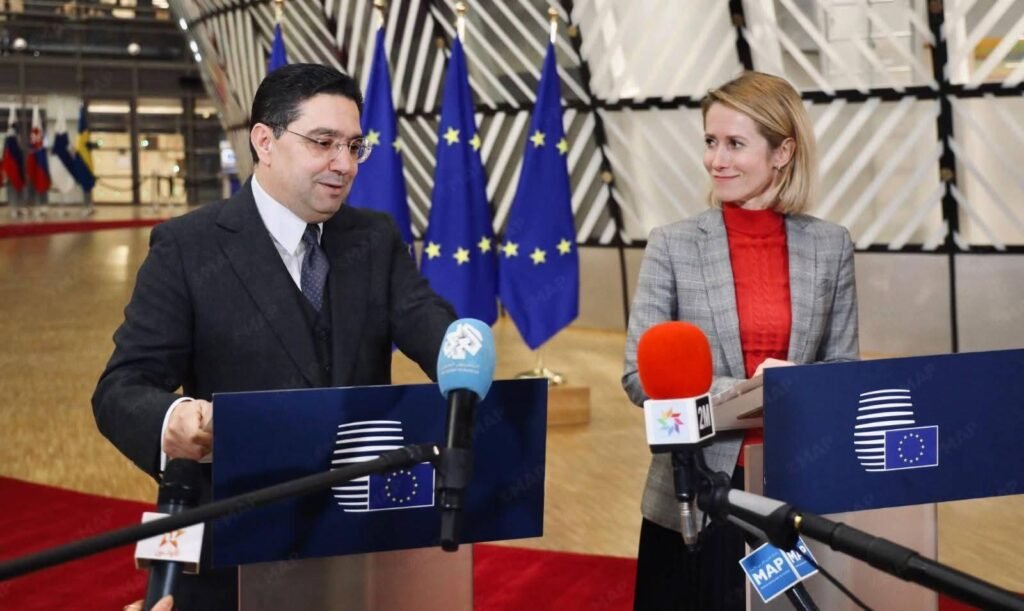
Marrakech – Foreign Minister Nasser Bourita expressed strong confidence Thursday in the positive prospects of the Morocco-EU partnership during the 15th Association Council meeting in Brussels.
“I am convinced that this meeting will be fruitful and bring positive perspectives for both parties,” Bourita told reporters before the council session began. The meeting was co-chaired by EU High Representative Kaja Kallas and Bourita, with European Commissioner for the Mediterranean Dubravka Šuica representing the European Commission.
The council session holds particular symbolic, political, and economic importance as it approaches the 30th anniversary of the Morocco-EU Association Agreement. Bourita noted that the meeting marks three decades of solid and diversified institutional partnership, positioning Morocco at the forefront of EU relations with its Mediterranean neighborhood.
The foreign minister pointed to Morocco’s political stability amid international uncertainty and conflict. “Under the enlightened leadership of King Mohammed VI, Morocco positions itself as a stable partner offering visibility to its allies while demonstrating lucid and precise understanding of regional and international issues,” he stated.
“The kingdom has always been both demanding in expressing expectations and loyal in honoring commitments,” Bourita added. This approach will continue guiding Morocco’s relations with the European Union.
The top diplomat affirmed Morocco’s position as the EU’s leading commercial partner south of the Mediterranean and in Africa. He suggested this partnership could serve as inspiration for future EU relations with its southern neighborhood.
The council meeting builds on an already solid foundation while carrying renewed ambition for the Morocco-EU relationship’s future.
Bourita observed that broad participation from EU member states, including at the ministerial level, indicates Rabat’s important place within the Euro-Mediterranean partnership and its capacity to contribute to managing regional and global challenges.
A broad agenda
Spanish Foreign Minister José Manuel Albares called the council meeting “excellent news” involving “a fundamental country for the European Union, a partner and friendly country for Spain.” Albares stated that Morocco provides the EU with successful commercial relations and serves as Spain’s second-largest client outside the EU.
The Spanish minister argued that joint efforts against human trafficking networks have produced “the lowest irregular migrant entry figures of all European Union routes.”
Albares committed to continue “working actively, as I have been doing until now, so that the relationship between the European Union and Morocco continues at the level it is, which is at the maximum level with our external partners.”
The Association Council meeting provided opportunities to exchange views on political, economic and trade matters, democracy and human rights, as well as cooperation, including migration, green transition, innovation, inclusive and sustainable socio-economic development, people-to-people contacts, and security.
The parties reviewed implementation of the EU-Morocco Association Agreement from 1996, reaffirming their joint commitment to relaunch and deepen the partnership. Regional and international developments, including regional stability, were also addressed.
Three decades of solid and diversified institutional partnership
The partnership has undergone a steady and substantive evolution since the Association Agreement entered into force in 2000, laying the institutional foundations for political dialogue, economic cooperation, and regulatory convergence.
This trajectory was reinforced in 2003 with the launch of the European Neighbourhood Policy, which introduced a framework of permanent and structured engagement, moving the relationship beyond trade toward broader strategic coordination.
A further qualitative shift occurred in 2008 with the signing of Morocco’s Advanced Status Roadmap, which deepened political and security dialogue and facilitated Morocco’s gradual integration into segments of the EU’s internal market.
More recent developments reflect a recalibration of the partnership around global and regional priorities. In 2022, the two sides signed a Green Partnership – the first of its kind between the EU and a non-EU country – establishing a structured framework for cooperation on climate action, environmental protection, energy transition, and the green economy.
This evolution continued with the launch of the New Pact for the Mediterranean in November 2025, which sets out a renewed vision for Euro-Mediterranean cooperation organized around three core pillars: people as drivers of change, stronger and more integrated economies, and enhanced cooperation on security and migration management.
Strategic diplomacy aligned with boosts in trade
Most of the bloc countries have gradually stepped out of strategic ambiguity, moving beyond cautious neutrality to express clearer political backing for Morocco’s sovereignty over Western Sahara.
In October 2025, Morocco and the EU amended their association agreement so products from Western Sahara under Moroccan customs benefit from EU tariff preferences and must carry regional origin labels (e.g., Laâyoune-Sakia El Hamra, Dakhla-Oued Ed-Dahab), securing trade continuity pending ratification.
Trade statistics demonstrate the relationship’s strength. Morocco is the EU’s 18th biggest trade partner and first among Southern Neighborhood countries, representing 1.2% of the EU’s total trade in goods with the world in 2024. The EU accounts for 59% of Morocco’s goods trade, with 67.7% of Moroccan exports going to the EU and 54% of imports coming from the EU.
Total goods trade between the EU and Morocco reached €60.6 billion in 2024. The EU’s imports from Morocco amounted to €25.3 billion, led by transport equipment (€7.1 billion), machinery and appliances (€6.2 billion), vegetable products (€3 billion), and textiles (€2.9 billion).
The EU’s exports to Morocco totaled €35.3 billion, led by machinery and appliances (€8.8 billion), transport equipment (€4.8 billion), mineral products (€4.2 billion), and base metals (€3.4 billion).
Two-way trade in services amounted to €14 billion in 2023, with EU imports of services representing €8.2 billion and exports reaching €5.7 billion.
Read also: EU Ambassador Salutes ‘Remarkable Success’ of Morocco-EU Economic Relations