


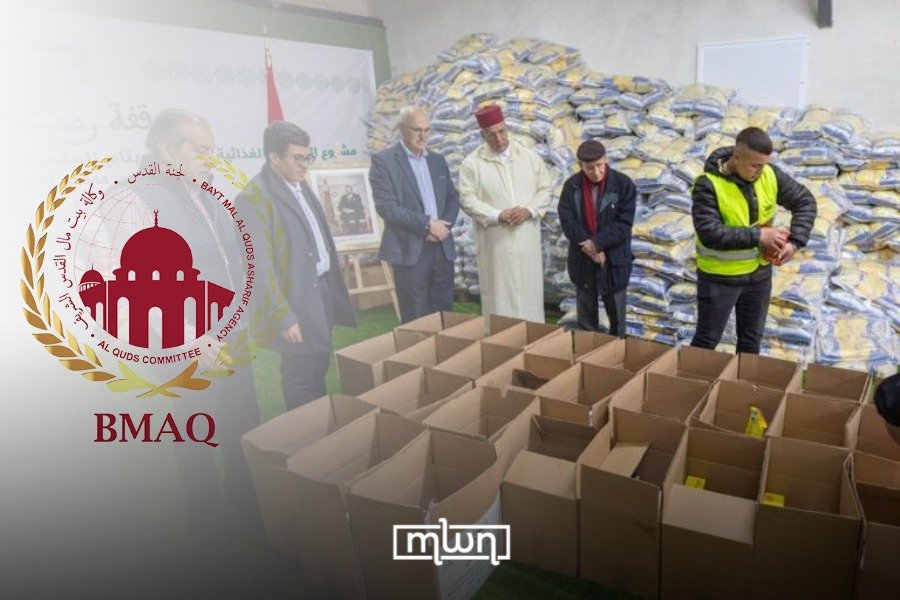
Agadir – The Bayt Mal Al-Quds Acharif Agency rolled out on Saturday its annual social solidarity campaign in Jerusalem, reaffirming its humanitarian engagement with Palestinian communities in the city and its surrounding areas.
The initiative was launched under the auspices of the Al-Quds Committee, chaired by King Mohammed VI, and took place in the presence of the agency’s acting director, Mohamed Salem Cherkaoui.
The 2026 Ramadan program combines immediate humanitarian support with longer-term social and economic initiatives. Throughout the campaign 5,000 food baskets will be distributed to vulnerable Palestinian families across Jerusalem and nearby villages.
These baskets typically include essential food items needed throughout Ramadan, reflecting the agency’s efforts for providing food assistance tailored to families’ monthly needs.
Alongside food distribution, the campaign includes large-scale iftar support through social institutions and healthcare facilities.
In previous Ramadan operations, similar programs provided thousands of meals daily to residents, orphanages, and social centers, focusing on reaching beneficiaries through social service networks.
The program also extends support to children and vulnerable groups through seasonal assistance such as Eid clothing for orphans under the agency’s care. As well as families and religious institutions.
The initiative further integrates economic empowerment and skills development. Training activities planned this year’s focus on strengthening local capacities, supporting small economic actors, and improving professional and entrepreneurial skills.
These efforts align with broader agency programs designed to reinforce institutional and community resilience in Jerusalem by equipping local organizations and economic actors with tools, training, and technical support.
The campaign reflects a wider development strategy focused on sustainability rather than short-term relief alone.
Bayt Mal Al-Quds Acharif’s Ramadan programs serve as broader social action, ensuring that assistance is distributed to those in need across multiple neighborhoods and villages to guarantee equitable geographic coverage and prioritize the most vulnerable populations.