


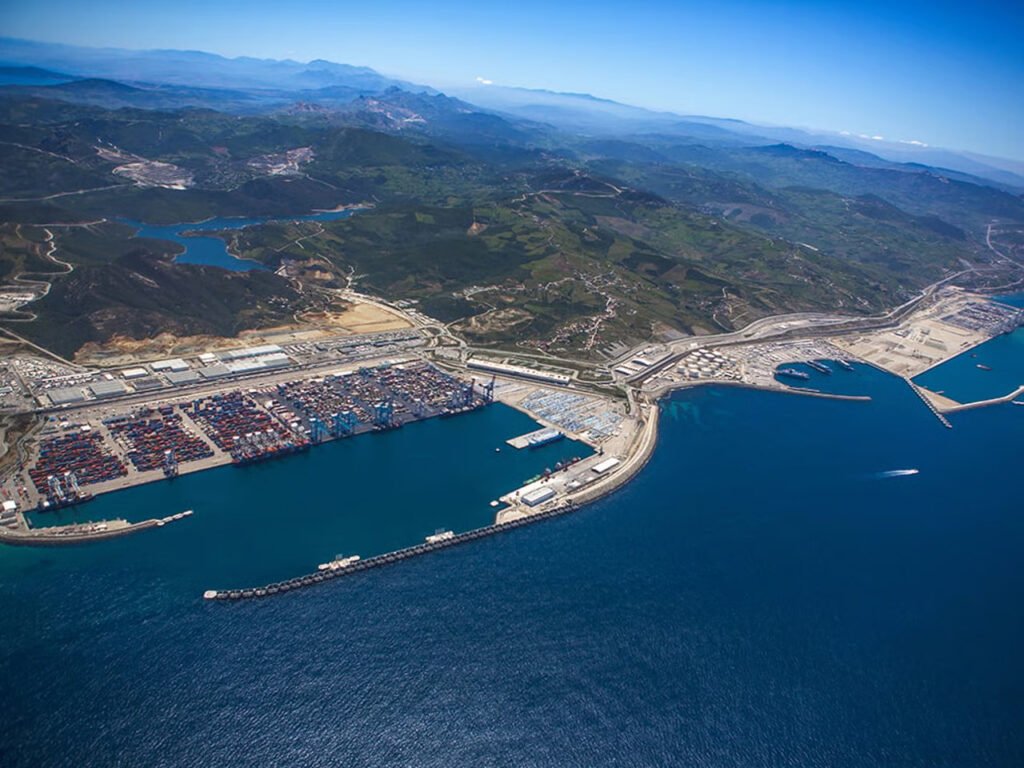
Marrakech – Aura Energy, an Australian-listed uranium developer, is in talks with the Port of Tanger Med Authority to use Morocco’s flagship port as a transshipment hub for uranium produced at its Tiris project in Mauritania. The disclosure came in the company’s half-year financial report for the period ending December 31, 2025, published last week.
The Port Authority is currently reviewing Aura’s application to handle class 7 materials – the international classification for radioactive substances, which includes uranium oxide concentrate, commonly known as yellowcake. Tanger Med is the company’s preferred shipping route to international markets, though Aura said it is also exploring alternative options.
The Tiris Uranium Project sits in northeastern Mauritania’s Sahara Desert. Aura holds 85% of the project through its subsidiary Tiris Ressources SA. The Mauritanian government owns the remaining 15%. The deposit hosts 91.3 million pounds of uranium oxide in mineral resources and 33.6 million pounds in ore reserves.
Under its production plan, Tiris would produce roughly 1.8 million pounds of uranium oxide per year over a 25-year mine life. The yellowcake would be trucked under armed escort from the mine site to Nouakchott, Mauritania’s capital, and then shipped to international converters in Europe, the United States, or Asia.
If development proceeds on schedule, Aura expects to commence uranium production in 2027. Aura has already contracted Orano Logistics, a French nuclear transport specialist, for the seaborne leg.
The project’s economics are built on shallow, calcrete-hosted mineralization less than five meters deep. Mining requires no drilling, blasting, crushing, or grinding. A wet screening process upgrades ore six to eight times before it enters an alkaline leach plant.
Read also: Tanger Med, Casablanca Ports Rank Among Top Arab Maritime Hubs
The company projects a post-tax net present value of $499 million, an internal rate of return of 39%, and an all-in sustaining cost of $35.7 per pound.
Aura is targeting a final investment decision in the third quarter of 2026. The timeline slipped from an earlier 2025 target after the company paused its basic engineering study to resolve a technical challenge – specifically, separating uranium-bearing solution from clay-rich residues in the leach process. Four dewatering methods are now under testing.
Funding discussions with the US International Development Finance Corporation have advanced toward a credit determination. The DFC received a six-year reauthorization in December 2025 with its investment cap tripled to $205 billion. However, the agency requires finalized construction contracts and detailed operating plans before committing.
In August 2025, Aura signed a long-term offtake agreement with a major US nuclear utility covering roughly 10% of Tiris output from 2028 to 2031. That contract’s condition requiring FID by the end of 2025 was not met, but both parties met in London to discuss keeping it in force.
The company held AUD 4.2 million in cash at the end of December. It raised AUD 20 million in February 2026 through a share placement at AUD 0.205 per share. Net loss for the half-year was AUD 6.7 million.
Mauritania’s President Mohamed Ould Cheikh El Ghazouani met with Aura’s Executive Chair Philip Mitchell in September 2025 and reaffirmed full government support for the project.