


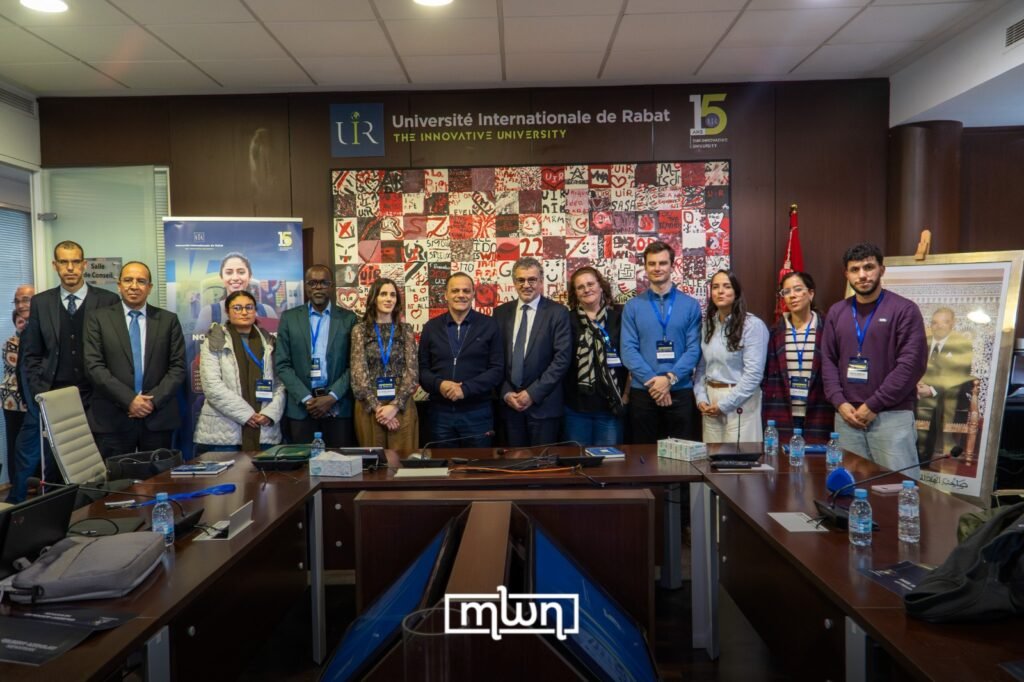
Rabat – The International University of Rabat (UIR) opened its doors to national and international media today for an immersive tour of its 30-hectare campus. Journalists walked through high-tech facilities, laboratories, and classrooms, and saw firsthand how the university is building links with industry while pushing research, sustainability, and employability at the center of its mission.
The visit combined guided tours with demonstrations and exchanges with the university’s leadership, who outlined UIR’s 15 years of development, academic priorities, and international ambitions.
UIR is structured around four main colleges: Engineering and Architecture, Social Sciences, Health Sciences, and Management, alongside a doctoral school dedicated to research and advanced studies. Since it opened its doors in 2010, UIR has welcomed more than 41,000 students across its programs.
A campus built for making, testing, and learning
To support this academic community, the university has developed a range of dedicated learning and research spaces adapted to each field. For students in engineering and architecture, UIR provides specialized laboratories and technical halls where they can move from theory to practice by working on prototypes, simulations, and applied research projects linked to industry needs.

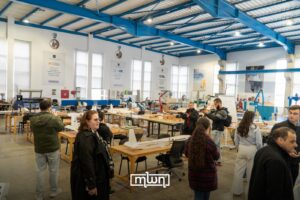
UIR’s campus feels like a working lab for tomorrow’s engineers, designers, and entrepreneurs. The “Halle Technique,” a 1,000 m² technical hall, is a hub for student-researcher projects where prototypes and small industrial parts are made.
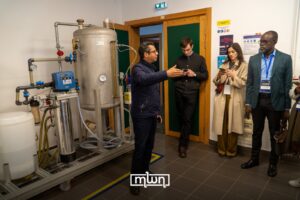
In addition, engineering facilities combine traditional teaching tools with advanced technologies, from a steam turbine simulator used to illustrate basic thermodynamics to modern equipment for electric vehicle systems, automation, and wind-tunnel testing.
Applied projects on campus include solar-powered seawater desalination, hydrogen production and storage, and solar-based electric vehicle charging. This reflects UIR’s focus on practical learning and clean energy.
Research and innovation also play a central role in UIR’s model. The university has invested in research infrastructure and partnerships that allow students and researchers to develop applied projects, particularly in fields such as renewable energy, industrial engineering, and sustainable technologies.

Students in other disciplines, including communication, social sciences, and management, also benefit from digital learning spaces and data-driven environments that allow them to work with real tools and real-world information.
The communications school showed off dedicated spaces built for hands-on learning. This includes camera and lighting kits, projection and voice-over rooms, a podcast room, a design studio, and computer labs. Students can practice filming, sound production, and editing in professional-style environments.


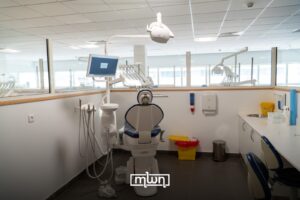
Meanwhile, the College of Health Sciences guided visitors through clinical training areas for dentistry students, including imaging facilities, patient reception spaces, and dental clinics. The dental program highlighted careful supervision, with one professor for every four or five students, and a focus on sterilization protocols.
The campus dental suite has over 75 dental units, an open space design for supervision, and a special children’s area for pediatric dental care.

RBS’s vision
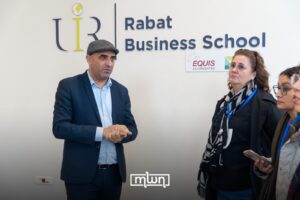
Meanwhile, the Rabat Business School’s trading room shows the school’s emphasis on experiential learning. A connected trading room with Bloomberg terminals gives students access to live data for projects and exercises. The school also showcased a large auditorium of over 600 seats and game rooms for student life and active learning.
Nicolas Arnaud, Dean of RBS, stressed the school’s international push, saying its central aim is to “build a world reference business school in Africa.” Arnaud told MWN that RBS recently achieved double accreditation (AACSB and EQUIS) and is aiming for the “triple crown” of business school accreditations.


The school saw a sharp rise in international recruitment in recent years, with a 60% increase in terms of international recruitment in September 2025, he noted, stressing: “We tripled the number of students not coming from Africa but coming from Europe, France, the UK, Germany, Thailand, China, and also North America.”
Arnaud also emphasized a push toward experiential pedagogy and preparing leaders for an AI-present future. “We’d like to invest a lot in experiential learning…because new generations are coming,” he said.
UIR’s campus is also home to state-of-art sports facilities for students interested in athletics. The campus notably includes an Olympic-style semi-olympic pool, a university swim team among others, a multi-purpose sports hall, and a football stadium.
Its green areas and a central lake offer a calm contrast to technical halls and labs. The university currently has a built capacity for about 12,000 students on campus, and it is preparing to double that on-campus capacity as it builds new dorms and facilities.


Research, innovation, and global partnerships
Speaking to MWN on the sidelines of the visit, UIR President Noureddine Mouaddib highlighted UIR’s patent activity and international partnerships. “We work with international partners to launch laboratories accredited by the CNRS, as well as with our strategic partners, including Sorbonne University and the University of Lorraine.”
He recalled the university’s strong record in intellectual property, noting that UIR leads African universities in patent filings, with nearly 700 patents registered, including around 20 at the international level.


Mouaddib presented employment outcomes as a key success metric. “We are very pleased to say that 93% of our students find employment within less than one year,” Mouaddib said. He described that outcome as proof the university’s strategy, of employability, research, and training, is working.
The university’s student body is resolutely international, with the UIR data indicating that 88% of the university’s international students come from Africa, 9% from Europe, 3% from the Americas, and 1% from Asia. Mouaddib described the wider goal to attract a growing share of the roughly six million international students studying outside their home countries, and particularly to become a destination for students across Africa, Europe, and Asia.

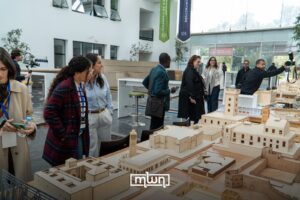
“That is the ambition of our university, beyond all the projects currently underway, including a new campus in Marrakech, another in Casablanca at Casa Finance City, and certainly another campus in Nouaceur,” he said.
UIR’s development projects for 2040 include the launch of several new campuses across Morocco, notably in Marrakech, Laayoune, Tangier, Oujda, and Casablanca. These projects represent a total investment of MAD 12 billion. The development plan also includes the construction of a UIR hospital spanning 65,000 square meters.
The final impression from the visit was of a university that wants to be more than a local school. UIR aims to be a regional hub for innovation, practical training, and international education.

As Nicolas Arnaud put it, building global recognition is not only about rankings or accreditations. “It’s a very, very good reason not just to retain Moroccan youth in Africa, in Morocco, but also, to attract people from the Global North in order for them to choose Africa, to choose Morocco, and to choose Rabat Business School.”