


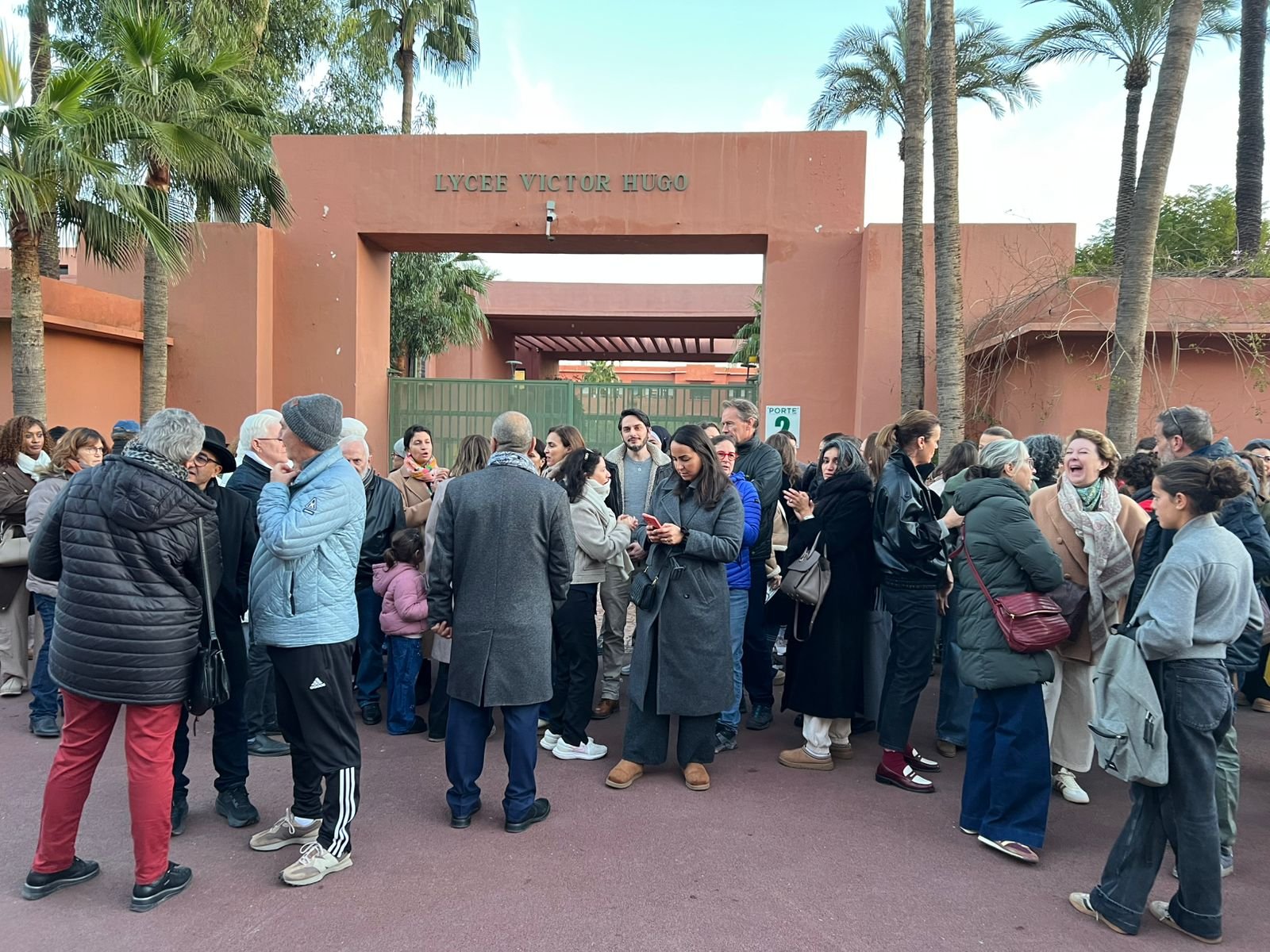
Marrakech – Parents at Marrakech’s prestigious French Lycée Victor Hugo say they are confronting a troubling paradox: steadily rising tuition fees accompanied by a visible deterioration in basic hygiene and infrastructure.
Several families told Morocco World News (MWN) that student lockers used by middle and high school pupils are in an alarming state.
Photos and videos shared with the publication show extensive mold and fungal growth inside the storage units – conditions that parents warn pose serious health risks, including allergies, respiratory irritation, and the potential spread of contamination to other areas of the school.
Parents have formally demanded immediate inspection, deep cleaning, and disinfection of the affected facilities, questioning how such conditions could persist in a high-fee international institution.
The concerns come amid sharp tuition increases across the student body. Monthly fees for Moroccan students have risen to MAD 5,200 ($520), while French nationals pay MAD 4,600 ($460). Students of other nationalities now face fees exceeding MAD 6,000 ($600) per month.
Across all categories, parents report increases of more than MAD 1,000 ($100), undermining expectations that higher costs would translate into improved services and standards.
These hikes sparked widespread protests on Thursday, as dozens of parents gathered outside the school to denounce what they describe as sudden and cumulative increases imposed over three consecutive years.
The mobilization at Victor Hugo reflects a broader wave of unrest affecting French schools nationwide. On December 18, 2025, the Agency for French Education Abroad (AEFE) announced tuition increases of up to MAD 10,000 ($1,000) per child across its Moroccan network, triggering demonstrations from Rabat and Kenitra to Marrakech.
At Victor Hugo, a collective of three parent associations has coordinated large-scale protests, condemning what they describe as a “progressive shift of French education abroad from a public service mission toward a commercial, selective, and socially exclusionary model.”
‘Families cannot compensate for the French state’s withdrawal’
Parents argue that families are being asked to absorb the financial consequences of France’s disengagement from its overseas education system.
According to parent representatives, the increases stem largely from France’s decision to gradually transfer civil pension costs for French civil servants to directly managed schools.
This cost transfer – set at 35% in 2026 and rising to 50% the following year – has resulted in automatic tuition hikes of 5.7% this year and an additional 7% next year. First-time registration fees have also climbed considerably, now reaching MAD 30,000 ($3,000), up from MAD 25,000 ($2,500).
Parents further point to structural underfunding at the state level. French government allocations to AEFE have reportedly fallen by €59 million over the past two years, while more than €90 million in recurring structural costs have been shifted onto individual establishments.
“Families cannot compensate for the French state’s withdrawal,” one of the parent associations said, warning that access to French education in Morocco is becoming increasingly restricted to affluent households.
In Rabat, anger crystallized into concrete action: demonstrations were held outside several schools, followed by the submission of nearly 3,000 individual letters to the French Embassy and to the principal’s office at Lycée Descartes. This wave of protest, emblematic of the scale of the backlash, drew attention in Paris.
In response to mounting criticism and sustained mobilization, the French Senate dispatched Senators Yan Chantrel and Mathilde Ollivier to Morocco to conduct a comprehensive assessment of the AEFE network.
Founded in 1962, Lycée Victor Hugo serves approximately 2,350 students and operates under direct AEFE management as part of the largest French education network in the world.
For many parents, the crisis exposes a widening rupture between the promise of educational excellence and the reality of an increasingly exclusionary French schooling model in Morocco. As protests continue, families say they are no longer questioning fees alone – but the very model of French education abroad.
