


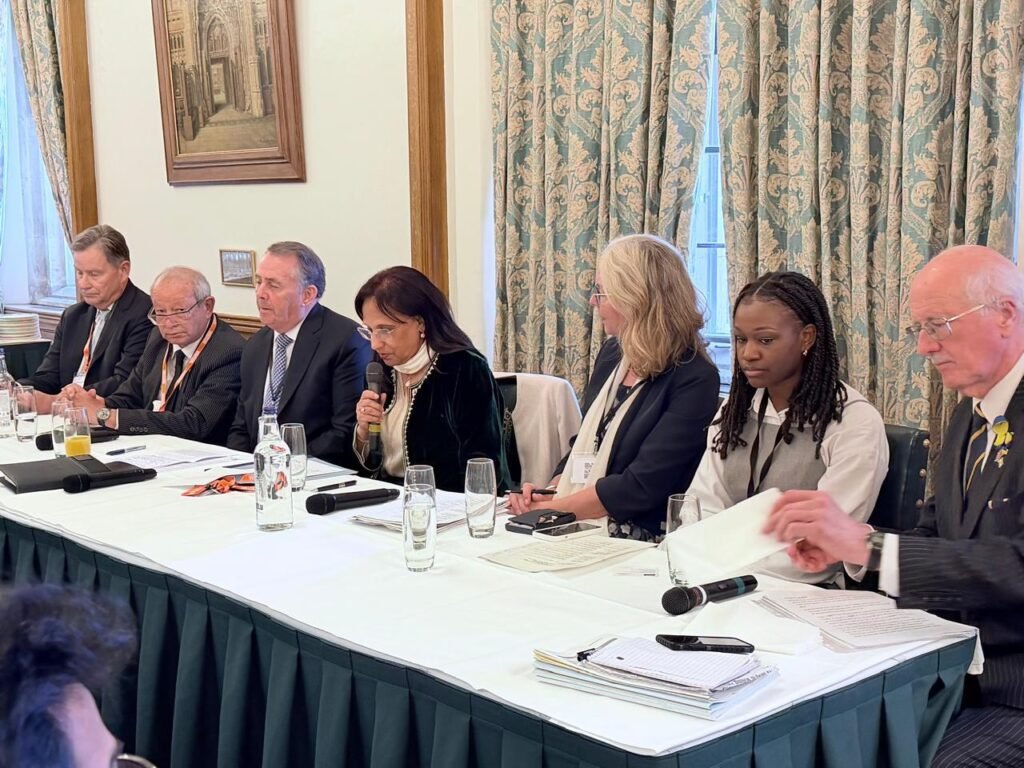
Rabat – Amina Bouayach, president of Morocco’s National Human Rights Council (CNDH), presented at the UK House of Commons key elements of Morocco’s approach to organizing the religious sphere and protecting religion from political exploitation.
Bouayach delivered a keynote address at an international meeting held in Churchill Hall on Thursday, where participants discussed the need for a global framework to prevent the misuse of religion for political purposes. Organizers described Morocco’s model as “distinct and advanced,” and thanked the country for hosting a similar conference last year with support from the CNDH.
In her remarks, Bouayach explained that Morocco’s model is based on clear institutional oversight. The Supreme Council of Ulema, chaired by King Mohammed VI, plays a central role as the only body responsible for issuing religious opinions. This structure helps ensure that religious interpretation remains consistent with social developments, argued the CNDH president.
She also recalled initiatives that reflect this approach, including the “mourchidates” program, which trains female religious guides. This initiative has strengthened women’s participation in the religious field, Bouyach said. She added that Morocco is among the few Muslim-majority countries where women are allowed to work as “adoul,” or notaries authorized to register marriage contracts.
According to her, this framework has helped limit extremist interpretations of religion while promoting a moderate and open understanding that expands rights rather than restricts them.
Read also: Amina Bouayach Receives International Award for Combating Political Abuse of Religion
The CNDH President also noted that Morocco prohibits the creation of political parties based on religion. She also pointed to rehabilitation programs such as “Moussalaha,” which aims to reintegrate individuals convicted in extremism-related cases through psychological support, education, and human rights training.
Morocco’s model shows how responsible governance, combined with the protection of rights and freedoms, can act as a barrier against the political misuse of religion.

Bouyach called for international efforts to establish clear standards to address the issue globally. She stressed that any such initiative should not aim to regulate religion itself, but rather to protect individuals and faiths from political manipulation or discrimination.
She proposed defining what constitutes the “misuse of religion,” distinguishing between legitimate religious practice and its exploitation for domination or incitement to violence. “Freedom of religion is not limited to belief,” she said, “but also includes protection from coercion and manipulation carried out in its name.”
Bouayach urged banning the use of religion to justify violence, exclusion, or violations of fundamental rights, while emphasizing the responsibility of states to uphold human rights and the rule of law.
The CNDH chief concluded by calling for stronger investment in education, institutional oversight, and international cooperation to address cross-border religious extremism, saying that religion should remain a force for stability and peace rather than division.