


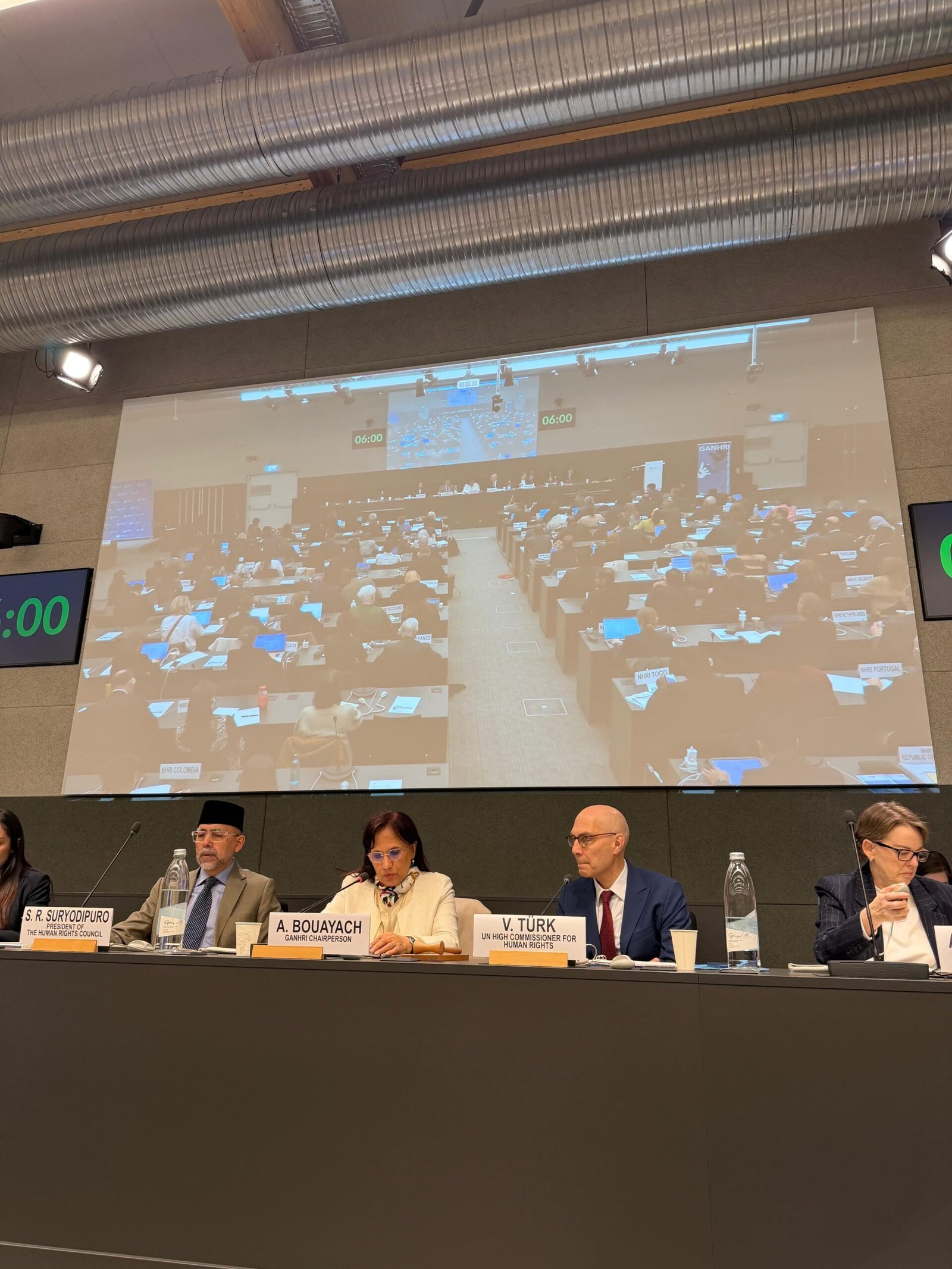
Rabat — The Chair of Morocco’s National Human Rights Council and President of the Global Alliance of National Human Rights Institutions (GANHRI) has urged international stakeholders on Wednesday to place human rights at the core of digital innovation, warning that emerging technologies carry both opportunities and risks for global societies.
Amina Bouayach made the remark while speaking at the annual GANHRI 2026 conference at the Palais des Nations in Geneva, where she highlighted the growing influence of artificial intelligence and digital tools on everyday life, from communication and work to public participation.
The conference, attended by UN High Commissioner for Human Rights Volker Türk and the President of the Human Rights Council, Sidharto Riza Seradipura, aimed to strengthen cooperation between national institutions and the UN to safeguard rights in the digital age.
“These technologies can expand access to rights and improve public services, but they can also deepen inequalities, threaten freedoms, and expose individuals to new risks,” she said.
Bouayach emphasized the responsibility of governments, tech companies, and human rights institutions to ensure ethical use of digital tools. The CNDH chief warned against unchecked technologies such as facial recognition and algorithmic systems, which, without proper safeguards, could undermine fundamental rights. She also called for recognition and protection of content moderators and data annotators, whose labor underpins the digital ecosystem.
The president framed the debate as a choice between passive adoption and proactive governance: “It is not technology that will decide our future—it is us. We must make the right choices and direct these transformations toward dignity, justice, and inclusion,” she said.
Her remarks positioned Morocco as a leading voice in advocating for responsible AI use and digital inclusion, reinforcing the country’s growing role in international human rights initiatives.
Digital Inclusion and Equity
Bouayach stressed that access to AI and digital technologies must be equitable. She warned against creating a “digital elite,” urging policymakers to ensure that vulnerable communities also benefit from technological advances.
Her remarks reinforced Morocco’s growing international role in advocating for responsible AI and digital rights, highlighting the country’s commitment to shaping global governance frameworks and promoting international cooperation.
Bouayach concluded by stressing the importance of global coordination, noting that challenges like algorithmic bias and disinformation require collective action from states, UN bodies, civil society, and private tech companies.
