


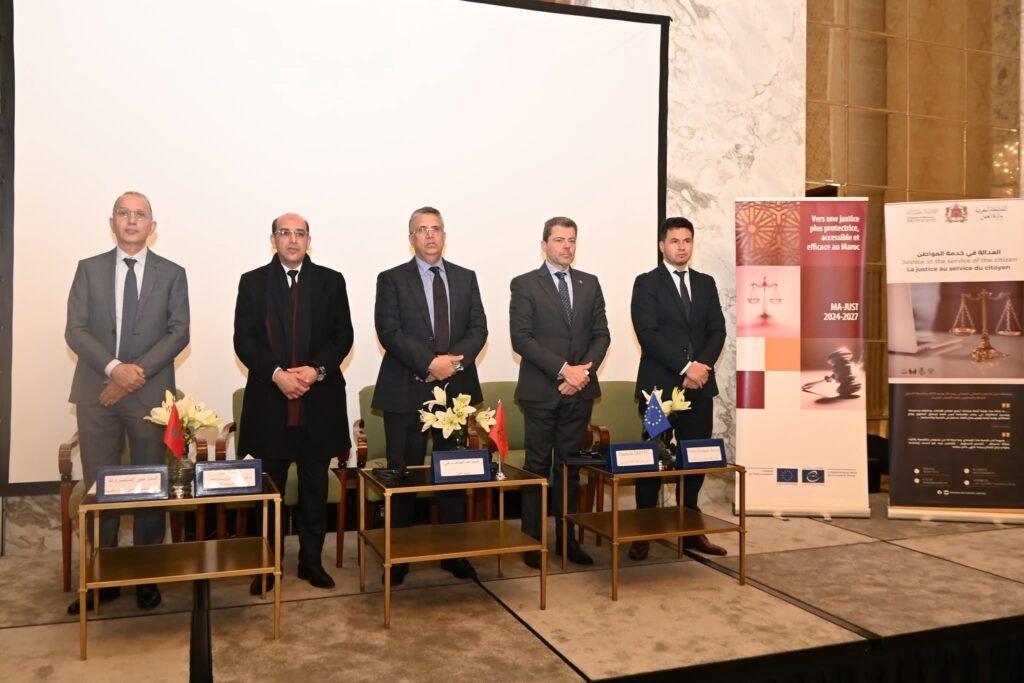
Rabat – On Tuesday, Morocco’s Ministry of Justice convened a national forum to commemorate International Women’s Day, entitled “Women’s Access to Justice: Achievements, Challenges, and Prospects.”
The event, organized in collaboration with the Council of Europe under the MA-JUST program, aimed to assess legal reforms and institutional mechanisms designed to enhance women’s access to justice.
Yet, despite its thematic focus, the forum’s structure showed a fundamental contradiction – all keynote speakers and panel leaders were men.
Government officials, judicial authorities, and academics delivered the entire formal program, while women, many of whom represent civil society, were restricted to audience roles, with no platform to speak up or contribute substantively.
This composition is a good example of exclusionary logic of institutional representation, in which women are discussed and legislated for, yet rarely participate in the decision-making spaces that define their rights.
The forum exemplifies an outdated symbolic approach to gender equality imbalances. While Morocco’s reforms may appear progressive in legal text, their enactment remains somewhat mediated through patriarchal institutional hierarchies.
Legal achievements and institutional contradictions
Minister Abdellatif Ouahbi opened the forum by pointing to Morocco’s legal milestones. He referenced the 2004 Family Code, which codified women’s rights within familial and social structures, and the 2011 Constitution, which formally guarantees equality and non-discrimination and enshrines Morocco’s adherence to international human rights conventions.
The forum also reviewed procedural reforms, including updates to the Civil and Criminal Procedure Codes, the establishment of specialized court units for women and children, and the creation of the Gender-Responsive Justice Observatory tasked with monitoring and evaluating public policies affecting women and vulnerable populations.
While these reforms signify institutional recognition of gender concerns, the all-male forum illuminates the critical disjunction that the existence of laws does not equate to the redistribution of institutional power.
Such codified rights, when produced and discussed exclusively within male-dominated forums, risk perpetuating structural inequalities and reproducing patriarchal authority under the guise of progress.
Institutional gatekeeping and structural exclusion
The absence of women also mirrors a broader pattern of institutional gatekeeping. Despite decades of constitutional and legal progress, critical forums, ministerial programs, and judicial decision-making spaces remain overwhelmingly male-dominated.
Civil society representation, while present, was relegated to spectatorship rather than active participation.
This scenario illustrates a blatant representation gap, where institutions may legislate equality, yet the mechanisms of power – who sits on panels, frames the discussions, and sets the agenda – remain dominated by men.
This structural exclusion undermines the legitimacy and efficacy of reforms, reducing gender equality to performative displays rather than actionable change.
Morocco’s gender equality rhetoric
The forum exposes the tension between rhetoric and practice. While Moroccan law has advanced significantly, through constitutional provisions, family law reforms, and procedural updates, the lived realities of institutionalized patriarchy continue to shape whose voices are heard.
Legal frameworks may codify equality, but representation, participation, and authority are necessary for these frameworks to translate into meaningful justice.
Morocco’s women’s justice forum raises a critical question: how can women truly access justice if they are absent from the platforms that define, implement, and evaluate justice itself?
Symbolic commemoration without substantive inclusion risks transforming legal reforms into abstract ideals, disconnected from the material realities of women’s lives.
This event shows that Morocco’s pursuit of women’s rights continues to be limited by entrenched male dominance. Without women in positions of authority within forums, ministries, and courts, even the most advanced legal reforms fall short.