


Rabat – Despite renewed lobbying by a small group of countries that continue to promote outdated pro-Polisario narratives, such maneuvers have not slowed Morocco’s diplomatic momentum and strategic partnerships, including with the EU.
On Thursday, the European Union adopted a unified position supporting Morocco’s Autonomy Plan as one of the most realistic solutions to end the Western Sahara dispute.
This trajectory comes as part of the diplomatic gains Morocco recorded in recent years, with over 120 countries – including European countries – supporting Rabat’s proposal.
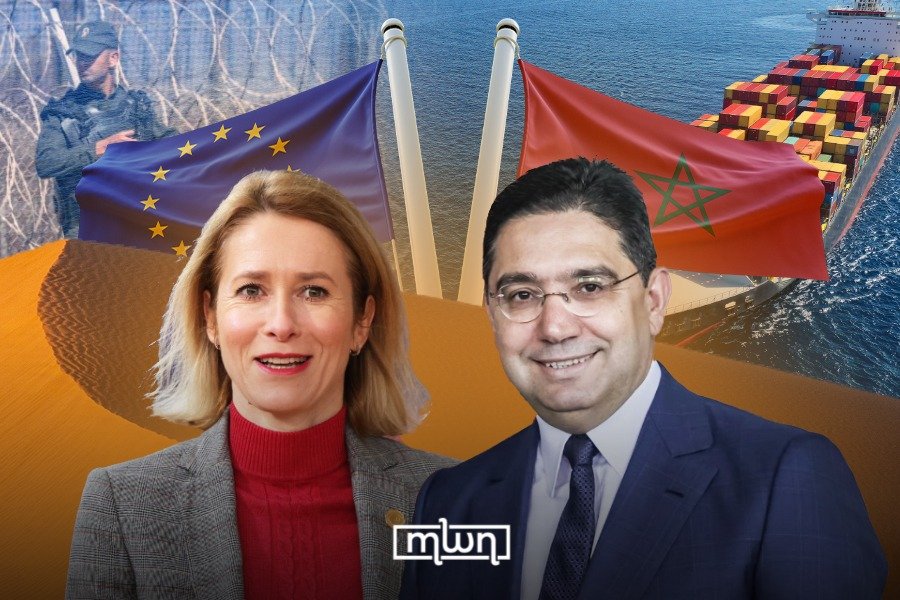
The unified position came in a joint communique that Foreign Affairs Minister Nasser Bourita signed with EU High Representative Kaja Kallas during the 15th EU-Morocco Association Council session in Brussels.
One of the major takeaways from the council is the participation of high-level officials, including Kallas, and the presence of Commissioner for the Mediterranean Dubravka Suica, and for the first time over than seven foreign affairs ministers representing European countries, such as Spain, the Netherlands, Slovakia, Estonia, Malta, and the Czech Republic.
This is in addition to other senior representatives of EU Member States.
“This is concrete proof that the EU sees Morocco as a major partner, not just a neighbor,” a source familiar with the dossier told Morocco World News (MWN).
The EU-Morocco joint statement lands in a context marked by sustained obstructionist campaigns led by Algeria’s regime and a shrinking ecosystem of pro-Polisario advocates, whose political project has long revolved around undermining Morocco’s territorial integrity and sovereignty over its southern provinces in Western Sahara.
For decades, Algeria’s military junta invested heavily in Polisario’s political sabotage aimed at manufacturing doubt around the Morocco-EU partnership, by targeting key sectors like agriculture and fisheries.
The Algerian lobbying attempts intensified further after the 2024 ruling of the EU Court of Justice, which annulled EU-Morocco partnership agreements, alleging they didn’t respect what the court described as the “right of self-determination of the Western Sahara population.”
Despite these increasingly frantic maneuvers, the EU and Morocco “stood together and displayed a steel unity,” the official source with knowledge of the Council meeting, who requested anonymity, told MWN.
“The revised agricultural agreement of last October is already being implemented, explicitly including the southern provinces in tariff preferences. The partnership not only overcame the obstacles but emerged stronger under pressure,” the source concluded.
In October last year, Morocco and the EU signed an amendment to the agricultural agreement, further backing Rabat’s position.
The agreement stipulates that agricultural products originating from Morocco’s southern provinces will benefit from the same preferential access conditions to the EU as those from the rest of the country.
The deal also introduces technical adjustments designed to facilitate access for Moroccan produce, with an emphasis on consumer information, including labeling regions of production. Earlier this month, reports said the European Commission is set to launch negotiations with Morocco on a new fisheries agreement in the coming days, noting that EU ambassadors authorized the EU Commission to launch negotiations with Morocco.
Substantial shift in EU position on Sahara
The position conveyed through the joint statement from the EU also reflects a major diplomatic breakthrough and a unified stance. Recently, many countries from the EU have joined the growing chorus in support of the Autonomy Plan. However, a unified position from the EU sends a new direct blow to Algeria’s regime and could also contribute to neutralizing their separatist, hostile, and coordinated obstruction within the European Parliament.
The new position shows that for the first time, all EU Member States unanimously endorsed the autonomy initiative as the central basis for negotiations, aligning their stance with UN Resolution 2797.
The UN Security Council adopted the resolution last year in October, officially endorsing the Autonomy Plan as the genuine political process to end the dispute over Western Sahara.
The resolution also explicitly identified the parties to the dispute, naming Algeria as part of the parties and urging it to shoulder its responsibility and contribute to the UN-led political process.
The joint statement also reflect EU’s approach in turning the page on calculated ambiguity and outdated neutrality, while endorsing the initiative as the only political solution – a strategy developed under King Mohammed VI’s leadership – resulting in widespread support from the international community.
The EU-Morocco Association Council also came to reaffirm the political launch of a new phase of bilateral ties between the two parties, as it marked developments far from a routine diplomatic engagement.
Instead, the meeting came to introduce a higher level of cooperation covering three key elements, including the EU-Morocco decision to establish a regular high-level political dialogue between Bourita and Kallas.
This effectivley create a bilateral political council tasked with strengthening the partnership.
The second key development is how the council granted a formal mandate to negotiate a new, deepened strategic partnership that expands cooperation on security, industry, digital development, and investment.
The cooperation will also include the EU’s explicit recognition of Morocco’s geopolitical role as a stabilizing leader in the Mediterranean and a driving force in Africa through its initiatives, namelythe Atlantic Initiative.
For the EU, Morocco has always been an indispensable actor in regional peace efforts.
On Thursday, Morocco also conveyed its position, valuing bilateral ties and partnership with the EU.
“I am convinced that this meeting will be fruitful and bring positive perspectives for both parties,’ Bourita told reporters before the council session.
He also stressed his country’s commitment to continue boosting bilateral ties with the EU, recalling King Mohammed VI’s leadership that boosts Morocco’s position as a stable partner that offers “visibility to its allies while demonstrating lucid and precise understanding of regional and international issues.”
