


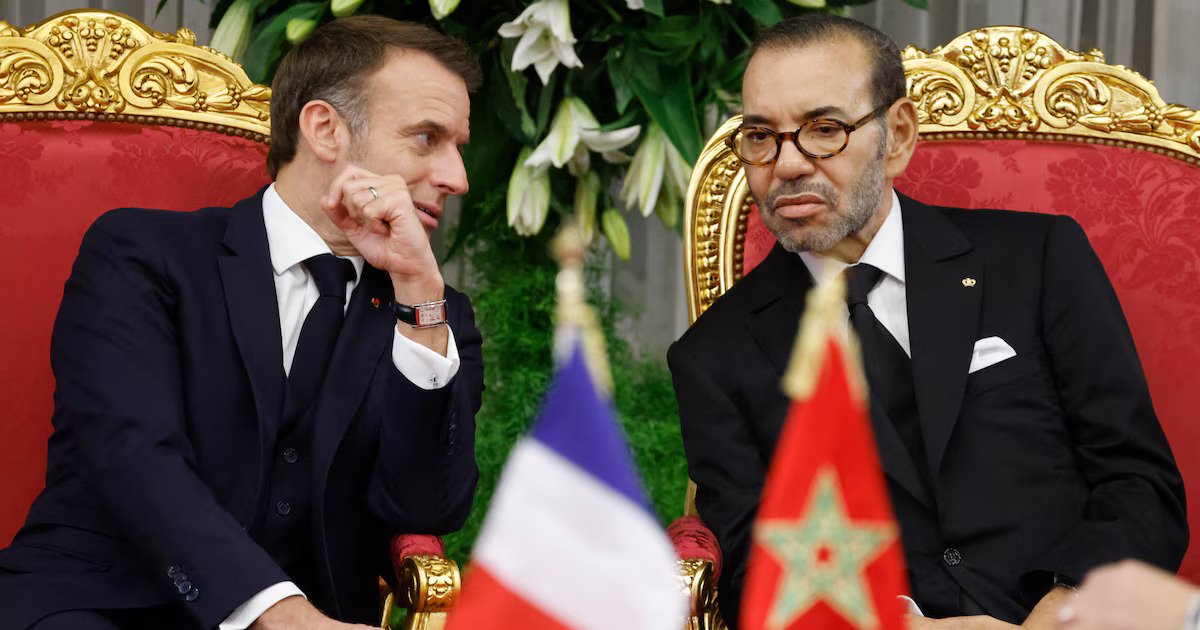
Marrakech – France and Morocco are quietly building what would be the first bilateral treaty between Paris and a non-European country from the Global South. A joint committee of 11 members is already at work on the text, Le Monde reported on Thursday, with a first draft expected in May.
The French side is supervised by former Foreign Minister Hubert Védrine, who accepted the mission in September 2025. Védrine, who maintains close ties with Morocco, was approached by Anne-Claire Legendre, former Africa adviser to President Emmanuel Macron. He organized two initial meetings with fellow committee members before the end of last year.
The French panel includes former Defense Minister Florence Parly, High Commissioner for Children Sara El Haïry, who holds dual Franco-Moroccan nationality, Safran board chairman Ross McInnes, and Christian Masset, president of the Mission Laïque Française and former secretary general of the French Foreign Ministry.
On the Moroccan side, the committee is coordinated by High Commissioner for Planning (HCP) Chakib Benmoussa, a former education minister. His team includes OCP Group CEO Mostafa Terrab, former Secretary of State for Foreign Affairs Mounia Boucetta, human rights advocate Driss El Yazami, novelist Leïla Slimani, and political scientist Rachid Benzine.
The two sides held their first joint meeting in Rabat in March. Members are not paid for their work. They communicate by phone and correspondence, operating informally without dedicated staff – only meeting rooms at the Elysée Palace and the Quai d’Orsay, the headquarters of France’s Foreign Ministry.
According to Le Monde, the timeline follows a two-stage process. A first version of the text is due in May, and it is being drafted in parallel by the respective administrations. A more political version would follow during the summer. The treaty could be formally unveiled during a state visit by King Mohammed VI to France, potentially in the autumn.
Such a visit would be the first of its kind since May 2012, when the newly elected François Hollande hosted the king at the Elysée. Mohammed VI has since made multiple private trips to Paris, where he owns a private mansion, but has not engaged in official meetings with the French executive.
The treaty’s scope remains broad and its title unsettled. Even the label “friendship treaty” is not confirmed. Christian Lequesne, a professor at Sciences Po and an expert on the Franco-German friendship treaty, told Le Monde the text could cover economic cooperation, diplomatic foundations, university and cultural exchanges, civil society issues, migration, and binational citizens. “What do you put in a treaty of this type, once the general principles have been set?” he asked.
Lequesne said he was not surprised by the panel’s diverse composition. He was more struck by the informal working method. Typically, a secretariat of senior civil servants oversees such efforts. This committee operates without that structure.
The Sahara question still haunts the treaty’s drafting table
A key point of tension within the drafting process is the likely inclusion of a reference to Morocco’s sovereignty over Western Sahara. Le Monde reported this remains a point of debate on the French side but is a firm demand from Rabat.
Paris officially recognized Moroccan sovereignty over Western Sahara in July 2024, when Macron wrote to King Mohammed VI on the 25th anniversary of his accession to the throne. Macron notably declared in his letter that the region’s present and future fall within Moroccan sovereignty and that the autonomy plan proposed by Morocco in 2007 is “the only basis” for a just and lasting political solution.
The move came after years of Moroccan pressure on France to abandon what Rabat viewed as a deliberately calibrated ambiguity. It also followed analogous realignments by the United States in 2020 and Spain in 2022.
Macron followed his letter with a three-day state visit to Rabat in October 2024 – his first in six years. The two heads of state signed 22 agreements worth up to €10 billion during the visit, covering sectors ranging from high-speed rail and green hydrogen to water management, agriculture, and defense.
Macron addressed the Moroccan parliament and declared that Morocco would always hold a “singular role as a gateway to Africa,” arguing France’s position is “not hostile to anyone.” France subsequently updated all government-affiliated maps to reflect Morocco’s complete territorial integrity. School textbooks for the 2024-2025 academic year followed suit.
The diplomatic weight of France’s recognition, as a permanent member of the UN Security Council, proved decisive at the multilateral level. In October 2025, UN Security Council Resolution 2797, which renewed the mandate of MINURSO, referenced Morocco’s 2007 Autonomy Proposal as a basis for negotiations and the final status of Western Sahara – the first time the Council had done so in such explicit terms.
France was among the key members of the so-called “Group of Friends of Western Sahara,” alongside the United States and the United Kingdom, that helped shape the resolution’s language. At that point, three out of five permanent members of the Security Council were aligned with Morocco’s position.
Inside the French state, the fracture persists
Yet none of this erased a deeper, more tectonic tension within the French state itself. Throughout the years of diplomatic freeze between Paris and Rabat – roughly 2021 to 2024 – a widening schism crystallized between the Elysée’s diplomatic signaling and the entrenched dispositions of parts of the French institutional apparatus.
Segments of the French foreign policy establishment, sections of the intelligence community, and influential media outlets had long operated within a strategic framework that treated Algeria as France’s principal North African interlocutor. This was a legacy of colonial history, energy interdependence, and a migration relationship that binds millions of binational citizens to both countries.
During the period when ties with Rabat were severed at the nerve – over visa restrictions, Pegasus spyware allegations, and France’s refusal to move beyond calling the autonomy plan merely “serious and credible” – these institutional currents found in Algeria a more familiar and, for some, more ideologically comfortable partner.
Macron himself had attempted a rapprochement with Algiers, visiting in 2022 and describing colonialism as a “crime against humanity.” But that gambit imploded, and the French president has since pivoted irreversibly toward Rabat.
The Elysée’s recognition of Moroccan sovereignty thus arrived not as a consensus position within the French state, but as a presidential decision imposed over institutional inertia – what Marine Tondelier, leader of the French Green party (Les Écologistes), described as “a decision taken by one man, at the head of a state without a government or a majority.”
The broader diplomatic calendar adds urgency. A high-level meeting between the French and Moroccan prime ministers is planned for May in Rabat. Established in 1997, this annual gathering has not been held since 2019. Its resumption signals the depth of the diplomatic reset. But both countries face electoral pressures. Morocco holds legislative elections in September. France faces a presidential vote in April 2027, making a royal visit next year unlikely.
Algeria’s energy card grows
This Franco-Moroccan trajectory, however, does not unfold in isolation. It runs parallel to a far more tentative – and structurally thaw, fragile – diplomatic recalibration between Paris and Algiers. This strategic readjustment introduces a competing axis into France’s North Africa calculus and raises fundamental questions about whether Paris can deepen ties with Rabat while simultaneously rehabilitating with Algeria a relationship that remains hostage to colonial memory, energy interdependence, and the unresolved fault line of Western Sahara.
The Atlantic Council noted recently that French Ambassador Stéphane Romatet may soon return to Algiers. Algeria’s parliament amended a law on colonial-era grievances in March, removing provisions that demanded formal French apologies. French Interior Minister Laurent Nuñez visited Algiers in February. Algerian Foreign Minister Ahmed Attaf and his French counterpart Jean-Noël Barrot spoke by phone on March 15 after nearly a year of silence.
Yet the Atlantic Council cautioned that Algeria “has not matched its recent diplomatic progress with a coherent political strategy,” warning that the rapprochement risks stalling in “a new limbo.”
What drives France toward Algeria is partly energy. Since Russia’s invasion of Ukraine in 2022, Europe has committed to ending reliance on Russian fossil fuels. The EU has finalized a phased, mandatory embargo on all Russian gas – both LNG and pipeline – to be fully implemented by late 2027 under the REPowerEU strategy. EU Energy Commissioner Dan Jørgensen recently ruled out any reversal. “In the future, we will not import as much as one molecule from Russia,” he said.
This structural shift benefits Algeria directly. A Carnegie Endowment analysis found the Ukraine crisis gave Algiers “a golden opportunity to establish itself as one of Europe’s most prominent energy partners.”
The ongoing Iran war and Gulf energy disruptions only deepen that advantage. Every spike in oil and gas prices fills Algerian state coffers, funding military and diplomatic ambitions. Algeria is also developing the Trans-Saharan Gas Pipeline linking Nigeria to the Mediterranean through Niger, which could further anchor its role in European energy security.
That energy leverage carries political weight. Algeria could use its growing clout with European gas clients to press a pro-Polisario line on Western Sahara, or at least push partners to soften their alignment with Rabat. It has already tightened ties with Italy and Germany through long-term gas contracts.
Residue of a bureaucracy still loyal to old maps
Meanwhile, the France24 map controversy this week offered a reminder of how raw these sensitivities remain. The French state-funded broadcaster published a graphic of African teams qualified for the 2026 World Cup that showed Morocco’s southern provinces separated from the rest of the country. The move contradicts France’s official position and drew sharp criticism from Moroccans online.
“It knows exactly what it’s doing by splitting the map in two,” one user wrote on X. Another pointed out that France24 is public media and “the voice of the Elysée,” suggesting the map was a pressure tactic linked to treaty negotiations.
Whether deliberate or careless, the incident laid bare a persistent and deeply structural pattern in which symbolic gestures on maps and media carry real diplomatic weight. For many in the North African kingdom, these are not accidents but symptoms of that unresolved fracture between what the French president says and what parts of the French state machinery continue to signal.
For Rabat, the treaty process is not an exercise in ceremonial friendship. It is a race to codify irreversible commitments from Paris at a moment when the window remains open – before Europe’s deepening energy dependence on Algeria, the structural realignment of Mediterranean geopolitics, and the growing transactional logic of fossil fuel diplomacy hand Algiers the kind of leverage that could fundamentally alter the balance of France’s North Africa policy and, with it, the diplomatic architecture Morocco has spent decades constructing.
