


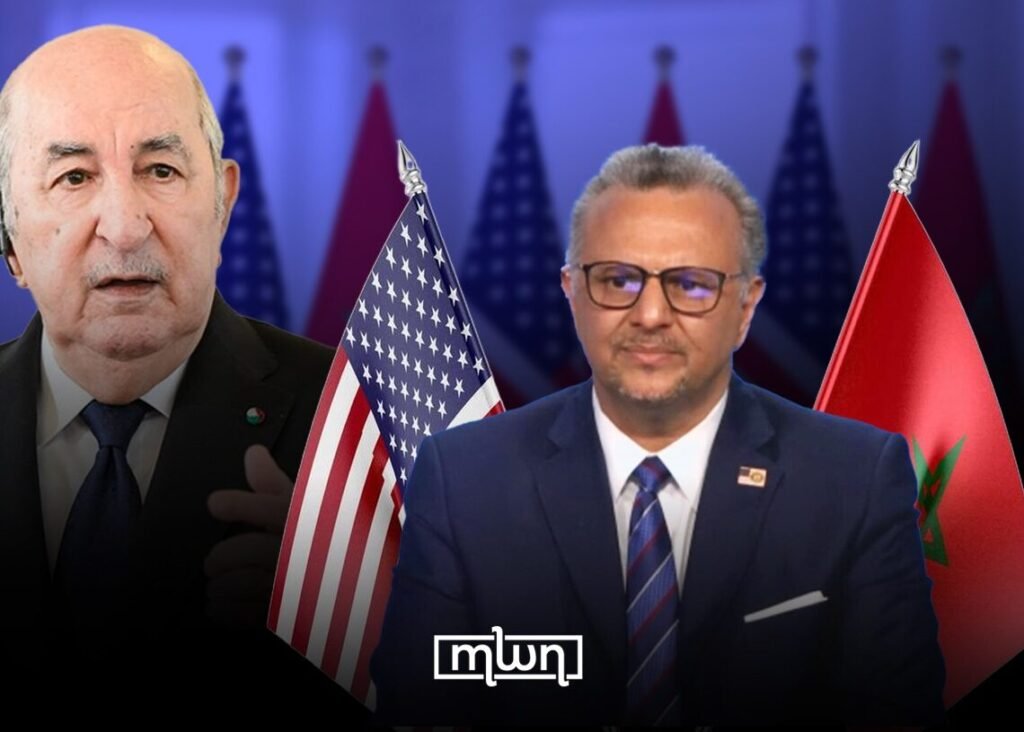
Beni Mellal – In his first media appearance following the Madrid talks, Massad Boulos, Special Adviser to US President Donald Trump for African and Middle Eastern affairs, did what he invariably does when he speaks on the file.
The American official dismantled – methodically and unequivocally – the long-standing Algerian fiction that it is merely an “observer” in the Western Sahara dispute. In doing so, he stripped away diplomatic camouflage, forced Algeria to confront the reality it has spent decades denying, and summoned the ruling regime back to the facts it has long tried to outrun.
Speaking to Deutsche Welle on February 14 on the sidelines of the Munich Security Conference, Boulos anchored his remarks in the binding authority of the United Nations, indicating that UN Security Council Resolution 2797 explicitly names Algeria as a party to the conflict.
“This is a very old conflict – more than fifty years – and therefore extremely complex,” Boulos said, stressing that the process remains “fully framed by the decisions of the Security Council and the UN-led track.”
He described UN Security Council Resolution 2797, adopted in October, as “an important and historic decision,” precisely because it breaks with decades of strategic ambiguity by explicitly naming the parties involved.
The resolution, Boulos noted, “clearly identifies the parties concerned: Morocco, the Polisario Front, Algeria, and Mauritania – each involved to different degrees.” There is no interpretive maneuvering left.
Far from offering any hermeneutic escape, Resolution 2797 locks Algeria into culpability – plainly and without refuge. It corners the regime textually and legally, stripping it of alibis, exits, and any remaining interpretive shelter.

The formulation was deliberate and lethal to Algiers’ narrative, collapsing its observer myth and locking the Algerian state firmly into the architecture of responsibility it has long sought to evade.
That clarity detonates the Algerian regime’s most cherished lie and ritualized falsehood – rehearsed again after Madrid – that it is a neutral bystander. Boulos’ intervention renders the claim legally void and diplomatically obscene.
While declining to disclose the contents of the autonomy document discussed in Madrid, Boulos cited confidentiality “out of respect for the parties concerned,” making clear that such details “belong to the parties involved – primarily Morocco and the Sahrawis.”
The United States, he stressed, “is not mandated to enter into the substance of those negotiations.” Yet on process and posture, Washington’s position was unambiguous.
The adviser reaffirmed that the US is the penholder on Sahara resolutions and has worked intensively within the UN system to advance the political track. “The United States plays a very important role within the United Nations on this file,” he said, putting emphasis on the efforts of the American mission to the UN.
“The American delegation worked intensively to reach Resolution 2797,” he added, noting that the resolution’s adoption and reception marked a rare diplomatic convergence. “When all parties welcome a Security Council resolution, that is a rare and positive indicator,” Boulos observed.
“Our position is always optimistic,” he said, attributing that outlook to “the pragmatism of President Trump’s leadership,” which, he argued, “gives hope for resolving complex conflicts” – not only in the Sahara, but across other protracted international disputes.
Addressing implementation, he cautioned against impatience. “These kinds of conflicts take time,” Boulos said, adding that “once the path is set, progress becomes possible.”
He articulated the need for strategic patience, warning against rushing outcomes in a dispute spanning more than five decades. “Placing the conflict on the right track is decisive,” he said, even if “the path may be long or short.” Still, he added pointedly, “the hope is that it will be as short as possible.”
The adviser’s comments also exposed the hollowness of the Polisario Front’s pretensions to independent agency. By situating the conflict within an explicitly four-party framework, the resolution – and Washington’s reading of it – implicitly recognizes what years of evidence have long suggested: that the Polisario functions not as an autonomous national movement but as an instrument embedded within Algeria’s regional hegemonic strategy.
In diplomatic terms, this is a withering demotion – from putative “representative” to appendage, client proxy militia subordinated to its patron state.
Boulos returned to these points the following day, February 15, in a wide-ranging interview on France 24, reiterating that Washington’s position is “fixed and unchanged” regarding Morocco’s sovereignty over its southern provinces.

He was explicit: US recognition of Moroccan sovereignty is a ceiling above Resolution 2797, even as Washington works within the resolution’s framework to facilitate negotiations. “Our position is stable and does not change,” he said, remarking that this stance has been repeatedly affirmed by President Trump, Secretary of State Marco Rubio, and by Boulos himself.
Pressed on Algeria’s role, Boulos again refused the observer fiction. Algeria and Mauritania, he said, are contacted as parties named in the resolution, even if they choose to limit their engagement.
Participation is not defined by rhetorical convenience but by international designation. Algeria’s attempt to hide behind semantics, he implied, cannot survive the plain language of Security Council texts.
The adviser’s intervention lands at a moment when the Algerian military junta – long accustomed to obfuscation and delay – has been compelled back to the table. After withdrawing in 2021 from UN-sponsored roundtables launched by former envoy Horst Köhler, Algiers resisted any format that exposed its direct stake.
‘These meetings will continue’
The resumption of talks in Madrid, under US auspices and within the strictures of Resolution 2797, marks a reversal forced by diplomatic gravity rather than voluntary enlightenment.
During the same interview, Boulos confirmed that the diplomatic track remains active and that further meetings are likely, even if no concrete arrangements have yet been finalized. “These meetings will continue, God willing,” he said, stressing that the objective is not endless dialogue but steady progress.
While no venue has been set for the next round – “this is a logistical matter,” he asserted – Boulos made clear that momentum is expected to carry forward, adding that the United States remains committed to facilitating discussions “as quickly as possible, without rushing the process or wasting time.”
What emerges from Boulos’ two appearances is a coherent American line: Algeria is not an observer; the Polisario is not sovereign; and Morocco’s autonomy initiative is the sole serious basis for a negotiated settlement. The language is diplomatic, but the implications are severe.
For the Algerian regime, this marks the final collapse of a half-century strategy built on denial, obstruction, deception, and long-practiced fraud. For the Polisario, it is an extinction as a separatist “dream.” And for the process itself, it is a re-centering of reality over slogans.
The only unresolved question now is internal and existential: how Algiers will reconcile its own people with the reality it long criminalized – how a state that spent fifty years manufacturing grievance, mythologizing conflict, and disciplining dissent will explain its acceptance of what it spent decades swearing could never be accepted.
In elevating Resolution 2797 as the dispute’s lodestar, Washington has narrowed the field of maneuver. There is now less room for theatrical abstention, less tolerance for manufactured ambiguity, and diminishing patience for proxy obstruction.
The message, delivered without bombast but with unmistakable force, is that the era of denial has expired – and that accountability, however delayed, has finally entered the room.
Read also: Madrid Talks Signal Beginning of Algeria’s Admission of Defeat on the Sahara