


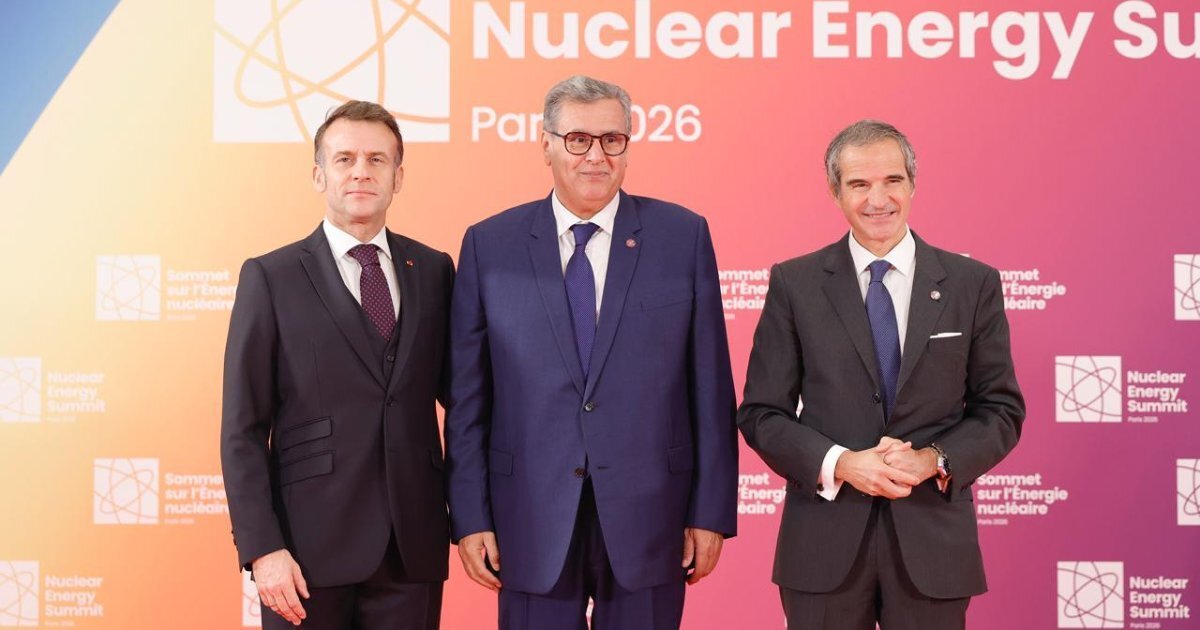
Rabat – Morocco joined world leaders and energy stakeholders in Paris today for the second International Nuclear Energy Summit.
Head of Government Aziz Akhannouch represented King Mohammed VI and presented Morocco’s approach to civil nuclear energy within its broader energy transition.
The summit, held at the initiative of French President Emmanuel Macron in partnership with the International Atomic Energy Agency (IAEA), gathers heads of state, senior officials from international organizations, financial institutions, industry leaders, and scientific experts.
Participants meet to examine how civil nuclear energy can respond to growing global electricity demand and the climate crisis.
Morocco’s delegation includes Foreign Affairs Minister Nasser Bourita, Director General of the Moroccan Agency for Nuclear and Radiological Safety and Security (AMSSNuR) Saïd Mouline, Director General of the National Center for Nuclear Energy, Science and Technology (CNESTEN) Hamid Marah, and Morocco’s ambassador to France Samira Sitail.
The Paris meeting follows a first edition held in Brussels in March 2024 and aims to strengthen political dialogue around nuclear energy at a time when countries reassess their long-term energy strategies.
Morocco links nuclear energy to its long-term energy strategy
During the opening session, Akhannouch said Morocco views the responsible integration of civil nuclear energy as a natural extension of its national energy policy.
He recalled that Morocco launched an integrated energy strategy in 2009.The policy rests on three central pillars: diversification of energy sources, large-scale expansion of renewable energy, and stronger national energy security.
Akhannouch noted that renewable energy already represents more than 46% of Morocco’s installed electricity capacity as of the end of 2025. Authorities expect that share to rise to 52% before 2030.
Within this framework, civil nuclear technology offers additional opportunities beyond electricity production. Akhannouch cited sectors such as green hydrogen development, seawater desalination, nuclear medicine, and agricultural and food safety applications.
Strategic resources and scientific capacity
The head of government also pointed to Morocco’s natural resources and scientific infrastructure as factors that support the country’s role in discussions on civil nuclear energy.
Morocco’s phosphate deposits contain measurable quantities of natural uranium, a resource that adds a strategic dimension to international debates on the future of nuclear energy.
The country already benefits from a solid institutional and scientific foundation in this field through research institutions and regulatory bodies, Akhannouch said.
Cooperation with international partners and African countries
He added that Morocco places strong importance on international cooperation in the nuclear sector, Akhannouch said, noting that the country remains a party to all major international agreements related to nuclear disarmament and non-proliferation.
Morocco also works with African partners through South-South cooperation programs that support the development of scientific knowledge and regulatory frameworks related to nuclear technologies.
According to Akhannouch, these partnerships help strengthen regional expertise while ensuring that civil nuclear projects meet international safety and regulatory standards.
Global energy debate
The summit comes at a time when global electricity demand continues to rise while governments face increasing pressure to reduce carbon emissions.
Akhannouch said energy stability now represents not only an economic concern but also a matter of sovereignty in a world shaped by geopolitical tensions and fragile supply chains.
Climate change, rising energy needs, and global uncertainty require a profound transformation of energy systems, he said. In this context, low-carbon technologies such as nuclear energy deserve consideration.
He also referred to the outcome of COP28, which recognized nuclear power as a low-carbon technology capable of supporting global climate goals and carbon neutrality targets by 2050.
A platform for partnerships and future projects
Organizers say the Paris summit aims to create momentum for new initiatives and partnerships among governments, financial institutions, industrial actors, and international organizations.
The meeting also seeks to strengthen the role of nuclear energy in energy security, low-carbon electricity production, and industrial development.
Morocco believes decisions taken today in the energy sector will shape future generations, Akhannouch said. Civil nuclear energy can contribute to regional stability, technological progress, and sustainable development if countries pursue it with responsibility and international cooperation, he concluded.
