


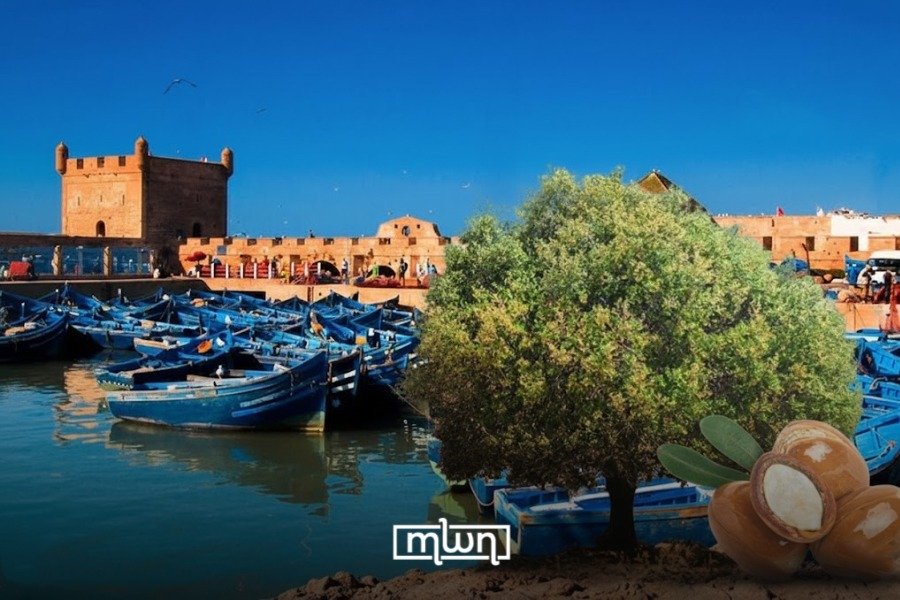
Rabat — Archaeological experts announced Sunday that humans have long relied on argan trees in the Essaouira region for more than 150,000 years, making it one of the oldest known examples of sustainable resource practices.
The National Institute of Archaeological Sciences and Heritage (INSAP) organized the scientific conference at Bayt Dakira in coordination with the Essaouira-Mogador Association and the Provincial Culture Directorate.
André Azoulay, advisor to King Mohammed VI and founding president of the Essaouira-Mogador Association, attended the event alongside scientists and cultural figures.
Ancient jewelry sites reveal more secrets
The findings build on research published in 2024 from excavations at Bizmoune and Jbel Lahdid, where archaeologists discovered the world’s oldest known ornamental objects, specifically jewelry, dating from 142,000 to 150,000 years ago.
This recent research reveals the density of prehistoric settlement and populations in the area, the diversity and age of ornamental objects, and how ancient populations systematically and sustainably exploited the argan tree.
“These new results consolidate the fact that Essaouira played a central role in human history, confirming the region’s importance as a cultural and ecological crossroads for more than 150,000 years,” Azoulay said.
Continuous human innovation
INSAP director Abdeljalil Bouzouggar presented scientific results that show continuous human settlement in Essaouira for over 150,000 years. The archaeological remains demonstrate prehistoric techniques that transformed natural resources and reveal ancestral knowledge about the argan tree that reflects both the antiquity and complexity of human societies in the region.
“The region of Essaouira was not only inhabited but constituted a remarkable center of human innovation,” Bouzouggar explained.
Doctoral researcher Ismail Ziani, a member of the Bizmoune archaeological team, said researchers used methods like liquid archaeology and organic remains analysis to reconstruct the plant landscape. These techniques proved the argan tree’s stability and persistence over 150,000 years.
“These studies highlight the importance of ancestral know-how for food and cosmetic production, attesting to cultural continuity over tens of thousands of years,” Ziani noted.
Provincial Culture Director Rania Khouya expressed pride in the research, which establishes Essaouira as a unique prehistoric site.
“The discovery of this ancient use of the argan tree not only enriches scientific knowledge of local heritage but also highlights Morocco’s cultural and historical wealth on the international stage,” she said.
The conference, themed “At the Origins of Essaouira: A Territory Thousands of Years Old and 150,000-Year-Old Argan Tree Know-How,” also examined survival strategies, human migration, and adaptation to climate change, demonstrating Essaouira as a central location in North African prehistory.
