


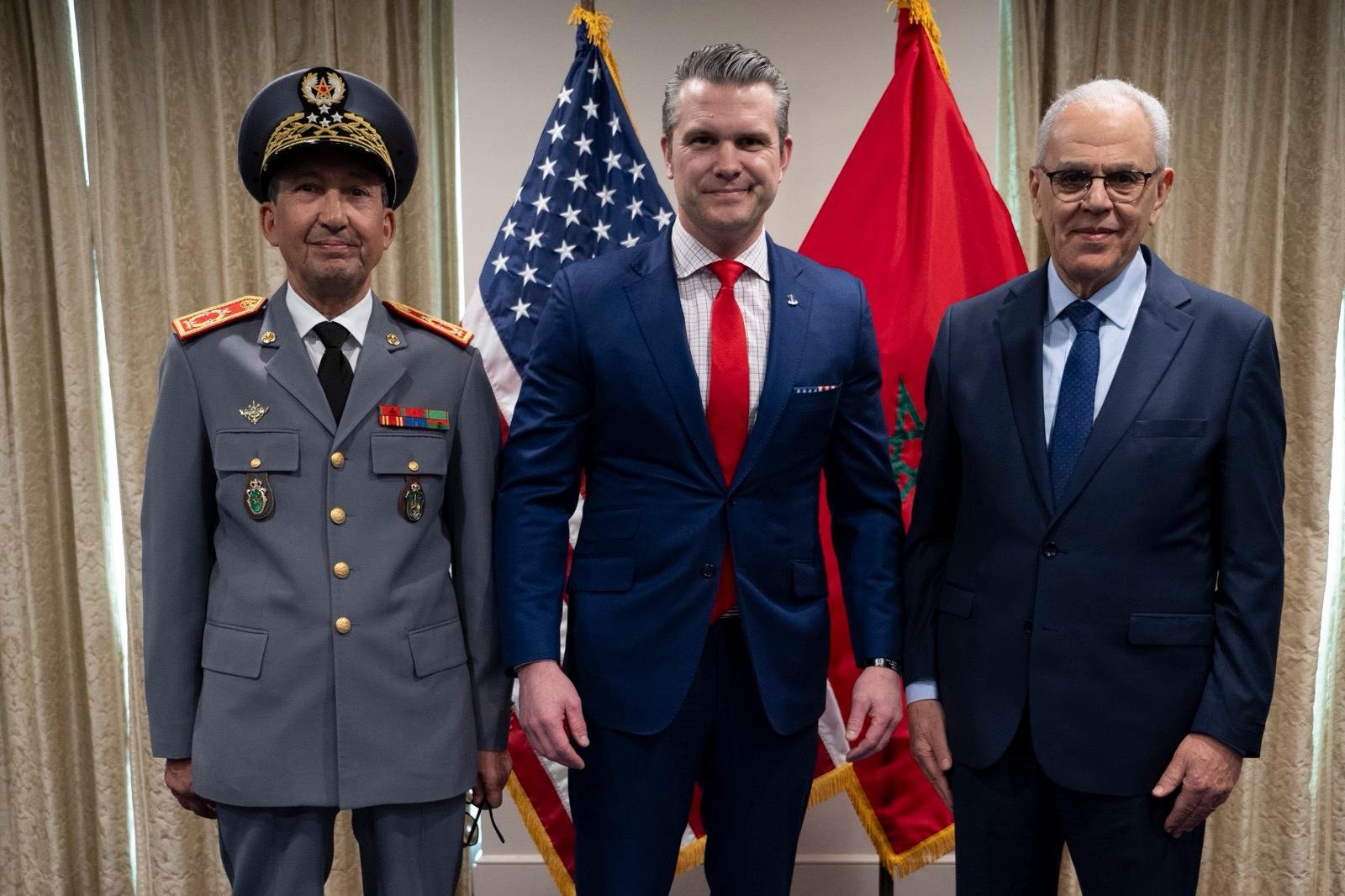
Agadir – US Secretary of Defense Pete Hegseth hosted Morocco’s Delegate Minister for National Defense, Abdellatif Loudiyi, on the occasion of the 14th meeting of the Morocco-US Defense Consultative Committee, held in Washington from April 14 to 16.
Also attending the meeting were General Mohamed Berrid, Inspector General of the Royal Moroccan Armed Forces (FAR) and Commander of the Southern Zone, Morocco’s Ambassador to Washington, Youssef Amrani, and the US Ambassador to Rabat, Duke Buchan III.
“The Delegate Minister to the Prime Minister in charge of National Defense Administration, accompanied by the First Marshal, the Inspector General of the Royal Armed Forces and Commander of the Southern Region, held a high-level meeting with Pete Hegseth, the US Secretary of War,” FAR announced today.
The talks focused on strengthening bilateral cooperation and expanding it into key strategic areas, particularly defense cooperation, defense industry development, and cybersecurity.
Both delegations reviewed ways to further enhance interoperability and coordination in addressing shared security challenges.
This meeting was conducted after the US and Morocco signed a new 10-year defense cooperation roadmap covering the 2026–2036 period, deepening their strategic military partnership.
The roadmap establishes a structured framework aimed at enhancing interoperability between the two armed forces, strengthening coordination, and expanding cooperation into key areas such as defense industries and cybersecurity.
“This Roadmap will guide our historic defense relationship for the next decade, building on a partnership that began 250 years ago when Morocco was the first nation to recognize the United States,” said Elbridge Colby, Secretary of War for Policy.
The recent successful integration and testing of the Link-16 tactical communication system between the Royal Moroccan Armed Forces and the United States further also shows the growing depth of military cooperation between Morocco and US.
This joint operational planning for African Lion 2026 enabled real-time, encrypted data exchange between both forces, including secure voice communication and the sharing of battlefield information such as positioning and operational coordination.
The initiative allowed Moroccan to operate beside the US on a shared secure network traditionally associated with NATO-level standards.
