


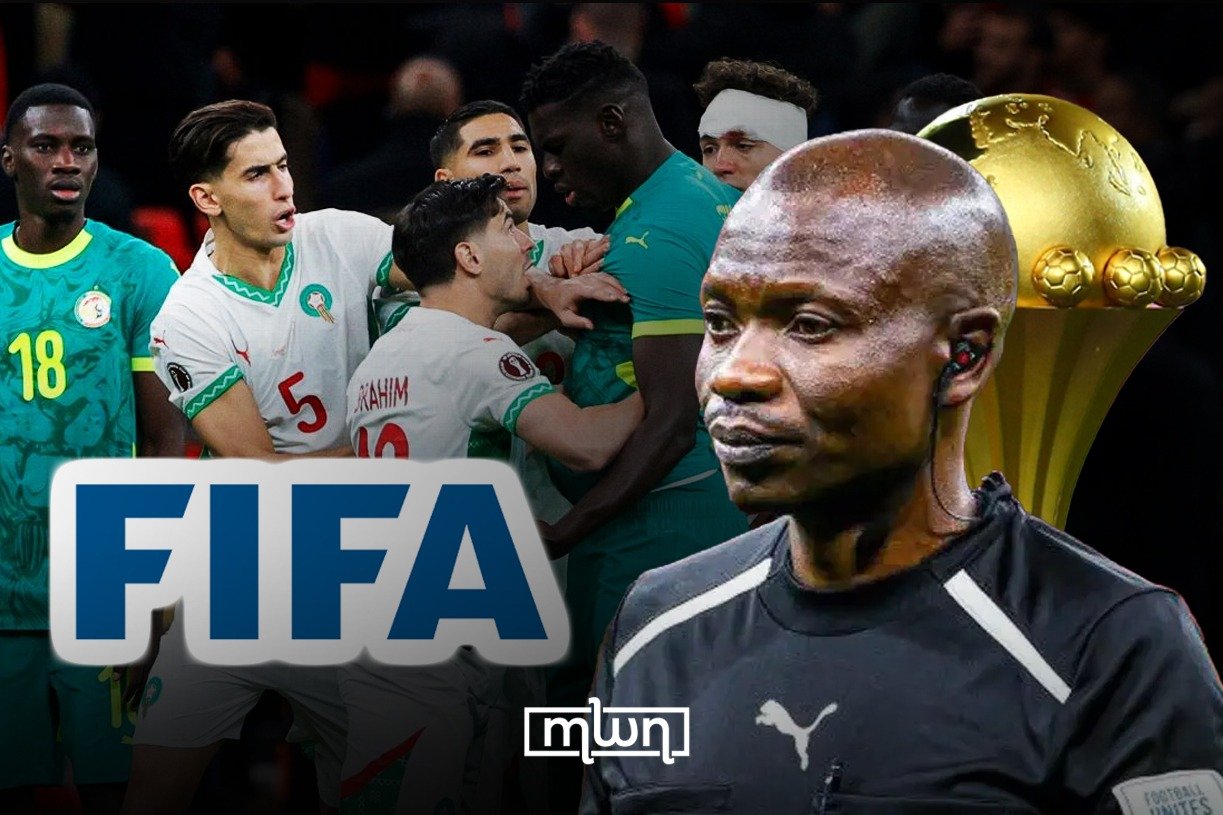
Washington – Jean-Jacques Ndala, the Congolese referee who officiated the chaotic AFCON 2025 final between Morocco and Senegal in Rabat, is nowhere to be found among the fifty-two referees FIFA has selected to officiate football’s most prestigious tournament this summer. This news might understandably sound banal and insignificant at first glance. But for a referee who just presided over the final of Africa’s most prestigious tournament, such an omission is a damning institutional verdict that carries profound implications for the ongoing legal and sporting dispute between Morocco and Senegal.
For those who have followed both this continental controversy and football in general very closely, Ndala’s exclusion from World Cup officiating duties represents something historically unprecedented. It marks the first time that an AFCON final referee has been excluded from World Cup officiating in the immediate wake of overseeing the tournament’s decisive match.
It goes without saying that officiating the continental showpiece is typically the crowning achievement of a referee’s career. It is normally a credential that strengthens, rather than undermines, a referee’s World Cup candidacy. That the inverse has occurred here constitutes a tacit but revealing acknowledgment that something went seriously, irreparably wrong during the January 18 final in Rabat.
Ndala’s intolerable abdication of authority
To understand the full weight of FIFA’s decision, one must revisit the events of the final in Rabat, and more specifically, what Ndala failed to do when it mattered most.
As official match reports subsequently confirmed, Senegal’s head coach Pape Thiaw ordered his players to abandon the field of play and return to the dressing room in the dying minutes of the AFCON final, following Ndala’s award of a legitimate penalty to Morocco. The match was halted for approximately seventeen minutes, leading to generalized chaos as Senegalese fans clashed with security officials while attempting to storm the pitch.
During those defining minutes, Ndala failed to do what the Laws of the Game required of him. Although reliable reports later confirmed that he had been given instructions to refrain from following the pertinent regulations, it is safe to argue that a referee of stronger character and more scrupulous legal preparation would have recognized this situation immediately for what it was.
As I have repeatedly argued over the past month, the situation called for a straightforward triggering of Article 82 of the AFCON regulatory framework, which states in unambiguous terms that if a team “refuses to play or leaves the ground before the regular end of the match without the authorisation of the referee, it shall be considered [the] loser and shall be eliminated for good from the current competition.” And, perhaps more importantly, the provision admits of no exceptions, no threshold of duration, and no clemency for teams that later reverse course.
This means Ndala possessed both the authority and the obligation to blow his whistle and declare the match forfeit in Morocco’s favor the moment the Senegalese team retreated to the locker room. That failure alone would have been sufficient grounds for serious disciplinary review. But Ndala compounded this dereliction of duty with a second and equally glaring breach of his duties.
Law 12 of the Laws of the Game explicitly stipulates that players “entering, re-entering or deliberately leaving the field of play without the referee’s permission” must be cautioned with a yellow card. Yet Ndala issued no single caution when the Senegalese players returned to the pitch. Furthermore, Senegal’s coach ought to have received a red card and been expelled from the technical area for giving his team illegitimate instructions that precipitated this entire crisis. Yet this did not happen either.
As I suggested above, we now know that Ndala operated under institutional instructions after receiving guidance from within the refereeing committee apparatus not to issue yellow cards to the Senegalese players. This means that, in Rabat on January 18, the CAF refereeing hierarchy instructed Ndala to ignore the law in order to preserve the optics of an AFCON showpiece that had already descended into undignified chaos.
Yet for a senior referee, the fact that he followed external instructions to decide the fate of a match over which he had absolute decision-making sovereignty is even more damning than the raw officiating failures I have so far highlighted. While such high-level external intervention is morally damning for the CAF refereeing committee, which can be held responsible for compromising the integrity of the final, the officiating failure itself spoke in louder volumes of Ndala being a weak referee caught in a tense situation.
Institutional alignment
In this sense, the significance of Ndala’s exclusion from the World Cup has little to do with what it says about what FIFA thinks of his cataclysmic performance in refereeing the AFCON final. More fundamentally, the significance of his snub by FIFA stems from what it reveals about the tacit institutional alignment between FIFA’s governance posture and the legal logic underlying the CAF Appeal Board’s ruling in favor of Morocco.
Consider the argument that has been rehearsed incessantly by Senegal’s defenders since the Appeal Board stripped the Teranga Lions of the AFCON trophy on March 17. Over the past month, these opponents of the Board’s verdict have argued that a referee’s on-field decisions are final, inviolable, and not subject to challenge through subsequent juridical proceedings. This contention has been deployed as a kind of rhetorical shield to suggest that if Ndala’s decision to allow the match to continue was legitimate, the argument goes, then no regulatory body has the standing to revisit the result.
FIFA’s snub has decisively shattered that shield. With this decision, the governing body of world football is implicitly making clear the depth of concerns over both the consistency of Ndala’s performance levels and his maintenance of high officiating standards on the global stage.
Quality first is the leading, non-negotiable principle in FIFA’s choice of World Cup referees, the organization’s chief refereeing officer Pierluigi Collina has insisted. One does not apply a “quality first” principle by rewarding a referee whose most high-profile assignment ended in one of African football’s most embarrassing fiascos. And so, excluding the AFCON final’s referee from World Cup officiating is essentially FIFA’s institutional acknowledgment that his management of the continental final fell alarmingly short of the standards required at football’s highest levels.
This places the CAF Appeal Board’s ruling and FIFA’s exclusion of Ndala in a relationship of mutual reinforcement. Far from being isolated or contradictory decisions emanating from separate governance bodies, they converge on the same factual and legal assessment. They tacitly agree that the AFCON final was mismanaged, that Senegal’s conduct violated the competition’s regulations, and that those who enabled or failed to correct that misconduct must bear institutional consequences. Thus, the two decisions are speaking to the same underlying wrong.
Yet it is worth the irony embedded in Ndala’s situation. Despite the severity of the AFCON final controversy, CAF had officially cleared Ndala of any professional wrongdoing and continued to deploy him in subsequent match appointments. But FIFA, operating with greater institutional distance and less exposure to the political pressures that evidently shaped CAF’s initial responses to the January 18 fiasco, has reached a sharply different conclusion. The divergence between the two bodies’ treatment of the same referee is itself a powerful commentary on the structural weaknesses within CAF’s refereeing governance.
CAS and the bumpy legal road ahead for Senegal
Senegal has predictably appealed the CAF Appeal Board’s ruling to the Court of Arbitration for Sport. CAS has confirmed that an arbitral panel will be appointed and that proceedings are underway, with both parties having been granted time to submit their legal arguments.
Supporters and advocates of Senegal who have tirelessly sought to denounce and ridicule the CAF ruling by insisting on the sanctity of the referee’s field decisions, appealing to procedural technicalities, and casting the Appeals Committee’s judgment as an unprecedented assault on sporting ethics, would do well to reckon with what FIFA’s decision adds to the evidentiary picture CAS arbitrators will survey.
As I have argued in a number of previous analyses, CAS does not adjudicate in a vacuum. That is, it will consider the full context of the judicial battle between Morocco and Senegal: the official match reports documenting the sequence of events, the text of Articles 82 and 84 of the AFCON Regulations, the unambiguous language of those provisions as applied by the Appeals Committee, and the broader institutional consensus. And when you add to that consensus FIFA’s implicit assessment that Ndala’s management of the final was gravely deficient, you have an emerging overall picture in support of Morocco’s position.
Through its refereeing appointments, FIFA has just effectively confirmed that a referee who failed to sanction the Senegalese team’s illegitimate and illegal withdrawal from the AFCON final should not be trusted with another assignment of comparable consequence.
Again, as I have argued consistently in recent weeks, Article 82’s text is structurally impervious to creative interpretation. There is no minimum duration of withdrawal that must be established. There is no exception for teams that eventually return to the pitch. A team’s or a player’s conduct either falls within the article’s scope or it does not. And by every available standard of textual analysis, Senegal’s misconduct does fall within that legal range.
Morocco’s supporters would be forgiven for experiencing Ndala’s World Cup exclusion as a moment of vindication. Although the snub does to a very large extent vindicate the Moroccan position, the more significant implication here is the apparent institutional alignment between CAF’s annulment of the AFCON final’s outcome and FIFA’s backhanded acknowledgement of grave concerns over the scandalous officiating of that continental final.
This confluence of the CAF Appeals Board’s ruling, FIFA’s refereeing appointment decisions, and the growing international consensus that the AFCON final was irreparably marred by officiating failures collectively confirm that Morocco’s legal position was never the product of grievance or opportunism. It was, and remains, an assertion grounded in the plain text of the regulations and the documented facts of what transpired on the night of January 18.
The AFCON 2025 final will be remembered for many things: for its drama, its controversy, its geopolitical dimensions, and the extraordinary judicial battle it generated. Yet with its published list of this year’s World Cup referees, FIFA is now indirectly reminding us that this embarrassing AFCON final should perhaps also be remembered as a case study in what happens when referees capitulate to pressure. If the professional implications of FIFA’s snub are damningly severe for Ndala, the snub’s accompanying message is also that the omens ahead of Senegal’s CAS appeal are nowhere near encouraging.
Samir Bennis is the co-founder and publisher of Morocco World News. You can follow him on Twitter @SamirBennis.
