


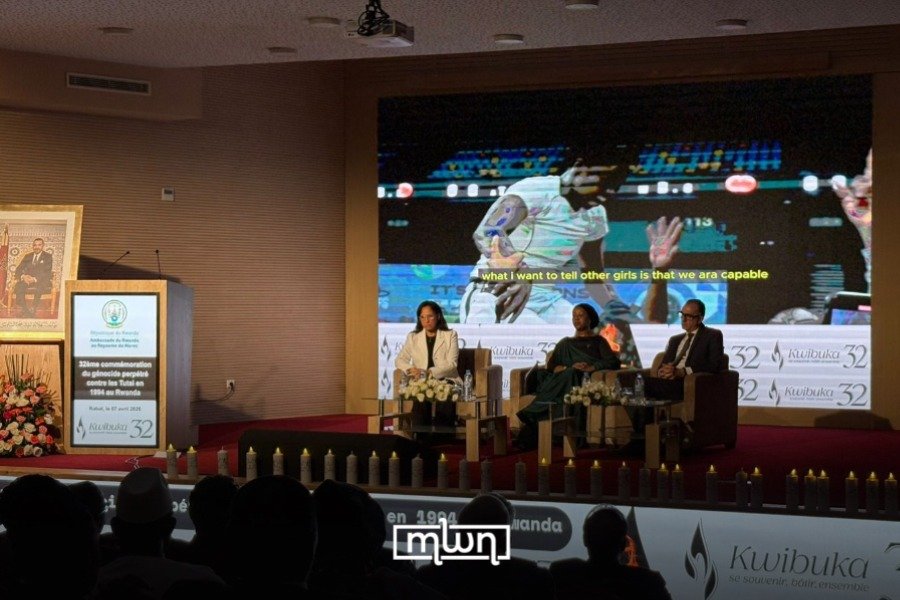
Casablanca – Moroccan officials, diplomats, members of the Rwandan community, and friends of Rwanda gathered today at the Palais des Congrès Bouregreg in Salé for Kwibuka 32, marking 32 years since the 1994 Genocide against the Tutsi that killed more than one million people in 100 days.
Held under the theme “Remember, Unite, Renew,” the ceremony began with a remembrance march, after which guests moved inside for a candlelighting tribute to the victims. A documentary screening revisited both the horror of the genocide and Rwanda’s long reconstruction.
Speeches by Amina Bouayach, El Ouafi Boukili Makhoukhi, and Rwanda’s ambassador to Morocco gave the ceremony its strongest political and moral message.
Bouayach framed memory as a tool of prevention, saying it is “a collective responsibility” and warning that the same warning signs that led to past atrocities still persist through exclusion, hate speech, stigma, and the erosion of rights.
Representing the Moroccan government, Makhoukhi called the 1994 genocide “one of the darkest chapters in the history of humanity” and said the gathering was also a reminder to remain “united and vigilant” against hatred and discrimination, while reaffirming Rabat’s solidarity with the Rwandan people.
He also pointed to the 2016 visits by King Mohammed VI and President Paul Kagame as the moment that gave bilateral ties “a new dynamic.”
Rwanda’s ambassador, Shaquilla K. Umutoni, used her address to link remembrance with Rwanda’s recovery, recalling how the country chose unity over revenge after July 1994 and rebuilt through reconciliation, gacaca courts, and institution-building.
She thanked Morocco for its “unwavering support” and said the commemoration was as much about resisting genocide denial and hate ideology as it was about honoring the dead.
Moroccan officials were joined by ambassadors, members of the diplomatic corps, and Rwanda’s community in Morocco, giving the event a clear diplomatic dimension as well as a memorial one.
The date itself carries global meaning. Since a UN General Assembly resolution adopted in 2020, April 7 has been officially observed as the International Day of Reflection on the Genocide against the Tutsi in Rwanda, placing ceremonies in cities like Salé within a wider international act of remembrance.
Read also: Bourita Details Morocco’s Gulf Repatriation Measures
For Morocco, the annual Kwibuka ceremony has also become a reflection of ties that have grown steadily stronger with Kigali over the past decade.
A major turning point came in 2016, when King Mohammed VI paid a state visit to Rwanda and held talks with President Paul Kagame. During that trip, the two countries signed 19 cooperation agreements covering diplomacy, finance, banking, housing, pharmaceuticals, and investment.
Some of those projects moved beyond symbolism. Moroccan banking group Attijariwafa Bank expanded its footprint in Rwanda through the acquisition of Cogebanque, while plans were launched for 5,000 affordable housing units and a pharmaceutical manufacturing plant led by Morocco’s Cooper Pharma. Officials later said Moroccan commitments linked to the 2016 visit reached around $160 million.
That history gave today’s ceremony added political weight. What began as a remembrance march and candle tribute also stood as a visible sign of an African partnership built around memory, reconciliation, and South-South cooperation.
In marking the 32nd year of the genocide with themes of unity, remembrance, and renewal, the message appears to be that genuine mourning of a national tragedy also passes through the determination to resist division, reject hate speech, and defend the kind of institutional solidarity that both Rabat and Kigali now increasingly place at the center of their relationship.
Morocco World News is also on X — check out our latest posts now! Get MWN on iOS and Android for instant access to breaking news.
