


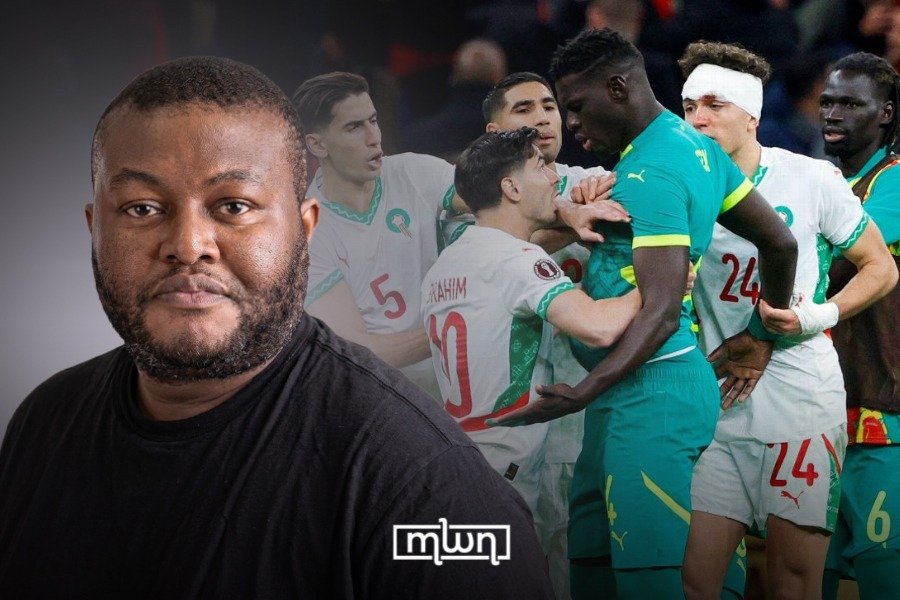
Washington – In the early days of the ongoing judicial battle over the outcome of the 2025 AFCON final, I chose to give Osasu Obayiuwana the benefit of the doubt despite the evident bias and sloppy cherry-picking in his articles, commentaries, and social media posts. Never prone to operating from the standpoint of a presumption of guilt, I had assumed that Obayiuwana’s take on the CAF Appeals Committee’s March 17 decision to strip Senegal of the AFCON trophy and declare Morocco victor by forfeit was, at worst, a reflection of personal conviction shaped by his reading of the events. In other words, I believed he was wrong, but at least that he was engaging in the debate in good faith.
And yet, after reading a number of his pieces — particularly those published recently in The Guardian and The Observer — I find myself compelled to ask a more unsettling question: are we dealing here with analysis, or with the construction of a narrative designed to serve a predetermined conclusion? Simply put, I am beginning to seriously question whether his recent outings on this AFCON controversy are paid pieces intended to advance the agenda of certain parties.
Analysis or advocacy?
In one of his recent articles, published on March 18, Obayiuwana writes that the CAF decision left him “gobsmacked” and that it provoked widespread anger across Africa. Notice here how both the headline and the opening lines significantly set the stage for the bias- and outrage-heavy tone that sustains the entire article. A journalist, commentator, or analyst writing on any issue of import, especially one that has elicited so much controversy and so many different perspectives, owes it to themselves to offer a fair and careful contextualization of the topic or debate at hand before giving their own take.
But instead of that rigorous, attentive engagement with the CAF Appeal Board’s legal reasoning, Obayiuwana proceeds by foregrounding what he thinks happened behind closed doors, looking for isolated details confirming his preconceived conclusion, and then finally concluding by stressing that his initial, instinct-based reading of the situation was right after all. Good journalism is hardly ever an exercise in confirmation bias: before being interested in how you view or feel about what you are tackling, your readers are first and foremost interested in reality-based, objective assessments of the situation. Yet Obayiuwana’s failure to meet that fairness and objectivity requirement is not even the most critical issue with his March 18 article. Rather, the piece’s real problem is that, beneath its language of outrage and self-righteousness, it offers no sound arguments that could withstand even minimal scrutiny when confronted with the factual record it purports to engage with.
Take, for instance, his assertion that only a portion of the Senegalese players left the pitch. Anyone who watched the final would struggle to reconcile this claim with the video evidence readily available online. Indeed, video evidence clearly shows that the entire team walked off, with the momentary exception of Sadio Mané, who himself stepped off shortly thereafter in an apparent attempt to bring his teammates back to the pitch. This factual detail cannot be glossed over or misleadingly interpreted when engaging in a serious analysis of the January 18 final in Rabat.
The inherent limits of creative interpretation
But the problem with Obayiuwana’s post-AFCON narrative spin does not end with his creative, ridiculously selective misrepresentation of events. It extends, more fundamentally, to the way in which he handles or invokes the CAF regulatory framework. Article 82 of the AFCON regulations is explicit: “If, for any reason whatsoever, a team withdraws from the competition or does not report for a match, or refuses to play or leaves the ground before the regular end of the match without the authorisation of the referee, it shall be considered the loser and shall be eliminated from the current competition. The same shall apply to teams previously disqualified by decision of CAF.”
As I have argued in previous analyses, there is no ambiguity here. And yet, in order to sustain his central claims, Obayiuwana narrows the scope of this provision to situations in which a team fails to report for or begin a match. And so, rather than the integrity of the rule as written by CAF legislators, what appears to matter to him is the usefulness of the rule within a broader narrative that seeks to delegitimize the outcome.
This tendency of creative engagement with an unambiguous rulebook is even more apparent in his April 1 piece in The Guardian and in his latest article for The Observer, where his focus shifts from the specifics of the final to a sweeping indictment of governance in African football. Bereft of a strong case against the legal reasoning underpinning the CAF Appeal Board’s verdict in favor of crowning Morocco African champions, Obayiuwana here turns to a general critique of the manifestly incompetent governance of African football.
I am outraged, therefore I am right
That makes it easier for him to dismiss and recast the AFCON verdict as evidence of a wider institutional crisis. Because he has no strong arguments to prove the supposed illegality or illegitimacy of the verdict, he builds his entire case around CAF’s governance crisis. As his creative interpretation of the CAF and AFCON rulebook does not come even close to a decent argument showing why the CAF decision on the AFCON final is supposedly a legal disgrace, he turns to asking: anyway, why trust the decision of an institution that has long been in moral and leadership crisis?
I do not deny that African football governance deserves scrutiny. Anyone watching continental football for the past few years — perhaps even for the past decade — knows that CAF’s credibility has often justifiably been called into question. But I cannot be convinced by Obayiuwana’s leap from a contested disciplinary ruling to a generalized narrative of systemic failure, especially when that argumentative leap is built on a selective reading of both the pertinent facts and the relevant rules.
The same pattern is visible in Obayiuwana’s treatment of Article 84. To argue that the article’s provision cannot apply to Senegal’s conduct on January 18, he insists on a cumulative interpretation of Articles 82 and 83, citing external opinions to support this position. But here again, Obayiuwana’s argument collapses under its own weight. As I have already explained in a previous analysis, a fundamental tenet of CAS jurisprudence is that regulatory provisions must be read in a way that preserves their practical effect. Under no circumstances can they be construed in a manner that renders them contradictory or meaningless.
In fact, such a cumulative invocation of the relevant rules suggests that Obayiuwana, like most of the diehard critics of the CAF verdict, may not fully understand the legal reasoning he is critiquing. Article 82 concerns a team that withdraws from a match already in progress. Article 83 tackles a situation where a team fails to show up in the first place. To require both conditions to be met simultaneously is to demand the impossible. A team cannot both abandon a match and fail to appear for it. These provisions describe distinct violations, each independently sufficient to trigger the sanction outlined in Article 84. Any other interpretation is analytically desperate and legally indefensible.
Therefore, as I emerge from my reading of Obayiuwana’s corpus on this protracted AFCON saga, I no longer simply see a genuine or good-faith disagreement over how to read or implement the pertinent CAF regulations. Instead, I now see a broader issue of narrative construction. Across his recent writings, Obayiuwana moves consistently from the particular to the general, from a specific disciplinary decision to an overarching claim about legitimacy, credibility, and crisis in African football. This is not, in itself, illegitimate. But it is journalistically problematic, analytically unconvincing, and legally laughable because the whole narrative is sustained by omissions, selective readings, and assertions that do not align with the available evidence.
And so, although I have repeatedly demonstrated this point over the past two months, I am compelled to repeat it here to Obayiuwana and all of those who have been quick to echo his conclusions: no amount of rhetorical amplification can alter the substance of what occurred on the pitch in Rabat on January 18. Senegal withdrew from the field in clear violation of the governing regulations. The CAF Appeal Board applied the regulations that apply in such an event. And Morocco, as a result, was declared the rightful winner of the AFCON final.
Obayiuwana may write other articles or social media posts in the coming days to further invoke outrage across Africa or gesture toward the depth of CAF’s institutional and credibility crisis. But when this post-AFCON matter is examined at CAS, it will not be decided by tone or narrative. There, too, the verdict will be decided by facts, by pertinent jurisprudence, and by the coherence of the arguments presented by the opposing sides. And on that terrain, the legal case and factual evidence appear to be firmly on Morocco’s side.
Samir Bennis is the co-founder and publisher of Morocco World News. You can follow him on Twitter @SamirBennis.
