


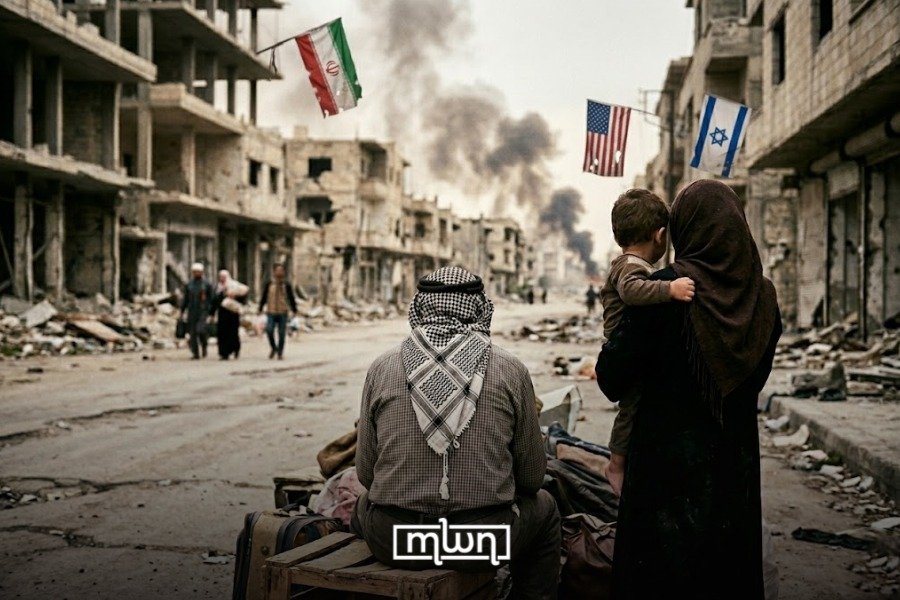
A handful of scholars, diplomats, journalists, and military strategists are invited to take part in a brainstorming session held by a renowned think tank in Morocco. The main topic is the tripartite war between the United States, Israel, and Iran. Participants who have a say on matters related to geoponics and security matters come up with very interesting reading and relevant opinions.
Curtain raised: well-respected people around an oval table overflowing with serenity and yet divergent readings. I’ll save my evaluation for later. But, already, I notice that everyone is left wanting more. Everyone comes with analytical tools that no longer necessarily count in terms of depth and foresight, leading to a superficial understanding of complex situations. The scene reflects the erosion of fundamental truths that have been flourishing so far. Because no one really expected the trilateral war to be triggered so soon and to be so bewildering.
Academic collateral damage, so to speak! Politics is not an exact science. Diplomacy is a game of fireworks that sparkle until the ashes cover land and sky and plunge everyone into darkness. As for the war. Oh! The war between the real and the virtual is chaotic for everyone.
I ought to be in Casablanca for the ritual iftar (breaking of the fast) with Hajja, my mother, and my sister, who promised me an unprecedented fruit salad. There will be an argument because Hajja, who no longer controls the kitchen business, will certainly raise the red flag about the quality of the product no matter what her daughter’s contribution might be. A few years ago, the family was all together: a full house, so to speak. Not anymore. Here too, the tools of community and conviviality have lost their physical and moral magic. Real solidarity is virtual… Everywhere!
On the way, I watch the ruins left by the bulldozers that have leveled a good part of the old medina as part of the new urban plan. The renovation includes, among other things, the redevelopment of the neighborhoods bordering the Hassan II Mosque and the implementation of the royal avenue project that dates back to the late 1980s.
Ordinary scenes, the same old story
Seagulls, pigeons, cats, and dogs take up residence in this deserted safe haven. The seagulls wait for the right time to pin down a pigeon. The cats and dogs work together to get the same job done. The International Fair facility and the nearby playgrounds, including the Rahal Football Club fairground stadium, will soon have their fate decided. There is talk that this huge space would serve for the construction of the International Broadcast Center (IBC) dedicated to the 2030 World Cup.
A parking attendant, flanked with his yellow jacket, takes advantage of a passerby’s generosity and asks him for 20 MAD on the pretext that his mother is sick. The latter gives him MAD 100. The caretaker, seizing this opportunity, tells him that his mother would be happy to learn that a generous benefactor is sending her MAD 200 to buy medicine. The passerby feels outraged and continues his way. If seagulls, pigeons, cats, and dogs could communicate with humans, they would have laughed in his face.
At the entrance of the building where my mother lives, I run into an acquaintance whose son had survived a head injury. He had a Kafkaesque experience. The child had been declared dead following a fall on the head and placed in a morgue. He was saved at the last moment before being taken to the cemetery. He came out after losing control over his body. I greet my acquaintance. He doesn’t respond. He is busy with his son, who is looking at me sideways as if he wants to start a conversation. The elevator is working this time. It’s not always the case.
A young lady storms out. She is crying. She is holding a medical file. She seems to have received bad news. Yes, in the building there are medical cabinets and a biological analysis laboratory. Such scenes are common and give the concierge his recipe for goosebumps.
I receive messages on my smartphone. No surprise: news about the war in the Middle East. A local radio station offers me the opportunity to go on air to share my take on what is happening. I politely decline the invitation because, from my perspective in the field, any interpretation is premature. Besides, from my professional experience, I know that hasty assessments always miss the mark.
The avalanche of shared information reveals to me the ideological divides among people. The divergences reflect political preferences that struck me. I am astonished by my friends’ readings. Normally, they adopt fair and balanced views on international politics. My surprise is complete. And it affects expatriates in Morocco.
The story applies to an expat who is fired — unjustly, she claims — just after being hired. She pays the price of chaotic management in a company that is searching for its way in the labyrinths of a bruised globalization. A rejuvenation is essential, she tells me, if Morocco aims to progress at the pace desired by decision-makers in strategic sectors.
Given her expertise, this person finds a job in the Middle East. She travels on the same day as the outbreak of the tripartite war between the United States, Iran, and Israel. She cannot reach her destination. She is stuck in a transit terminal in a country and taken hostage. The airports are blocked because of the drones and missiles flying in the air.
The blockage reflects a feeling of general panic. And this raises the following question that kills slowly: what do we weigh in a world where free choice is entangled in a never-ending curfew? The hierarchy of issues is shattered by the fact of a shallow classification that people share randomly. The tragedy in Gaza and the war between Russia and Ukraine are momentarily relegated to the background. And then, the Lebanese front is open. The story of the Iranian proxies is not over yet.
A Moroccan activist known for her versatile political and ideological views declares that she is no longer a Muslim. She goes on to stress that she has not been observing Ramadan rituals for eight years. She adds fuel to the fire of Moroccan society, which is searching for itself in a swamp of contradictions and feeding on the display of a tattooed ethic sounding cacophonous anyway. This describes personal ambitions dissolved in the alleged sense of belonging to a strong community.
At the same time, people who claim to be Moroccans converted to Christianity are once again coming out to claim their right to freely choose their faith. They refuse being fingerprinted as apostates. They do it as they did in 2012, in the aftermath of the “Arab Spring.”
This also brings to mind the unprecedented saga of these young people who, in February 2003, were labeled as “Satan worshippers,” while they were merely amateur rock musicians promoting the metal subculture.
Two months later, in April, the United States led an international coalition to invade Iraq to topple Saddam Hussein’s regime. A month later, in May, terrorist attacks struck Casablanca. Religious, ideological, and mercantile calculations under the guise of diplomacy turn into a business. This is the prelude to what will become, in 2011-2014, “the Arab Spring.”
Movements are also coming out to claim the right to demonstrate to show their support for Iran. They are the same ones who are active in northern Morocco, particularly in Tangier, which has made headlines for years when elements affiliated with the Islamic State in Iraq and the Levant were killed in the fighting in Syria and Iraq. They were identified as Moroccan.
Similarly, women from the north of Morocco who joined the ranks of ISIS were left on their own along with children. The latter were born under dubious circumstances, according to the bizarre term “marriage jihad” (temporary sexual relations framed within the battle for the triumph of Islam, as its defenders claim).
Frantic mothers demanded the right to return to Morocco. This raised thorny questions of identification and regularization. Some of them have been luckier than others and were enabled to come back home. The competent authorities are tasked with finding solutions. Everything points to optimism, although the task is not easy.
Confusion is the hallmark of many activists. They take the stage and cast a wide net. They identify with movements that, logically, have nothing to do with their real beliefs, neither in form nor in substance.
This behavior recalls the coalition of ideologues from all walks of life that filled the media and political space in the United States during the 1980s-2000s. Fundamentally extremist currents of thought drawing from the framework of the Christian right, liberals, socialists, Trotskyists, and anarchists, who lost hope in the American political system and the distribution of power in the United States, took over the stage.
People hop on the train without being sure they’ll reach their destination. They are found in spontaneous mass demonstrations or unauthorized gatherings. This reminds me of the story of an unemployed person, who is awakened from this nap by shouts and slogans across the street. He looks out the window. He sees people walking in a well-organized procession. He decides to join them. He puts on his slippers and goes out.
He joins the last row and starts to sneak in timidly at first. He hears the marchers chanting, hands raised as a sign of threat: “Baba Doum Ahna leek بابا دوم أحنا ليك.” It means something like “Baba Doum, we’re coming to get you.”
Fire of all woods
The procession is moving slowly. Our friend is bored. He decides to drop by first. There, he can’t believe what he hears. At the head of the procession, he discovers that the first row of marchers is chanting, “No bomb in Africa.” The organizers of the march refer to the first nuclear atmospheric and underground test that France conducted in Reggane, in the eastern Sahara, in 1960, long before Algeria’s independence in 1962.
A first attempt that will be followed by sixteen (16) others until 1966. At the time, this part of the Sahara that France attached to Algeria was claimed by Morocco. King Mohammed V sent a reply letter on April 19, 1960, to the French president, Charles de Gaulle, in which he denounced this first nuclear test taking place on Moroccan territory.
Naturally, the other walkers have no idea why they are participating in the march, repeating slogans they don’t understand at all.
Well then! The culture of marches is highlighted by certain political movements to support the Palestinian cause. This is tolerated by the authorities. However, on the occasion of the ongoing war, a planned demonstration in Tangier is prohibited even before it starts. Verbal arguments between the organizers and the local law enforcement officials put an end to the misunderstanding.
Some deem the determination of these movements to support Iran, while the latter targets Arab Gulf countries as a sign of retaliation against American-Israeli airstrikes, as astonishing political myopia. They are criticized for their inaction during the Gharb region floods just two months ago and during the Syrian civil war, particularly since 2014.
An exaggerated reproach one would argue. No doubt, but astute observers note that part of these movements remained silent following the fall of Bashar al-Assad (2025), Muammar Gaddafi (2012), and Saddam Hussein (2003). Without going so far as to label them as a fifth column, their detractors do not hesitate to conclude that these movements serve transnational agendas that sometimes harm the national interests of their own country.
What does all this mean? Explanations abound in the arena and dazzle with their impact. One: it seems that the feeling of humiliation and loss of trust is persistent in people’s hearts. A truth that is difficult to deny. It expresses the feeling of despair that the vast majority of Arabs and Muslims brood due to the various defeats recorded since the end of World War II. Although this feeling is variable and depends on the proximity of conflict zones, people share the view that moral and religious duties impose on them as Arabs and Muslims to get rid of eventually.
Two: the victim syndrome is omnipresent in people’s daily behavior. The narrative says that the victim would be envied for what they hypothetically possess. This is a fact of wrong prospection and casting, as one might be tempted to state. However, instead of seeking convincing explanations, including identifying the flaws and determining the causes, public opinions are driven to advocate for a headlong rush as if to finally ward off their fate.
Three: there is a common feeling of panic for fear of being overtaken. It manifests through behaviors that challenge false confidence and the allegedly ascendency of political and ideological beliefs.
Is it enough to cover the issue? Of course not. Let’s revisit the actors cited above. First, the think tanks that challenge the objectivity of information and analytical tools to offer refined expertise to decision-makers.
Two imperatives to take into account: on the one hand, how to reconcile political planning with concocting urgent scenarios within renowned think tanks? On the other hand, how to combine the useful with the pleasant within think tanks to limit the risks of watching them trapped in social networks or fooled by the latest so-called experts?
Secondly, the opinion of renowned personalities. There are former decision-makers who have nothing left to lose. Their political and military careers are behind them. There are politicians who are still active. Some aspire to run for the highest office in their country.
This is the case, for example, of Dominique de Villepin, former prime minister and foreign affairs minister of France. He makes very informative and appreciated podcasts on literature and philosophy. However, he does not miss any opportunity on other media platforms to wage sharp criticism against the United States. He would have nostalgia for his rhetoric from the time when he was minister of foreign affairs (2002-2004).
Brainstorming at odds
The nostalgia for good thinking is associated with the nostalgia for Gaullism, illustrated by his famous speech on February 14, 2003, before the United Nations Security Council on the eve of the United States’ intervention in Iraq. De Villepin expressed France’s opposition to such an intervention. France was not convinced of the authenticity of the evidence Colin Powell, the American Secretary of State, presented a week earlier regarding Iraq’s possession of biochemical weapons.
The French position inspired other political figures on the international stage at the time. This attitude irritated the American neoconservatives who vowed to take their revenge and take him down. Curiously, this is what is currently happening between the United States and the European NATO member countries. They refuse to get directly involved in the tripartite war between the United States, Israel, and Iran. This is what leads some strategists to predict that the Atlantic Alliance will be dismantled real soon.
The same goes for Hubert Védrine, former French Minister of Foreign Affairs (1997-2002). He prefaces Kishore Mahbubani’s book titled “The Day the Chinese Win, the End of American Supremacy,” published in 2021. He recalls his years-long advocacy for the construction of a Europe that, if not completely independent, would at least be relatively autonomous in terms of common security and defense policy.
Védrine shares Mahbubani’s view on American hegemony and China’s role in achieving strategic parity by the 2040-2050 horizon. It goes without saying that both personalities condemn the American-Israeli intervention in Iran.
Thirdly, the behavior of ordinary people. Sharing of videos and news articles has become people’s favorite cup of coffee. The boom in information technology is a double-edged sword. Yet, there is a certain carelessness, even callousness, among users. In the case of recent mass protests or sporadic wars, users, even among the most careful, do not hesitate to share information without double-checking it in the first place.
Fourthly, the commotion that distorts the debate and heightens the competition. The rules of prudence and reservation are ignored. When value judgments come into play, the spectacle is mind-boggling. This affects another category of users: the Moroccan spectator. He is torn between his religious devotion and his awareness of the risk that the tripartite war brings about in his daily life.
In short, war is multifaceted. It is perceived and experienced differently. My predictions about the salad concocted by Hajja and my sister turn out to be correct: a slight feud on the quality of the ingredients and the dressing. The car attendant continues his maneuvers under the pretext that his mother cannot heal without feeling MAD 200 warm her hands. He makes sure to never get close to me. Just like the neighbor, whose son is in a state of total incapacity, never tires of fighting a heroic battle every day. I don’t know what happened to that young lady who was leaving the biological lab in tears.
And then, the think tanks… Everyone is aware that the tripartite war between the United States, Israel, and Iran has distorted all predictions with respect to its timetable and long-term impact. Policy-planners and military strategists draw the same conclusion. Now, who would dare challenge the idea of the existence of a transnational deep state and interests superior to those of nation-states.
Indeed, war is multifaceted. It is omnipresent and makes fun of statements of goodwill in rooms that smell of promiscuity, envy, and men and women’s propensity to win at any expense by neutralizing or even terminating others. War rides the waves of the virtual and the real in a crystal ball. Wherever its theater of action may be, war is driven by people’s need to survive.
That is what makes war dangerous when the locks of control inadvertently fail or when they result in false projections that sow chaos in the mind of those who lavishly advocate for easy solutions.
Indeed, easy solutions are evidenced by the fact that so-called informed observers or seasoned diplomats debate international politics and military strategy while frantically gazing at their smartphones and sharing fast-food information. They predict the outcome of a war without being sure if the belligerents have an exit strategy or, like the average individual, they are floundering. Sure, war is multifaceted. It feeds on the real and the virtual in a crystal ball.
The post Multifaceted Wars: The Fortune Tellers in Dire Straits appeared first on Morocco World News.
