


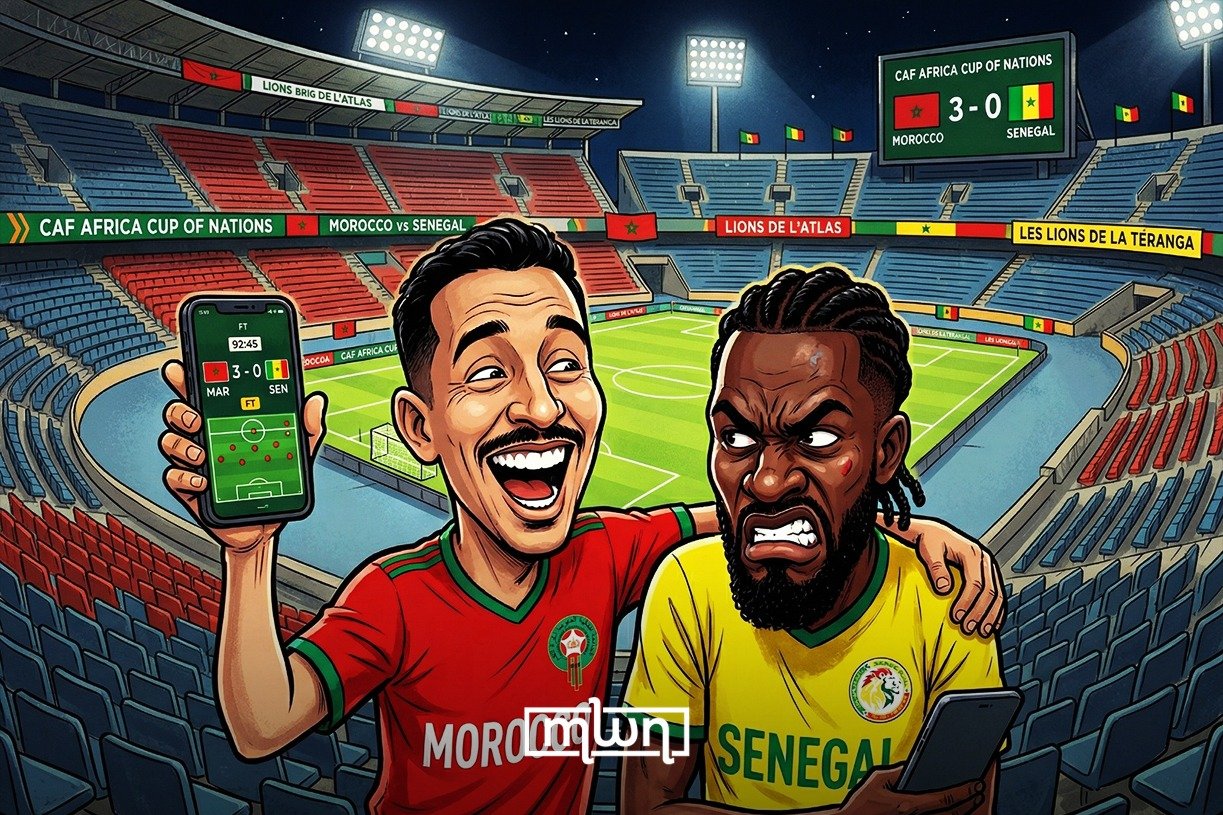
Marrakech – A social intelligence analysis of 30,000 online comments reveals that Morocco has dominated the public conversation surrounding the AFCON 2025 final marred by Senegal’s unsportsmanship.
The findings, published by AchGal Insights, a marketing intelligence platform that analyzes large-scale digital conversations and transforms them into structured, actionable insights for decision-makers, deliver a detailed picture of how African football audiences processed CAF’s ruling.
The ruling itself rested on Articles 82 and 84 of CAF regulations. Article 82 defines serious breaches of competition rules, including refusing to play or leaving the pitch without the referee’s permission. Article 84 sets the punishment: an automatic 3-0 forfeit.
CAF’s Appeal Board determined that Senegal’s conduct during the January 18 final in Rabat fell within those provisions, reversing the original result and crowning Morocco African champions for the second time.
But the legal outcome is only part of the story. AchGal Insights collected and analyzed 30,000 public comments across Instagram, Facebook, and TikTok to map how audiences across Africa reacted to CAF’s decision to reverse the AFCON final result two months after the match. The corpus spanned four languages, with Arabic accounting for 76.7% of all comments. Facebook generated the highest volume at 13,920 comments, followed by Instagram at 12,450 and TikTok at 3,630.
Senegal was a footnote in its own controversy
The data reveals a lopsided narrative landscape. Moroccan celebratory voices outnumbered Senegalese support nearly four to one. The report noted that Senegalese voices were structurally under-represented in the sample, with only 5.8% of comments expressing a pro-Senegal position against 22.4% of Moroccan national celebration.
The report acknowledged this disparity may partly reflect data collection conditions or an initial shock effect that compressed Senegalese response volume. But even accounting for those factors, the Senegalese narrative failed to achieve the scale, coherence, or emotional dominance that Moroccan voices sustained across all three platforms.
This narrative remained confined largely to francophone spaces, which accounted for just 2.3% of the total pool of comments. In raw conversational terms, Senegal lost the digital battlefield before it could mount a proportional response.
Trophy celebration accounted for 13.7%. Religious expression represented 10.9%, while political diversion, institutional distrust of CAF, and sporting ethics each hovered between 2.5% and 3.7%.
AchGal Insights’ report also flagged structural absences in the recorded reactions that carry analytical weight of their own. First, tactical analysis of the match itself was almost entirely absent. The conversation never centered on football. It constituted itself from the outset as a debate over identity, justice, and institutional power rather than sporting content.
Second, there was no discourse of pan-African solidarity anywhere in the data. The digital discourse fractured sharply along national lines, with very few voices articulating a shared African interest in football governance.
Together, these absences suggest that what audiences across Africa processed was not a football final but a proxy conflict over legitimacy, national dignity, and institutional trust.
Positive sentiment outweighed negative sentiment by a ratio of 13 to 1. Only 2.7% of comments carried explicitly negative signals, compared to 36.9% positive. The report cautions, however, that negative sentiment in Arabic-language social media is structurally suppressed. Critical views are often encoded in irony, religious framing, and political deflection rather than stated outright.
The analysis identified three distinct narrative ecosystems operating in parallel. The first, dominated by Moroccan voices, frames the CAF decision as justice restored. Supporters invoke divine justice, royal references, and national dignity, viewing the ruling as the restoration of a legitimate right rather than a gift.
The second ecosystem, centered on Senegalese audiences, treats the original 1-0 result as the legitimate outcome and views the administrative reversal as politically motivated. These voices rally around the CAS appeal and statements by Sadio Mané.
The third ecosystem transcends national lines entirely. Algerian, Egyptian, and neutral African commentators use the controversy to mount a systemic critique of CAF’s governance, citing past disputed results and institutional corruption.
Algeria and Egypt: absent from the final but pervasive in the fury
One of the report’s most damning findings concerns nations that were not even in the final yet seized the opportunity to settle old scores under the cover of the controversy. Algeria and Egypt generated significant comment volume and high emotional intensity.
Algerian reactions predominantly supported the initial Senegalese result: not out of solidarity with Senegal, but as opposition to Moroccan regional dominance. This confirms that major African football events function as arenas for multilateral regional rivalries far beyond the two competing teams.
Within the dominant Moroccan celebration narrative, the report detected an internal ambivalence. A minority of Moroccan voices questioned whether a title won through administrative procedure, without a stadium ceremony, without lifting the trophy at the final whistle, carries full symbolic weight. These voices described a victory that felt procedurally delivered rather than sportively earned. The report rates this finding at medium confidence.
Another notable signal came from 3.3% of the corpus. Moroccan citizens used the trophy celebration to criticize their own government, describing the sporting spectacle as a distraction from rising prices, economic hardship, and institutional corruption. The report flags this segment as analytically rare and strategically undervalued, representing a politically sophisticated audience whose views diverge sharply from the dominant celebratory register.
On the behavioral side, 2.3% of the online conversations actively tracked CAS appeal timelines and discussed legal procedures. The Senegalese Football Federation’s declaration that the physical trophy would remain in Senegal created a parallel legitimacy claim sustained by social media. Some Moroccan voices called for a formal trophy ceremony at the original stadium, indicating a need for symbolic closure that the administrative process did not provide.
The report concludes with a pointed assessment for institutional stakeholders. CAF faces a structural credibility deficit that predates this controversy and will outlive it. The analysis found that procedural correctness alone does not produce narrative legitimacy in African football. Audiences evaluate institutional decisions based on whether they align with the sporting narrative, not on regulatory compliance.
For Morocco, these numbers mean that the Atlas Lions have won not only the legal battle through CAF’s application of Articles 82 and 84, but also the broader public conversation. The narrative war, at least for now, tilts decisively in Morocco’s favor.
