


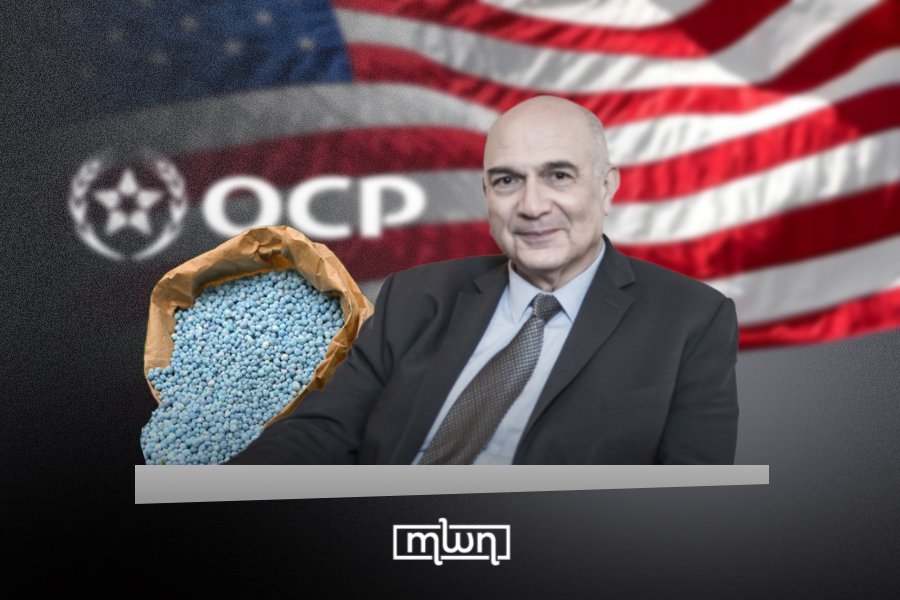
Marrakech – The United States government agreed to dismiss its appeal against Morocco’s OCP in a long-running countervailing duty (CVD) case on March 4 – the same week that American farmers were sounding the alarm over fertilizer shortages linked to the war in the Middle East.
The dismissal, filed at the US Court of Appeals for the Federal Circuit under case number 26-1459, ends a legal battle that began in 2021 when the US Department of Commerce (DOC) imposed a 19.97% countervailing duty on phosphate fertilizers from Morocco.
The appeal was dismissed by mutual agreement of the parties under Federal Rule of Appellate Procedure 42(b), with each side ordered to bear its own costs.
The order followed a petition by Florida-based Mosaic Company, a domestic phosphate producer, which alleged that OCP – Morocco’s state-owned phosphate giant and the sole Moroccan respondent in the case – benefited from unlawful government subsidies.
The largest single element in that original determination was Commerce’s finding that the Moroccan government had granted OCP exclusive phosphate mining rights for less than adequate remuneration, a benefit Commerce valued at a subsidy rate of 18.42% alone.
The case stems from a process initiated by the US Department of Commerce in June 2020 after Mosaic filed a petition with both the Department and the US International Trade Commission (ITC) seeking countervailing duties of more than 70% on OCP.
The case then wound through years of litigation and judicial review
The legal dispute moved slowly through the US Court of International Trade (CIT) over the following years. In the first administrative review, covering the period from November 30, 2020 through December 31, 2021, Commerce calculated a combined net subsidy rate of 2.12% ad valorem for OCP.
That figure included rates across five government programs – government loan guarantees at 0.02%, tax incentives for export operations at 0.71%, reductions in tax fines and penalties at 0.01%, revenue exclusions for minimum tax contributions at 0.06%, and customs duty exemptions for capital goods at 0.05%.
An additional 1.27% was added after Commerce determined that OCP had failed to report a payroll tax refund on time, applying what the agency called “facts otherwise available” with an adverse inference.
Both Mosaic and OCP challenged the Final Results in court. In its April 1, 2025 opinion, Judge Timothy C. Stanceu of the Court of International Trade sided largely with OCP on one critical point. The court found that Commerce had wrongly concluded that Morocco’s nationwide tax fines and penalties relief program – a program available to all Moroccan taxpayers, including individuals – met the legal definition of a “specific” subsidy under US trade law.
The court ruled that Commerce’s finding “does not accord with the limiting principle” set forth in congressional intent, which requires distinguishing between subsidies targeted at discrete industry segments and those spread broadly across an economy. Commerce was ordered to reconsider that determination.
On remand, Commerce revised its position under protest. In its July 2025 redetermination, the agency found that the tax fines and penalties program was not specific and therefore not countervailable against OCP. The revised subsidy rate dropped slightly from 2.12% to 2.11% ad valorem.
Then, on December 16, Judge Stanceu sustained that redetermination in full. OCP had argued that its benefit from the program was proportionate to its size, noting that the OCP Group had annual revenues equivalent to 6.6% of Morocco’s GDP and ranked only sixth in total reductions granted to corporate taxpayers in 2021. The court agreed that Commerce had been right to account for OCP’s relative scale.
The Department of Commerce published a notice in the Federal Register on January 12, 2026 amending its final results to reflect the 2.11% rate. The United States then appealed to the Federal Circuit. That appeal was dismissed on March 4 by mutual agreement of the parties. Each side was ordered to bear its own costs.
Beyond the courtroom, the strategic calculus in Washington was shifting fast
The dropped appeal also coincides with a broader strategic shift in Washington. On February 18, the US administration officially designated phosphate and potash as critical minerals and invoked the Defense Production Act (DPA) to secure the domestic supply of elemental phosphorus and glyphosate-based herbicides.
The move repositioned Morocco – which controls over 70% of the world’s known phosphate reserves – from a trade dispute counterpart into a strategic resource partner. With China and Russia together controlling nearly 40% of the global processed phosphate export market, maintaining punitive duties on OCP imports had become, in the eyes of the administration, a self-imposed liability.
The case’s conclusion comes in the context of rapidly escalating agricultural pressure in the United States. Since air strikes began on February 28, the war in the Middle East has disrupted shipping through the Strait of Hormuz – a corridor through which roughly a third of global fertilizer supply passes.
Urea prices at New Orleans, a benchmark for US markets, rose from $465 per short ton on February 27 to $580 per ton by March 9, a jump of nearly 25%. Some American suppliers pulled offers entirely as markets absorbed the shock.
On March 9, the American Farm Bureau Federation (AFBF) sent a letter directly to President Donald Trump urging immediate action. AFBF President Zippy Duvall warned that the supply chain disruptions were “expected to drive already record-high input prices even higher at a time when farm margins are already extremely tight and many farmers are underwater.”
On the question of countervailing duties, the letter asked Trump to use presidential authority to temporarily suspend them on imported fertilizer products broadly “to moderate price increases,” without naming specific countries. The request implicitly points to Morocco and Russia, the two countries whose phosphate fertilizers are currently subject to active US countervailing duty orders that the Department of Commerce is expected to begin reviewing this month.
AFBF’s chief economist John Newton cited a North Dakota farmer whose remaining fertilizer purchases came in at $200 per ton above earlier prices, raising his total fertilizer bill by nearly $20,000.
AFBF’s letter laid out seven specific requests: US Navy escorts for fertilizer shipments through the Strait of Hormuz, international coordination to keep shipping lanes open, federal insurance mechanisms for vessels carrying fertilizer, ensuring domestic port, rail and barge capacity is available to deliver fertilizer to rural America in time for application, Jones Act waivers to improve domestic port-to-port shipping, exemption list additions for sulfur, sulfuric acid, phosphoric acid, anhydrous ammonia, aqua ammonia and calcium nitrate, and the temporary presidential suspension of countervailing duties on imported fertilizer.
On the ground, American farmers described the pressure in stark terms
Duvall’s own language was direct. “Without strategically prioritizing the delivery of critical farm inputs such as urea, ammonia, nitrogen, phosphate, and sulfur-based products, the US risks a shortfall in crops. Not only is this a threat to our food security – and by extension our national security – such a production shock could contribute to inflationary pressures across the US economy,” he wrote.
He also called on fertilizer companies to “avoid price gouging or optimizing their pricing that would further strain our farmers who are already under tremendous financial pressure.” The letter warned that “failure to act could lead to disruptions to the food supply chain not seen since 2022 when food price inflation reached 40-year highs.”
South Carolina Farm Bureau President Harry Ott, who grows cotton, corn, and peanuts, described the stakes bluntly during the March 9 call. “I’m afraid a lot of farmers are not going to be able to finance putting a crop in, and it could not come at a worse time,” he told journalists.
Ott added that he still does not believe there is an actual shortage of fertilizer in the Southeast right now, but that companies are pricing in anticipated future costs onto inventory already in local warehouses.
“That means I was already being charged $150 to $200 a ton for urea fertilizer that was already in the dealer’s warehouse,” Ott said. He estimated the higher urea prices would add roughly $100 per acre to his costs.
“What we’re asking for is simply some fairness in the system,” he said. “If you’ve already purchased it, it’s in your warehouse – don’t make an additional profit on us during these really hard times.”
The following day, on March 10, Duvall appeared before the Senate Agriculture Committee. His testimony focused on structural weaknesses in the farm economy that predated the war. “USDA projects that farm income this year will be down nearly $50 billion below the levels of just a few years ago,” he told the committee.
He pressed lawmakers to act on the supply side as well. “We must support increased production of critical ag supplies and restore domestic processing,” he said. The hearing, which examined ways to increase domestic consumption of US-grown agricultural products, drew testimony from leaders across the cotton, corn, soybean, and produce sectors, all of whom pointed to shrinking margins and the need for stronger domestic demand.
The five-year sunset review of the CVD order on Moroccan phosphate fertilizers is now underway at the Department of Commerce – coinciding with the dropped appeal, a revised subsidy rate reduced to 2.11%, and mounting calls from farm groups to ease barriers on fertilizer imports at a moment when global supply chains are under severe strain.
Read also: India Secures 2.5 Million Tonnes of Fertilizer Supply from Morocco
